Hoverfly, Vermont - USA (0875)

Macro Magic

Shot of the Month – November 2012


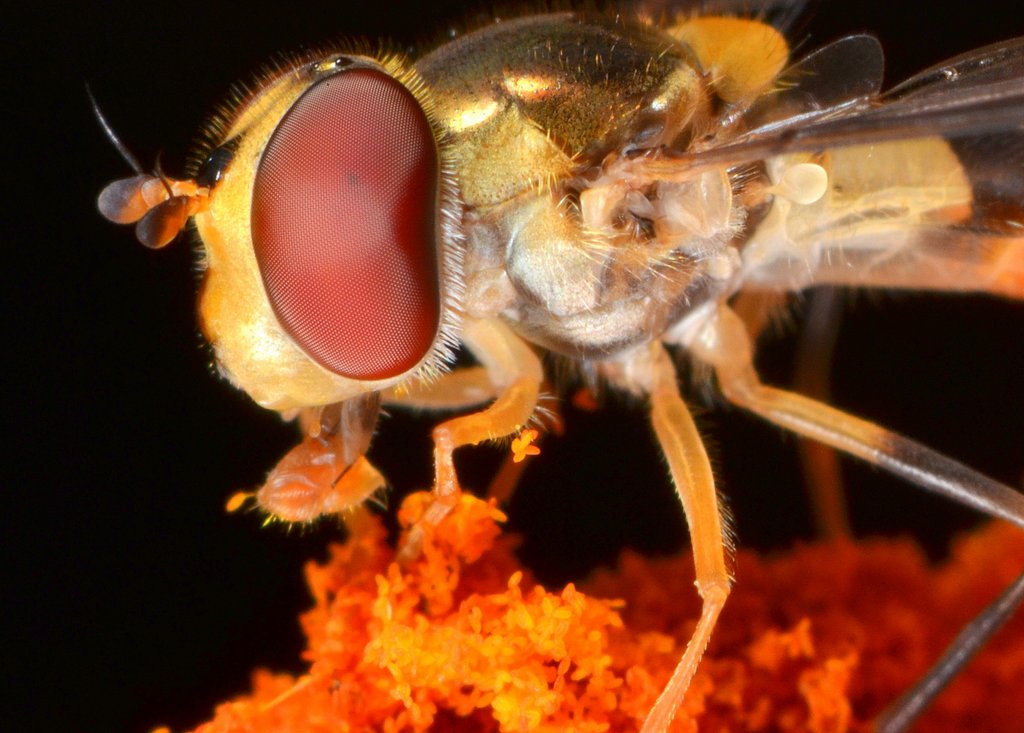
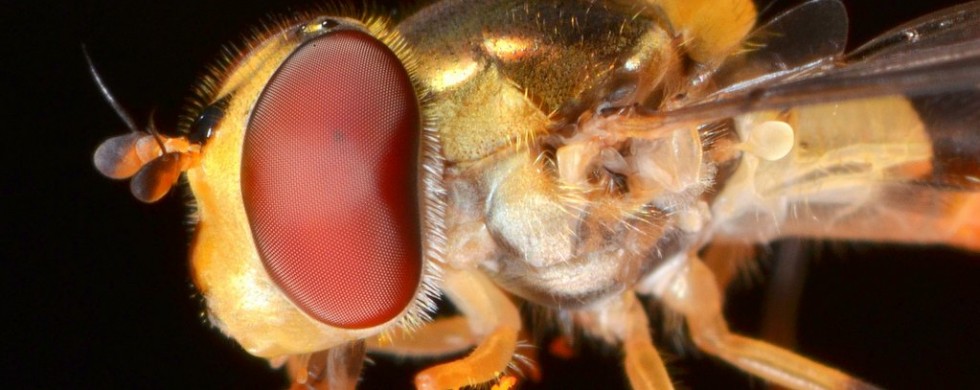
Hoverfly, Vermont - USA (0875)

Fear not, we are not under attack from giant mutant killer bees.

This lil fella, a Hoverfly, is actually less than an inch in length and quite harmless.

There are over 6,000 species of hoverflies around the world and not a single one will harm you.

Most hoverflies look like more dangerous wasps and bees but this is simply a ploy to look threatening and hopefully scare off potential predators.

Gardeners in the know dig hoverflies because they prey on pest insects like aphids and leafhoppers.  Savvy growers will cultivate plants that attract hoverflies so they can naturally deal with pests and promote natural pollination.

This extreme close-up (the hoverfly is sitting on the stamen of a flower in our garden and those orange blobs are individual grains of pollen!)  is an example of macro photography.  What is macro photography?  The answer to this takes us down a rabbit hole to a confusing, complex world that can involve all sorts of physics and geeky science.  How to shoot such shots equally leads us into a world with a bewildering array of equipment options and solutions.  Just a quick tour to give you a sense of it all.

Macro photography, for most of us, simply means close-up photography, usually of small stuff.  The end result is an image where the subject appears at least life-size (one inch equals one inch) and often the subject appears greater than life-size, as with this photo.

Do you need fancy equipment to do close-up photography?  No.  Yes.  Well, it depends.  You can probably start taking macro shots today if you have a digital point-and-shoot (PaS) camera.  Ever notice that little flower icon on your camera?
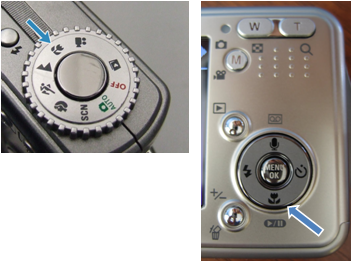
That setting puts your camera in “macro” mode.  The small sensors of PaS cameras allow for some good macro shooting (I’ll spare you the science on why this is the case).  If you want more professional results use a DSLR.  From here the options are nearly endless.

You can use a “normal” lens and attach diopters in front which are basically magnifiers.  You can put a normal lens on backwards (with an adapter) and voila, you have a macro lens.  Or you can attach extension tubs to your normal lens which moves it further from the body and allows you to get closer to your subject (which makes it appear bigger).  Or you can buy a true “macro” lens which has been designed specifically to give excellent image quality for close-up photography.  For stationary subjects, like flowers, you will want to use a tripod.  For insects, you will want to use a flash to freeze the action.

For more on the science and equipment options look here, and here.

You can spend a lot or a little.  Either way, you can get some very nice shots if you work at it.

One of the biggest challenges in macro photography is the minuscule depth of field.  The closer you get (the more magnified the subject) the shallower the depth of field.  This means that if you focus on the eye of a bee, his nose could be out of focus!  You normally want to set the camera on manual focus and adjust the lens to its minimum focus distance.  Then you physically move in until the subject comes into focus.  From here, rock back and forth and shoot away when you see the element you want clearly.  This can be brutally tiring as the slightest drift can cause you to miss the shot.  And it is especially hard with insects and other moving critters.  You may need to shoot dozens, and perhaps hundreds of images till you get one where it all comes together.  One technique to get around this problem is to shoot multiple images where different parts of the subject are in focus.  You can then use software to merge these images and the final result is a photo where much more of the subject appears sharp.  This technique is called focus stacking.  This is best accomplished with a tripod as the images must be identical so they overlap properly.  Hand-held stacking is possible, but you need to be be a Jedi master with an incredibly steady hand to pull it off.

One such macro master is Thomas Shahan.  Check out his site for some of the most amazing insect photography I have ever seen.

Thomas also made a great video on macro photography.  I have watched it a half dozen times.  His Zen-like narration is ultra soothing and the images are spectacular.


The great thing about macro photography is that you need not go far to find compelling subjects.  Walk outside and you can spend hours within a few square feet shooting an astonishing array of flora and fauna.  Even around your house, the most mundane object can suddenly become a work of art once you find the right scale and angle.

Let the Lilliputian adventures begin…..


Hyrax Huddle, Serengeti NP-Tanzania (6891)

Hyrax Huddle – October 2012

Shot of the Month – October 2012

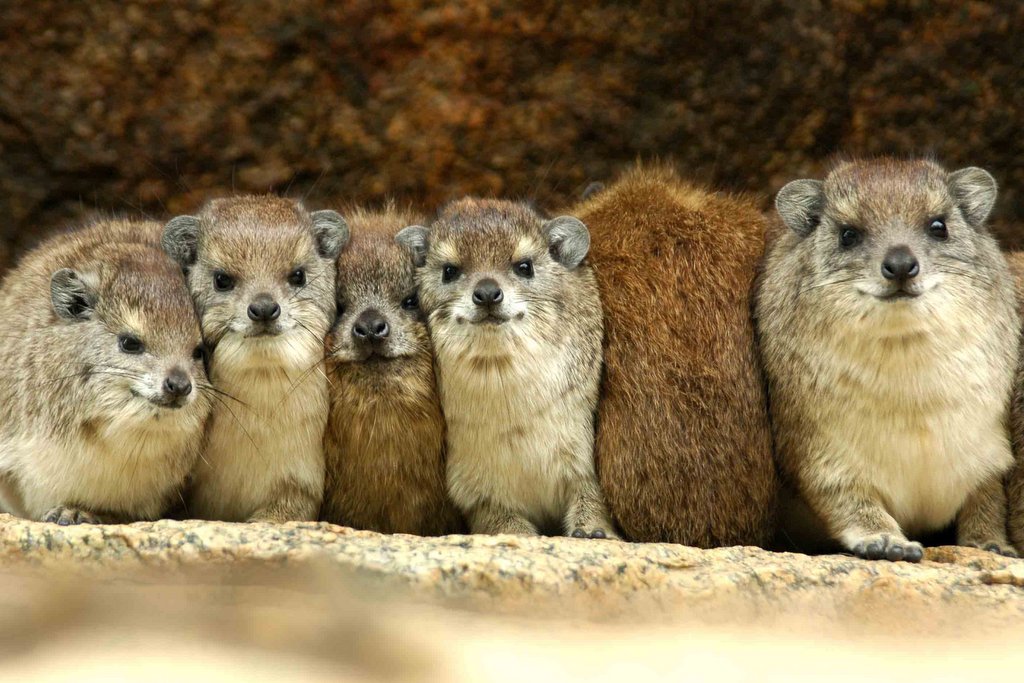
Rock Hyrax, Serengeti NP-Tanzania (6891)

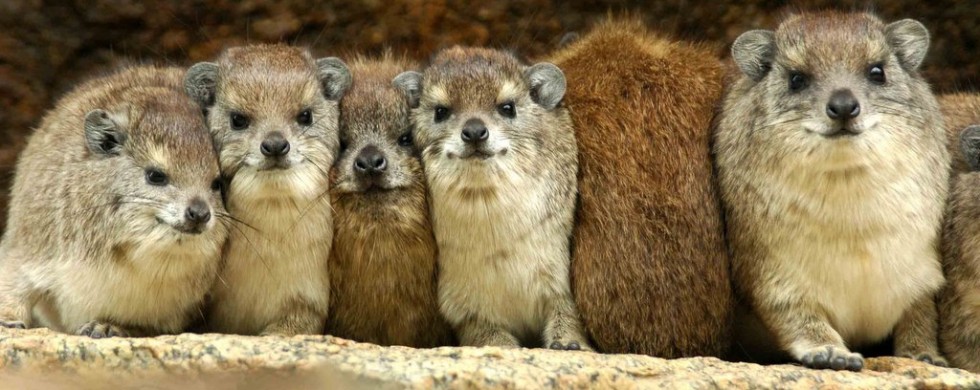
This month a family photo of the Rock Hyrax (RH) – an image that is bound to please a diverse range of audiences.

First, for the lovers of all things cute and cuddly, this photo is definitely a crowd favorite.  An easy addition to the “Awwwwwl” Collection.

Second, this image will resonate with those who love a good joke.  Like really, what’s up with contestant #5 there?

“Hey, where’s the camera?”


(Send your favorite caption/tagline as a comment below)

And these little guys are going to blow your mind if you’re into zoology/taxonomy (read “animal geek”).  Most people think that these little fur balls (they weigh from 4-10 pounds) are some form of guinea pig or similar rodent.  Nope, not even close.  The rock hyrax is actually very closely related to the elephant.  All yeah, sure, that makes perfect sense….!!???

Well, it seems that elephants, hyraxes, and dugongs (a marine mammal) all came from a single common ancestor.  So these three creatures are more closely related to each other than to any other living animal.  (Dude, like my mind is so, pphhhtttttt, completely blown right now..pphhhhtttt..).  DNA evidence indicates that hyraxes share many features with elephants:  similar toenails, excellent hearing, sensitive pads on their feet, small tusks (hyraxes have 2 incisor teeth that continually grow like the tusks on elephants (they look more vampire-esque than elephantine if you ask me), good memory, high brain functions (compared to other similar mammals), and the shape of their bones.

As you can see from the photo rock hyraxes are a pretty social bunch and can live in groups of up to 80 individuals.  RHs are not good at regulating their internal body temperature so on cool days you can find them huddled like this for warmth.  I photographed these fellows on a cloudy, chilly morning in the Serengeti NP in Tanzania.  They are also pretty talkative –  they can make at least 21 different vocalizations.  Apparently, RH calls, called “songs” contain rich layers of information about the animal’s size, age, social status, body weight, condition, hormonal state, and so forth.


There you have it, the  Chatty-Cathy-social-butterfly-elephantine-cuddly-I-want-to-spoon-fur-ball-but-not-a-rodent!-rock hyrax.


Until next month….


Colorful Creation – September 2012

Shot of the Month – September 2012

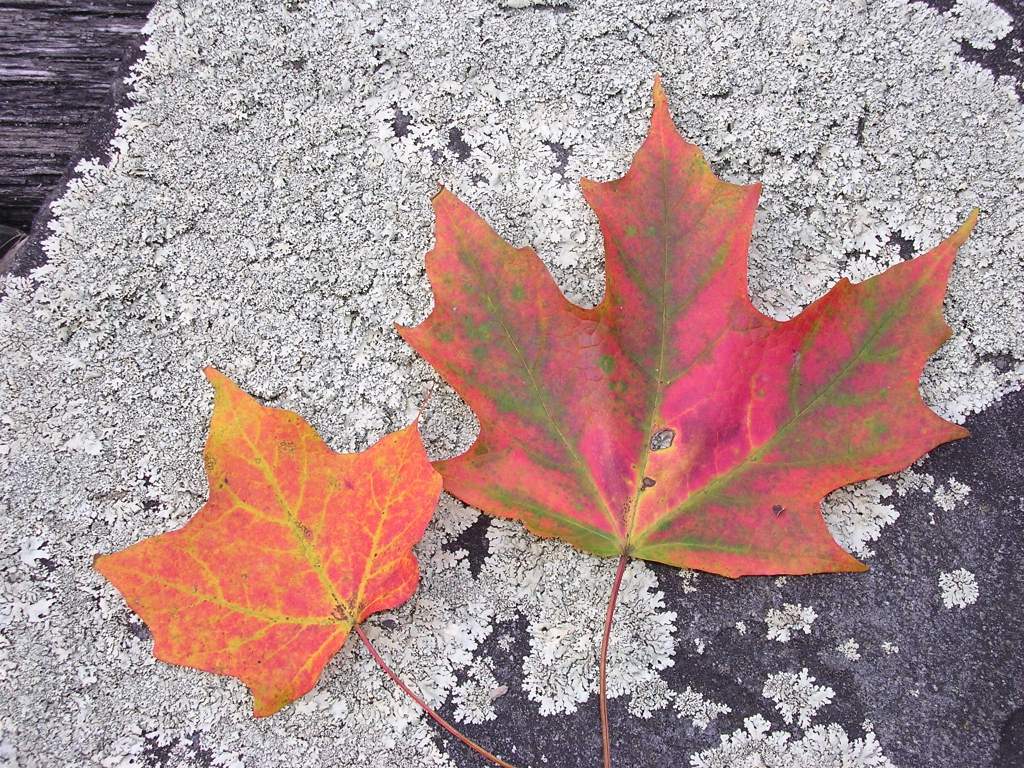
Fall Leaves, USA (0750)

An image of colorful leaves in September — seems pretty normal, if a tad overdone.  Other than the subject and the timing, everything else about this photo is pretty unusual– for me.

First, I “made” this shot, rather than “finding” it.

Typically, I go out into the world and look for wildlife or “wild” scenes and try and be in the right place at the right time and capture what unfolds before me.  That is not the case here.

While visiting a friend in upstate New York, close to  10 years ago now, we went for a walk in the woods.  I found these leaves, separately,  and picked each up.  I didn’t know what I would do with them, but I liked their looks and carried them along.  Later, back at my friend’s house, I noticed a lichen-covered rock slab on a piece of wood on their deck.  Inspiration struck and I placed my leaves just so.  Click.

Another unusual feature of this image is the camera I used in capturing it.  It was not one of my big, “serious” cameras.  Rather I shot this with a Nikon Coolpix 3100 – a little 3.1 MP “beginner”  point-and-shoot camera.    Not very sophisticated to say the least.

The last unusual feature of this shot is that is a “still life.”  No critters, just a scene.  Just not something I do very often.

For all these reasons I love this photo.  I was not only witness but also part creator.  That gives me a buzz.  And it was so EASY.   It doesn’t seem fair — feels like cheating.  So different – a shot that took me out of my comfort zone.  And I just really like the shot.  I am amazed at how nice it looks — I love the hues of the leaves, and the contrast between the vibrant colors and the muted wood, stone, and lichen.  And I love the different textures of the muted background.

And I dig this photo because it reminds me that I don’t need fancy equipment or go on long trips to find or make beauty.  It is often nearby — simply the right attitude and openness to “seeing” can suffice.

Until next month…


Monday Moose

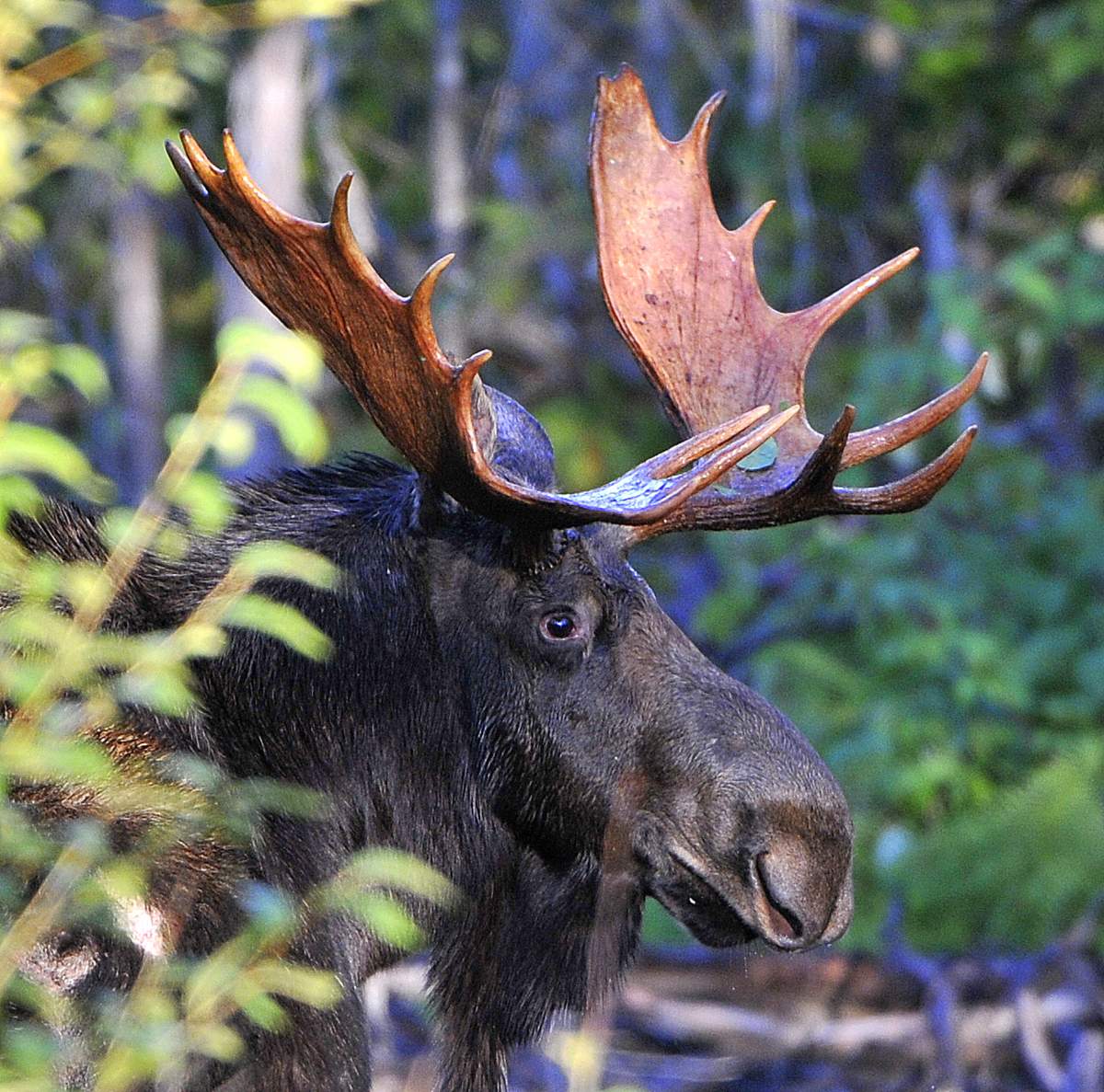
Spending a week in Maine to photograph moose.  The rut is just starting so the males are getting increasingly, uh, animated.

We had 3 sightings today but only the one at the end of the produced some images.


Moose, Maine - USA (9809)


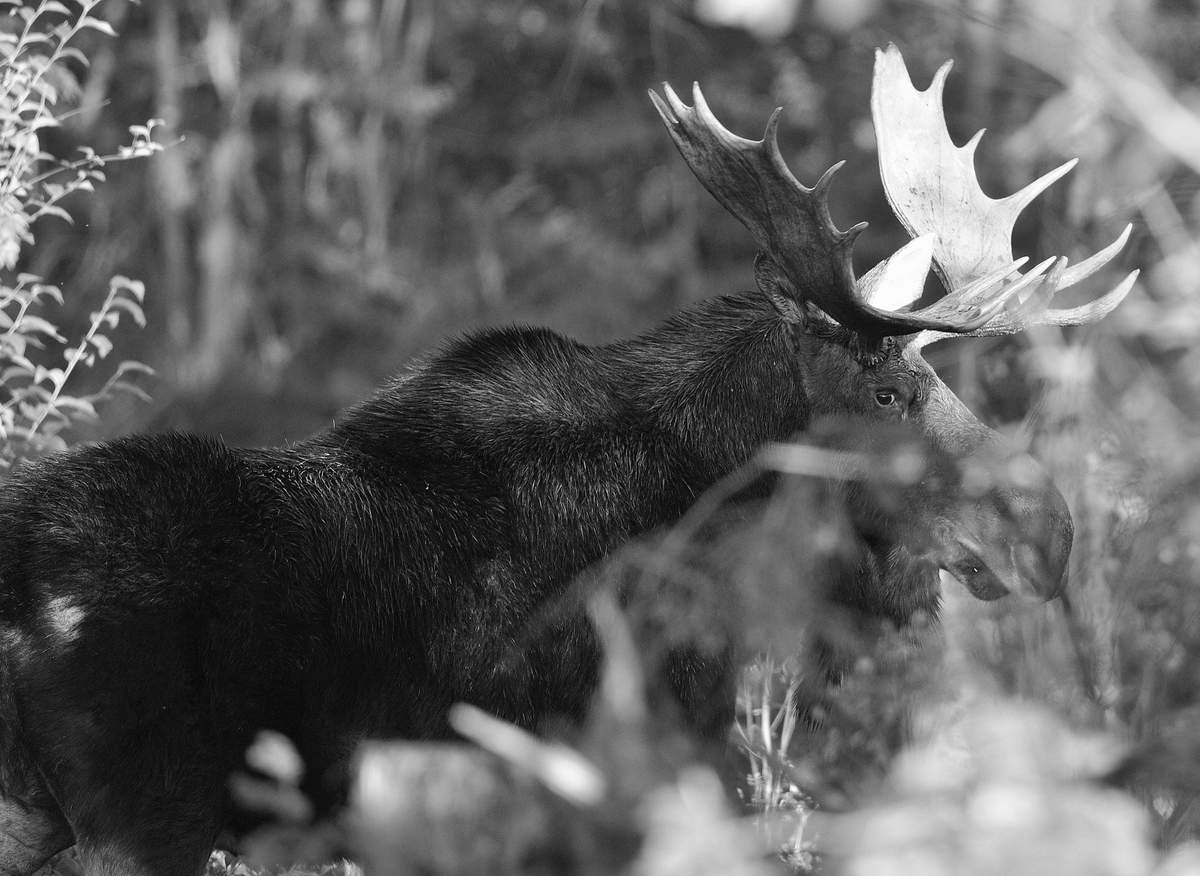
The same male, but in B&W

Moose, Maine - USA (0001)


Painted Lady

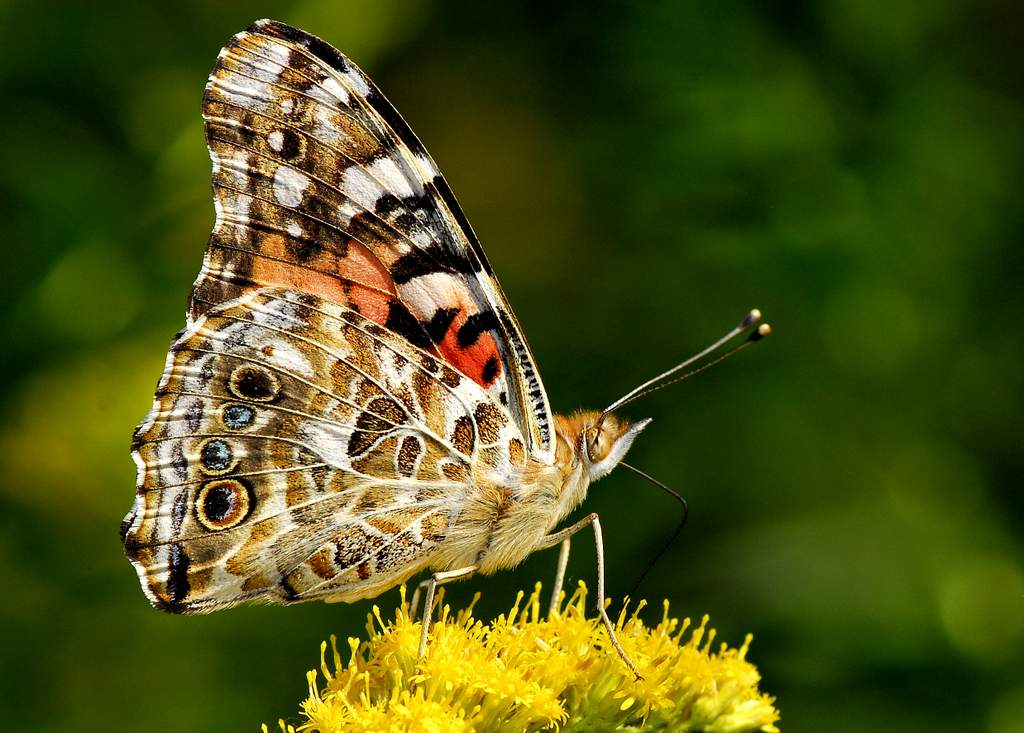
A few weeks ago a big wave of butterflies came through our area and covered a hillside near our abode.  Lot’s of Monarch Butterflies and these fellows.  For you science types they are called Vanessa cardui, more commonly, the Painted Lady.

Painted Lady, Vermont - USA (1983)