Each year, millions of mature salmon leave the ocean in search of the inland tributary where they were born. If they survive this epic Ulyssesian journey, they will mate and die at their birthplace. The sudden bounty of food in the rivers attracts numerous predators and fuels entire ecosystems.
I have visited Katma National Park twice to witness this epic event. Standing on the bank, we watched the river’s surface churn as thousands of fish coursed through the water. Massive brown bears were all around us, but we were in little danger as the bears were solely and completely focused on catching the calorie-rich salmon.
At times, the scene was chaotic as the bears would bound into the water, the fish fleeing in every direction, some leaping out of the water to escape teeth and claws. The shrill calls of the seagulls nearby only added to the cacophony as they impatiently waited to feast on the remains of the partially eaten salmon.
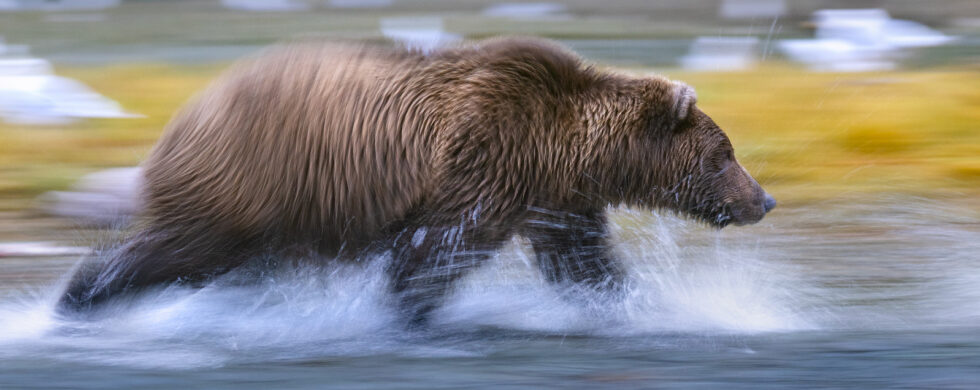
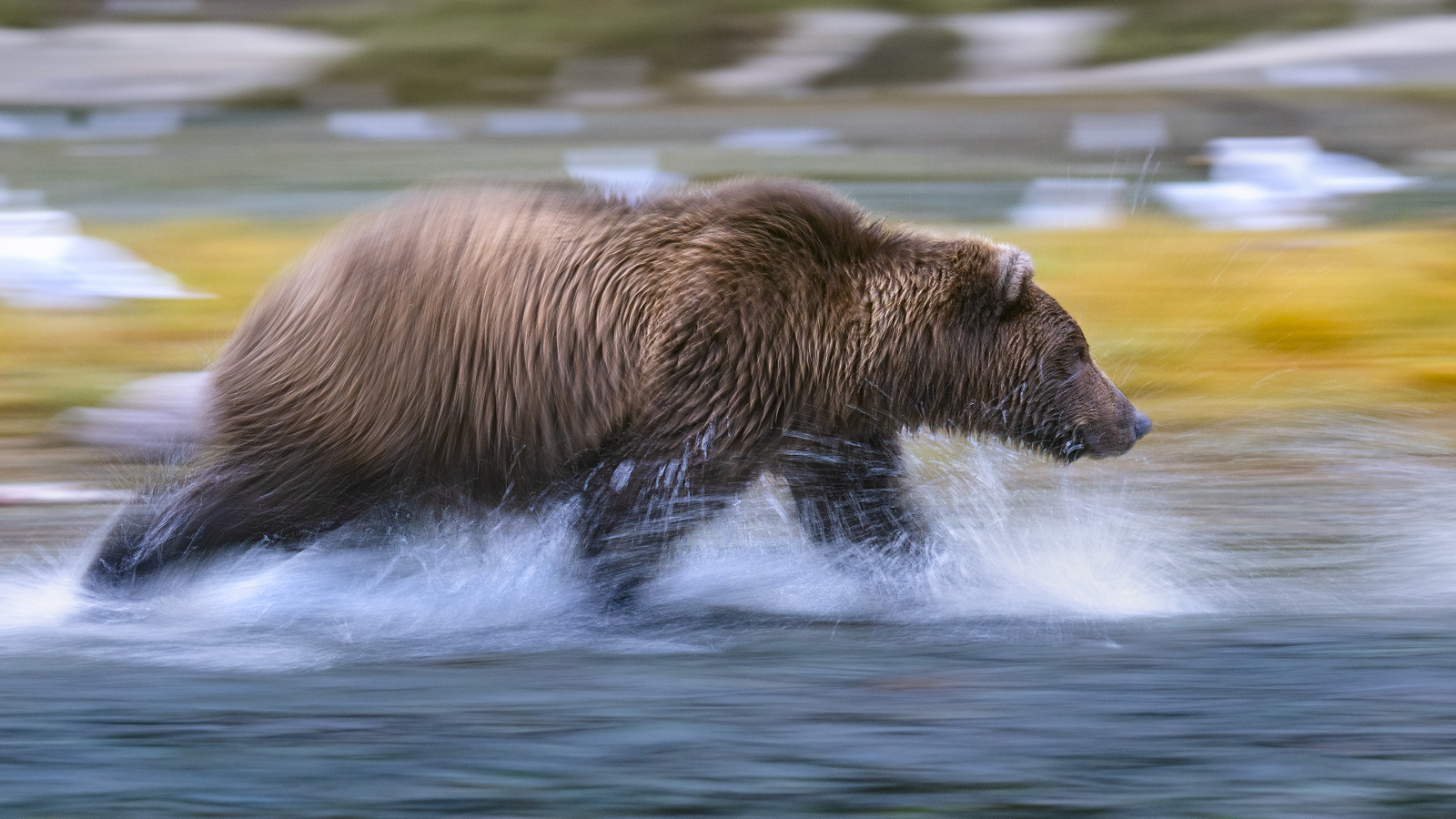
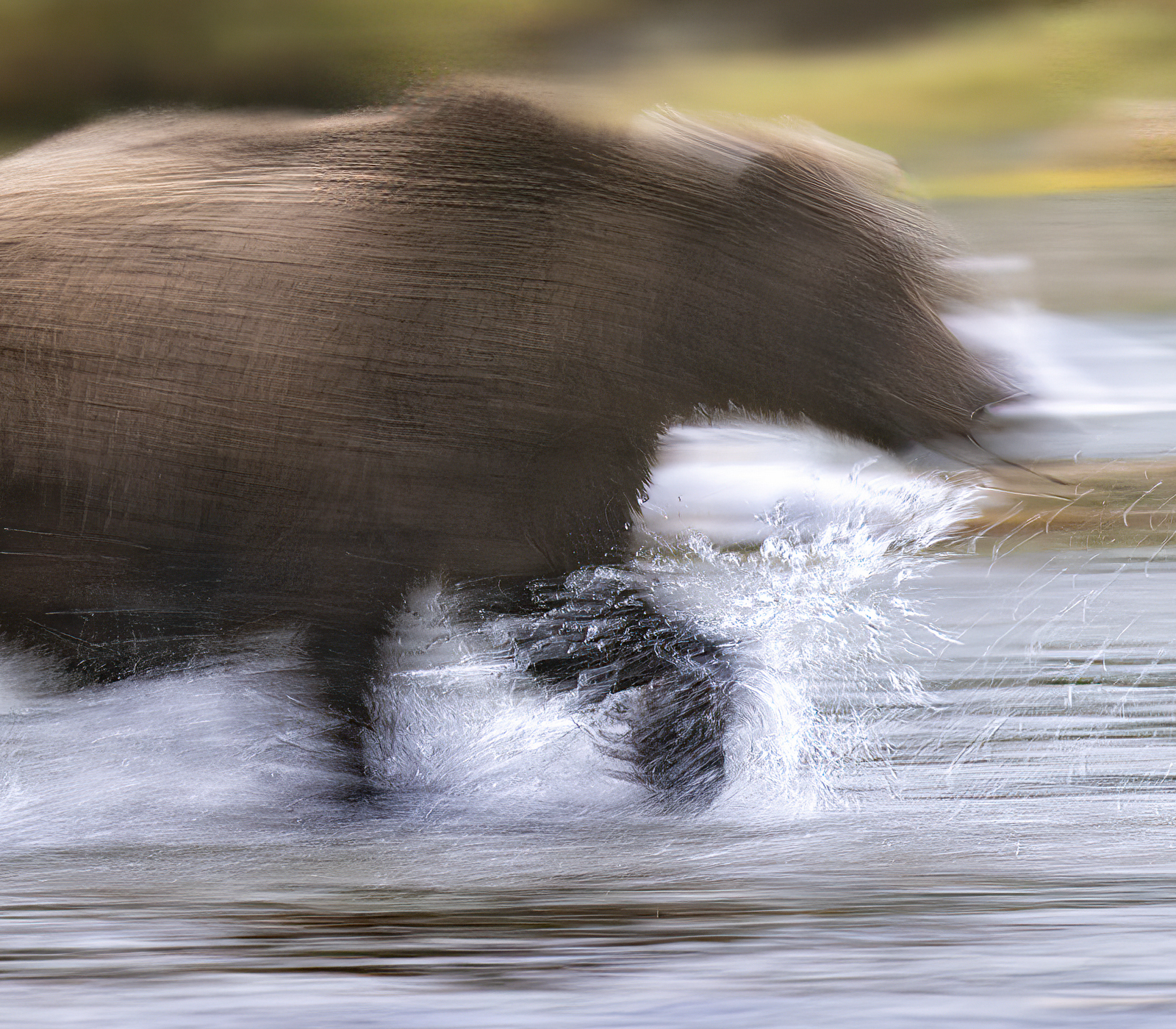
In the image above, I used a slow shutter speed to convey the mad rush, highlighting the splashing water and chaos. The swirling fur adds to the sense of motion. I like how the image is divided into three horizontal layers, and how the bright yellow grass in the middle adds a nice contrast to the brown bear and the gunmetal blue water.
Here’s a bit more on how to use a slow shutter speed to convey motion: Capturing Speed
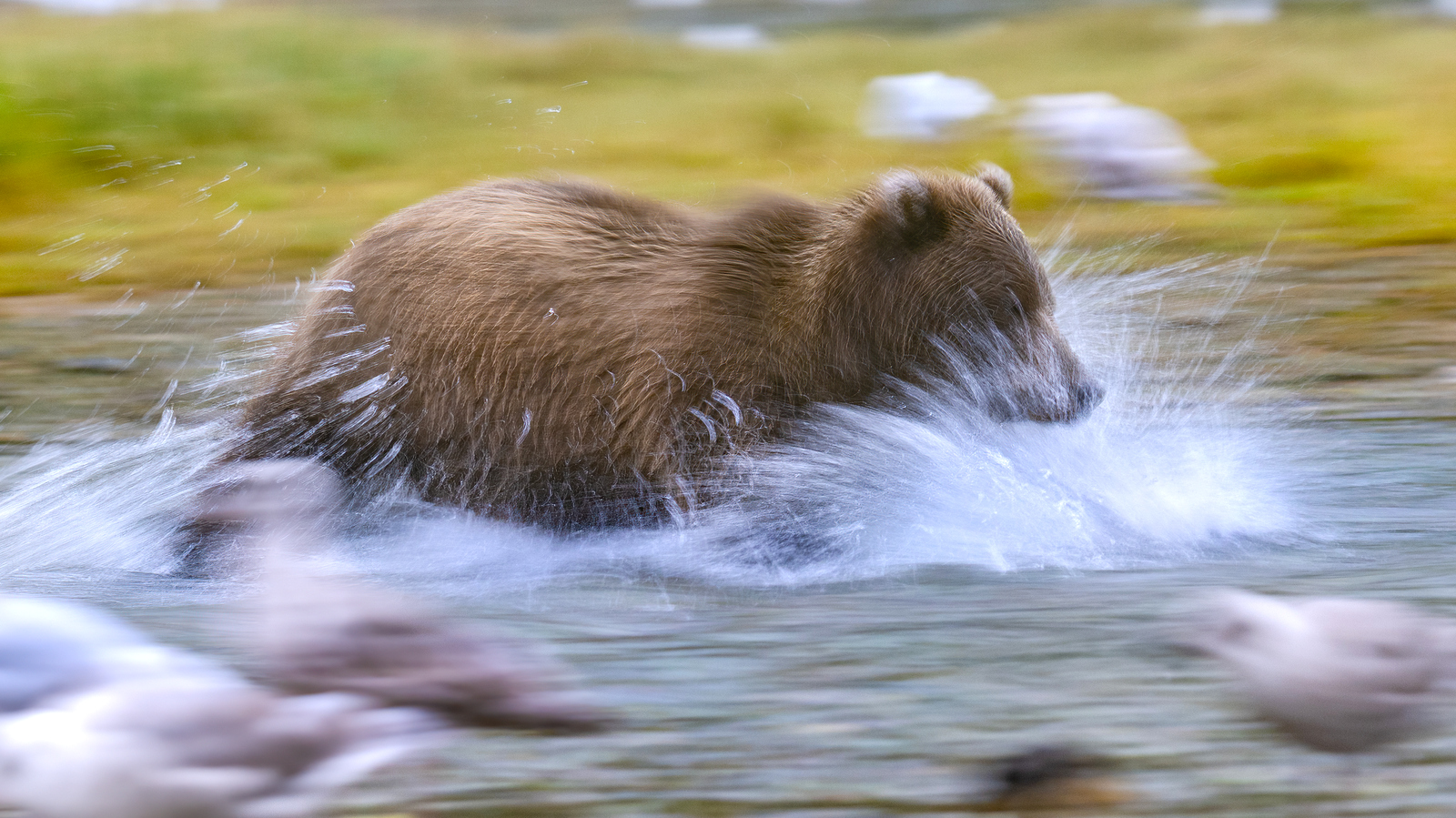
Here is another slow shutter attempt (I don’t like this one as much):
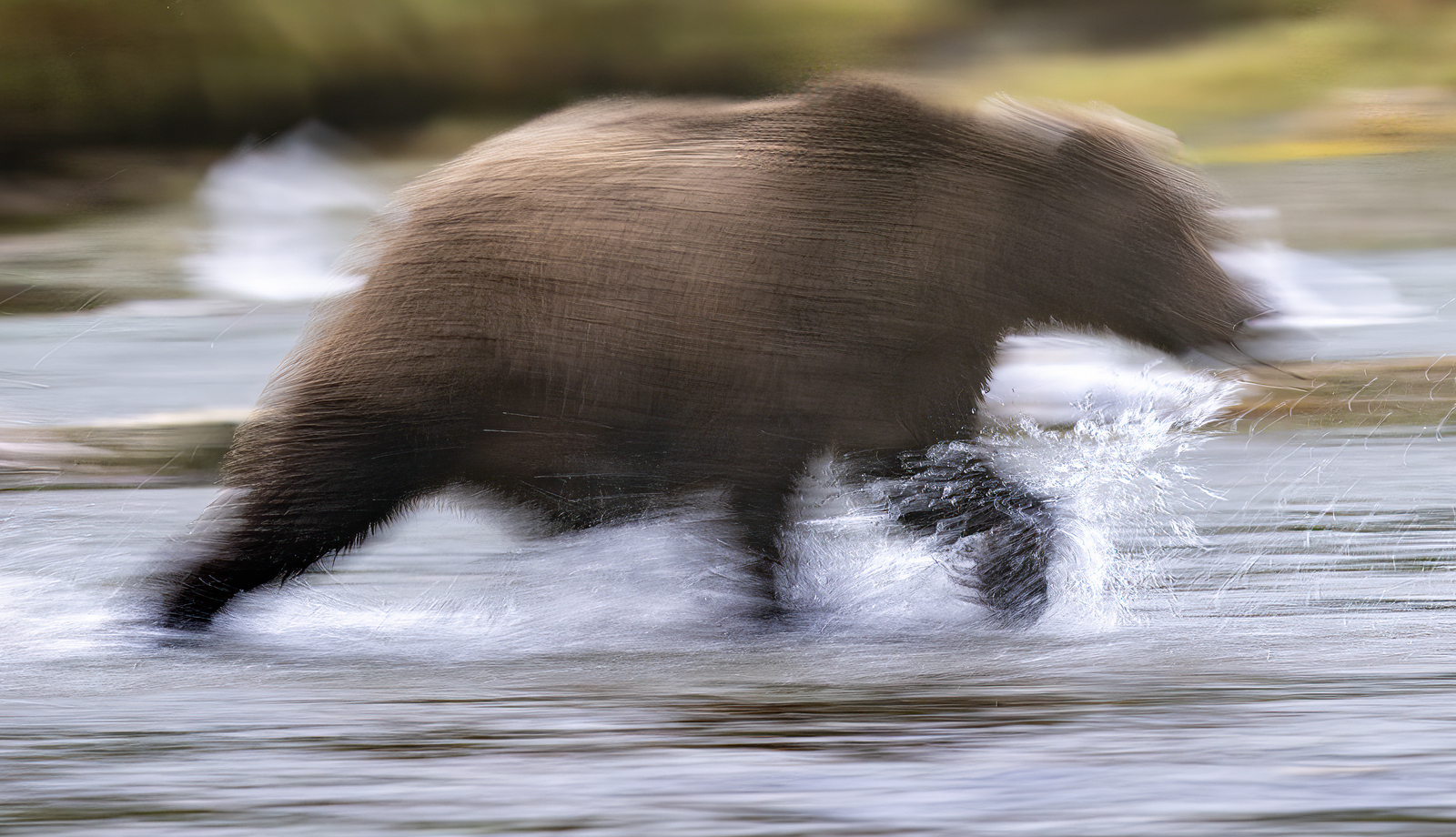
And another:
I like this closer view that highlights those massive claws:
Here is a slow-motion video that I shot that captures a brown bear in hot pursuit (this is the mother of the first bear):
You can read about more Brown Bear adventures here:
Using a slow shutter speed is a high-risk proposition, and one can easily shoot hundreds or even thousands of images before finding the right mix of blur, motion, and sharpness. But when it all falls into place, a blurry image can sometimes convey the essence of a natural scene better than the standard “all-sharp” capture.
Until next month…..m
Nikon Z9, Nikkor 100-400mm, f/5.6, 1/20 sec, ISO 250
Every year, about 2 million people flock to the Columbia River Gorge (CRG) to enjoy the endless hiking trails, take in the glorious vistas, and to admire the numerous waterfalls. The CRG stretches for 80 miles along the border between Oregon and Washington. The gorge was carved by, yep you guessed it, the Columbia River.
The waterfalls found here are the main attraction, well, at least for landscape photographers, and most focus (no way to avoid this pun, sorry) on the Oregon side as it is home to 90-ish waterfalls, while the Washington side is the neglected stepchild with only about 15-20 falls to admire
Most visitors head to the “Waterfall Corridor” on the Oregon side, where quick hikes concentrated along an 8.5-mile portion of the Historic Columbia River Highway will allow you to visit a dozen or more waterfalls. Here is a good overview of what can be seen there. Multnomah Falls, Oregon’s tallest falls, is found here and is often the KEY attraction for most visitors.
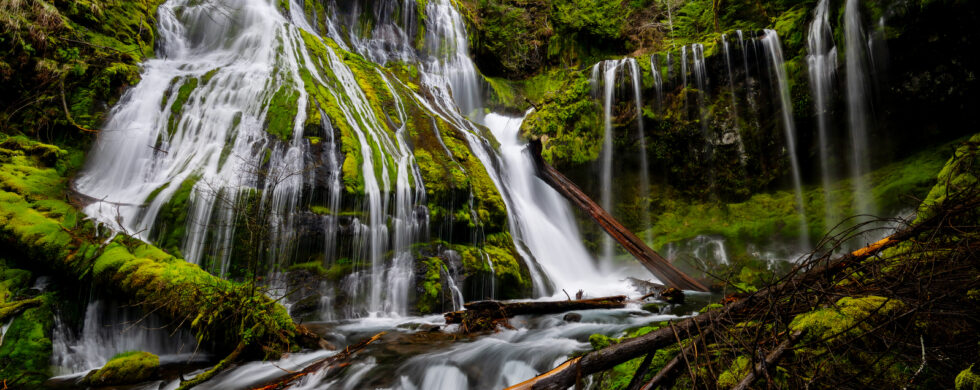
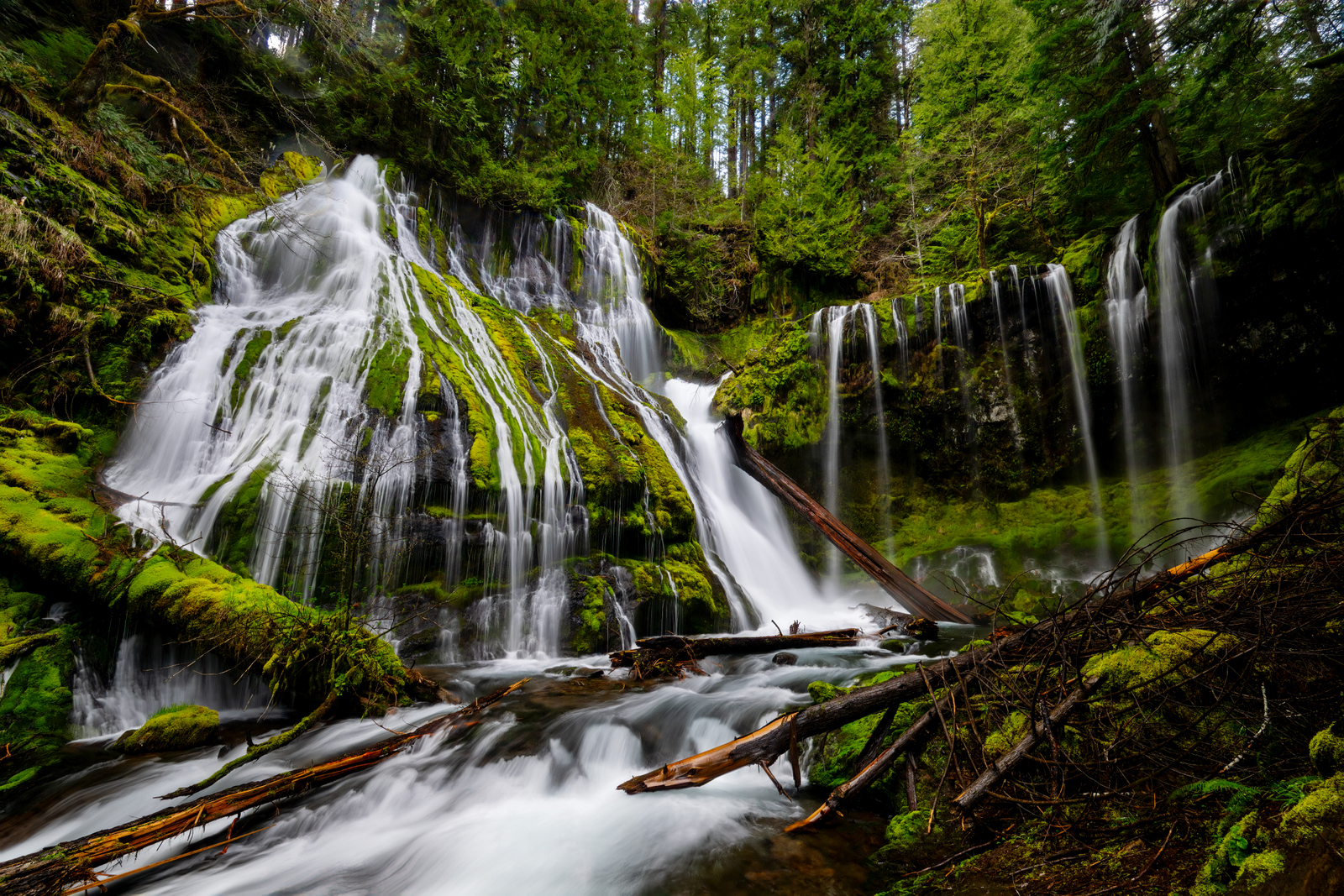
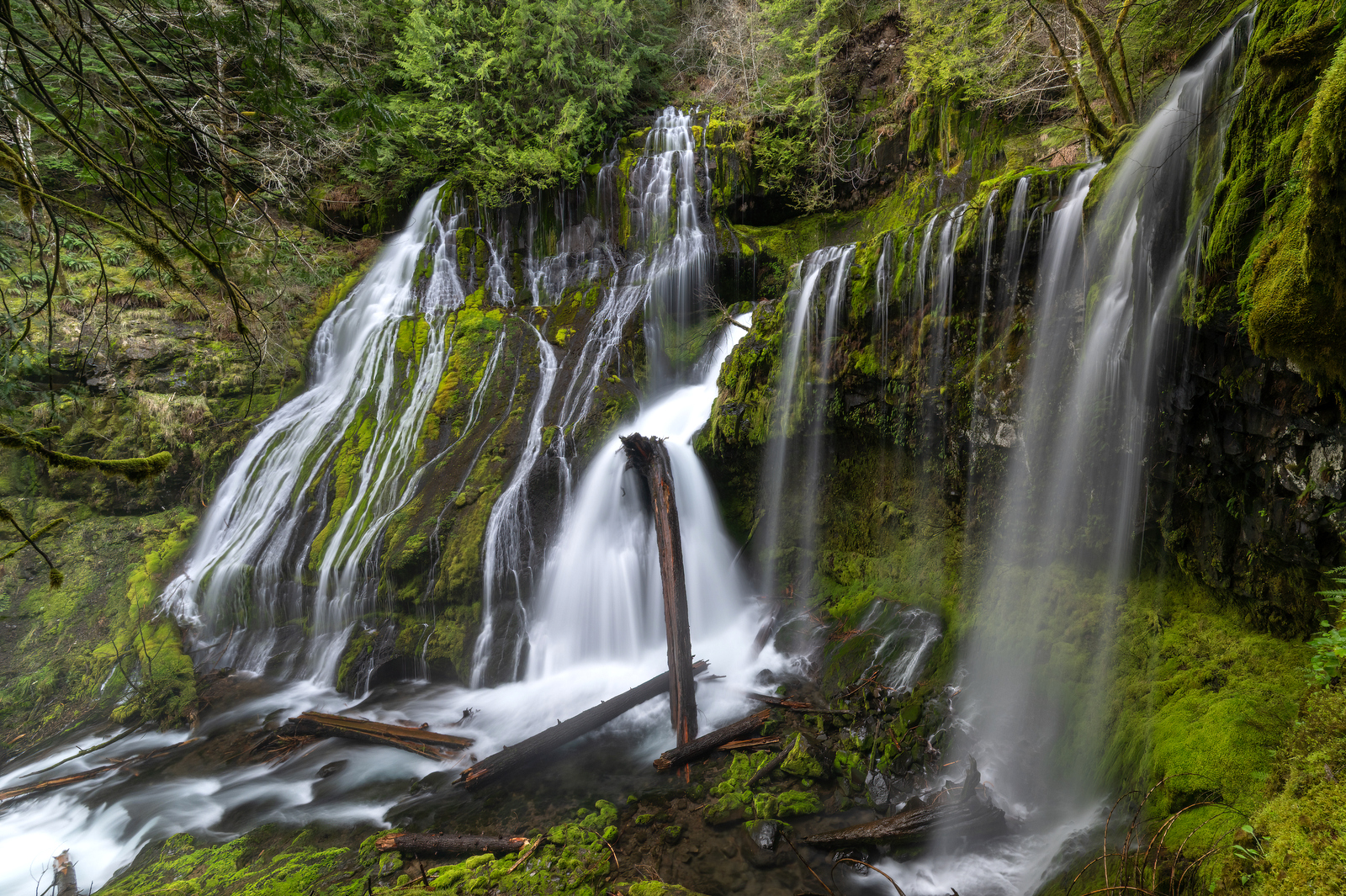
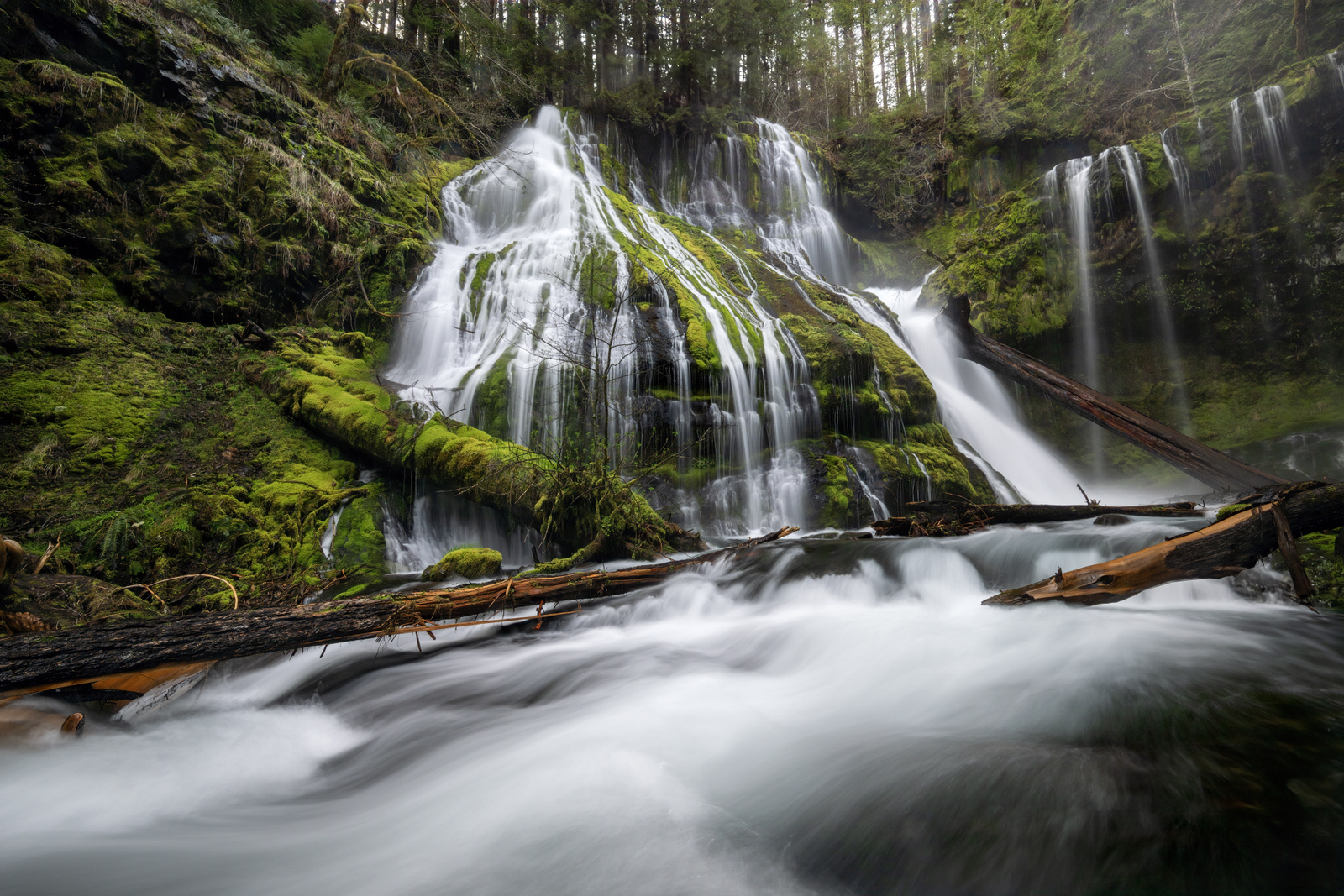
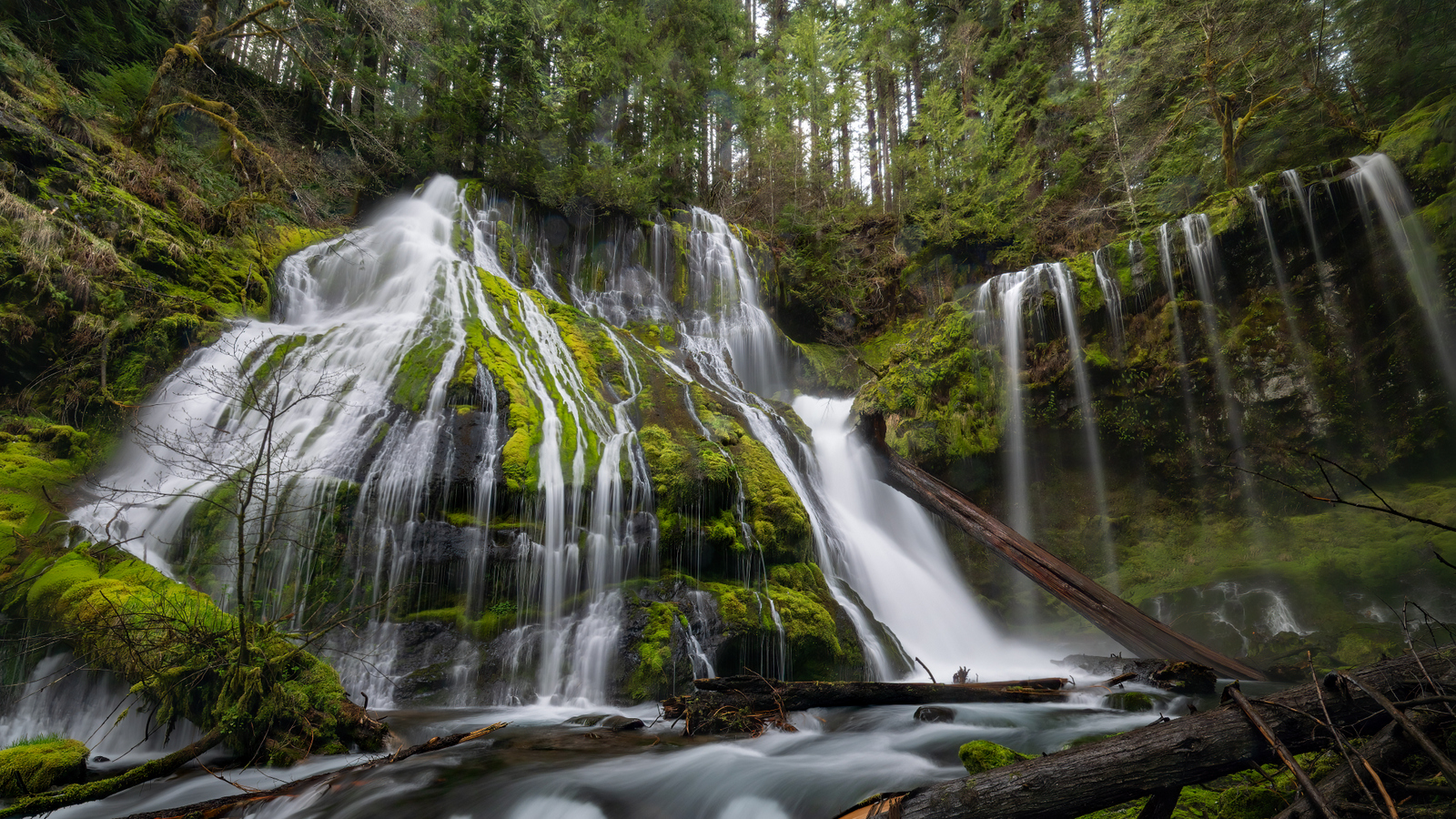
Despite Oregon’s waterfall numerical superiority, my favorite waterfall (so far) is actually found on the lesser-visited Washington side of the Columbia River. For my money, the Panther Creek Falls (PCF), as shown in the image above, is the most beautiful waterfall I have ever seen. The waterfall forms a bowl that wraps around, creating a magical, lush, green, ever-misty universe of tranquility. The main fall drops 100 feet and then a secondary fall (not shown in my image) drops another 30 feet into the river below. When the water flow is especially heavy, like during the spring when the snowmelt is at its greatest, some water will escape through the mossy field to the right of the main falls. PCF is located in Gifford Pinchot National Forest. Directions can be found here.
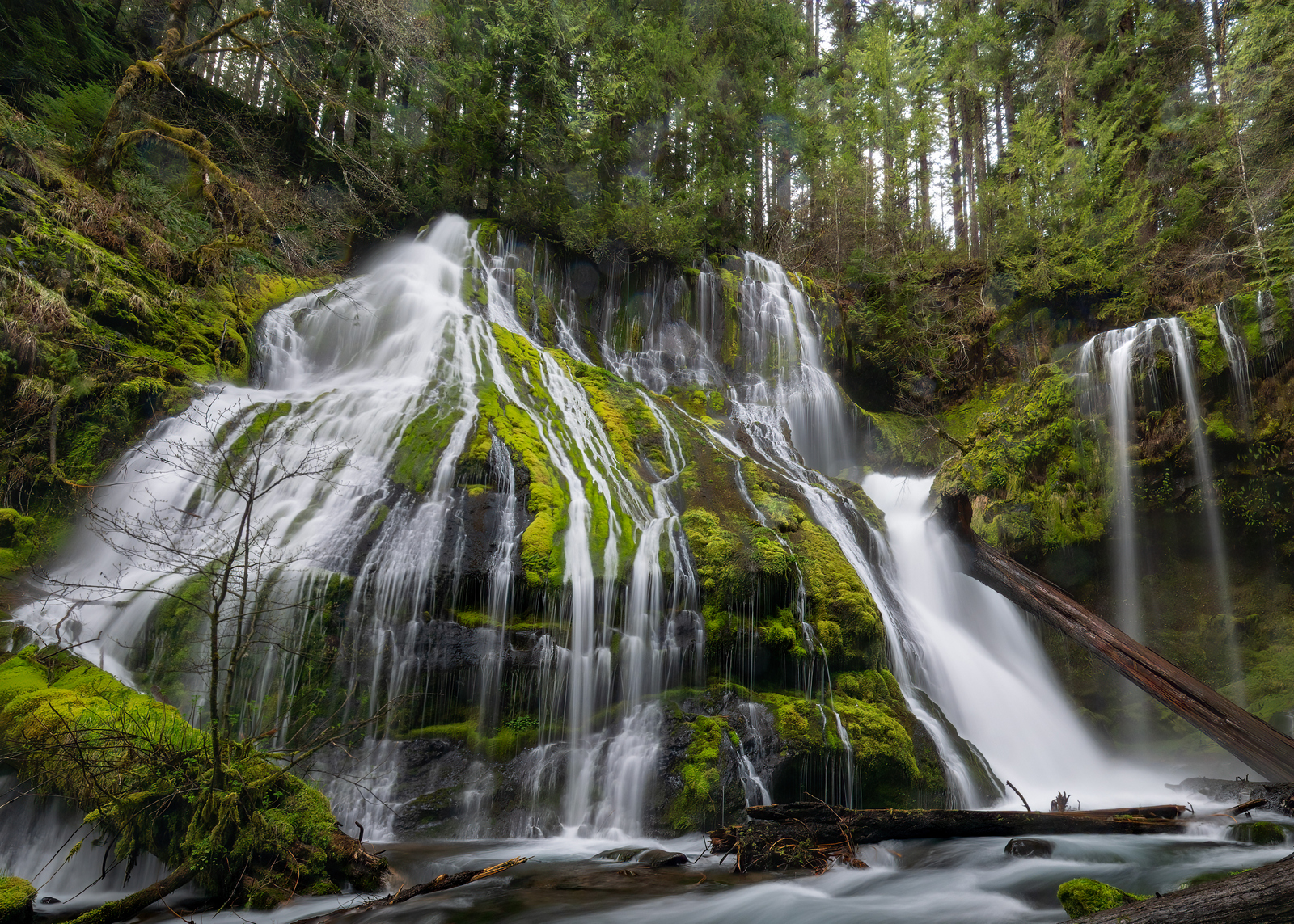
In the image below, we see the main falls off to the left, while to the right, in the foreground, we see smaller, more intricate channels that run off through moss-covered cliffs.
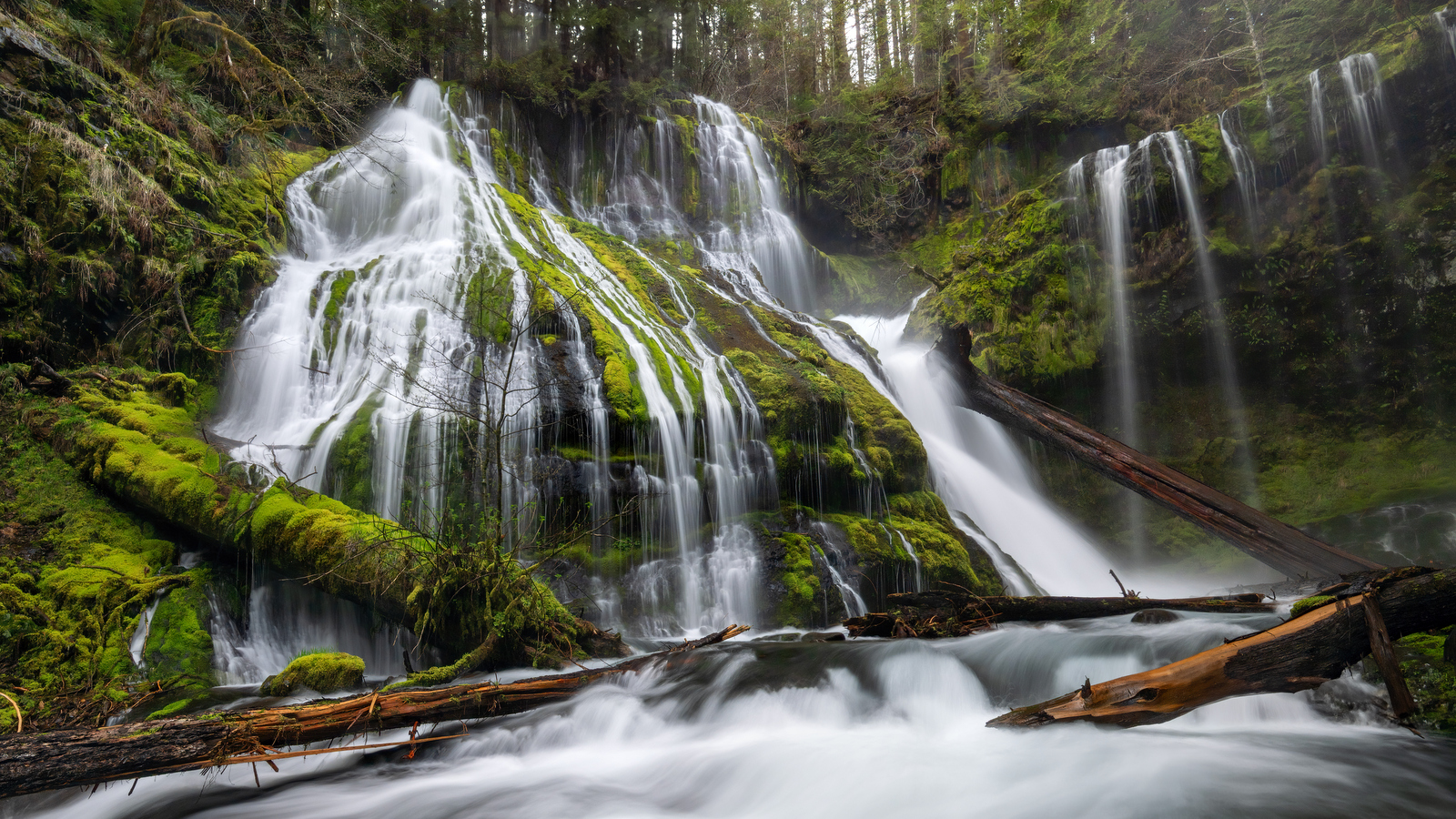
Here is a lower view as the water goes rushing by:
Another shot from below the falls:
And a final perspective focused on the main section of the falls:
If you are heading to the Columbia River Gorge, of course, hit the Oregon side and feast on the buffet of endless options of hikes and waterfalls along that 8.9-mile stretch of road. But, if you can, get off the beaten path and visit the Panther Creek Falls for a tranquil treat. In the spring, these falls are bursting with water and shades of green and are at their misty best. Go early in the morning to beat the crowds (for the tranquil part) and bring a raincoat as the falls emit an endless fine spray that will leave you soaked if you linger. It’s glorious.
Until next month…..m
Nikon Z9, Nikkor Z 14-30 mm (@15mm), f/9, 1/3 sec, ISO 64
Life as a predator seems all glamorous and cool but catching other critters is hard work. I know we feel sad for that cute, fluffy thing with big eyes being chased by the thing with sharp teeth, but Fluffy actually wins most of those encounters. Predator success rate varies widely by species, but broadly speaking, ol’ Sharp Teeth is only successful about 10% – 30% of the time (for many large mammal carnivores).
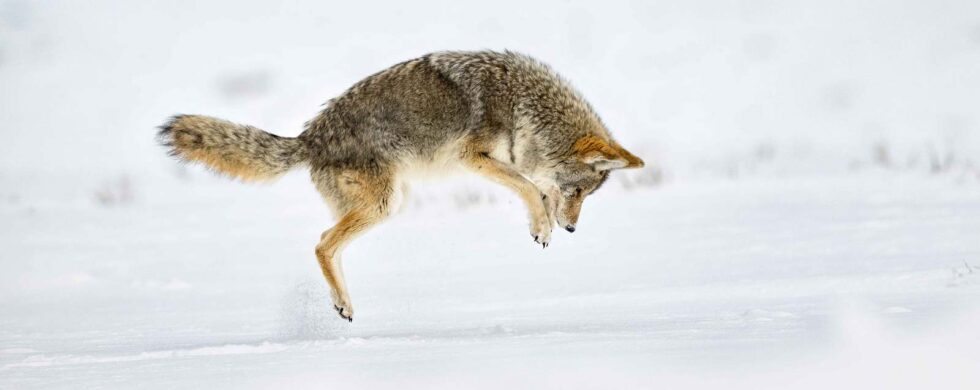
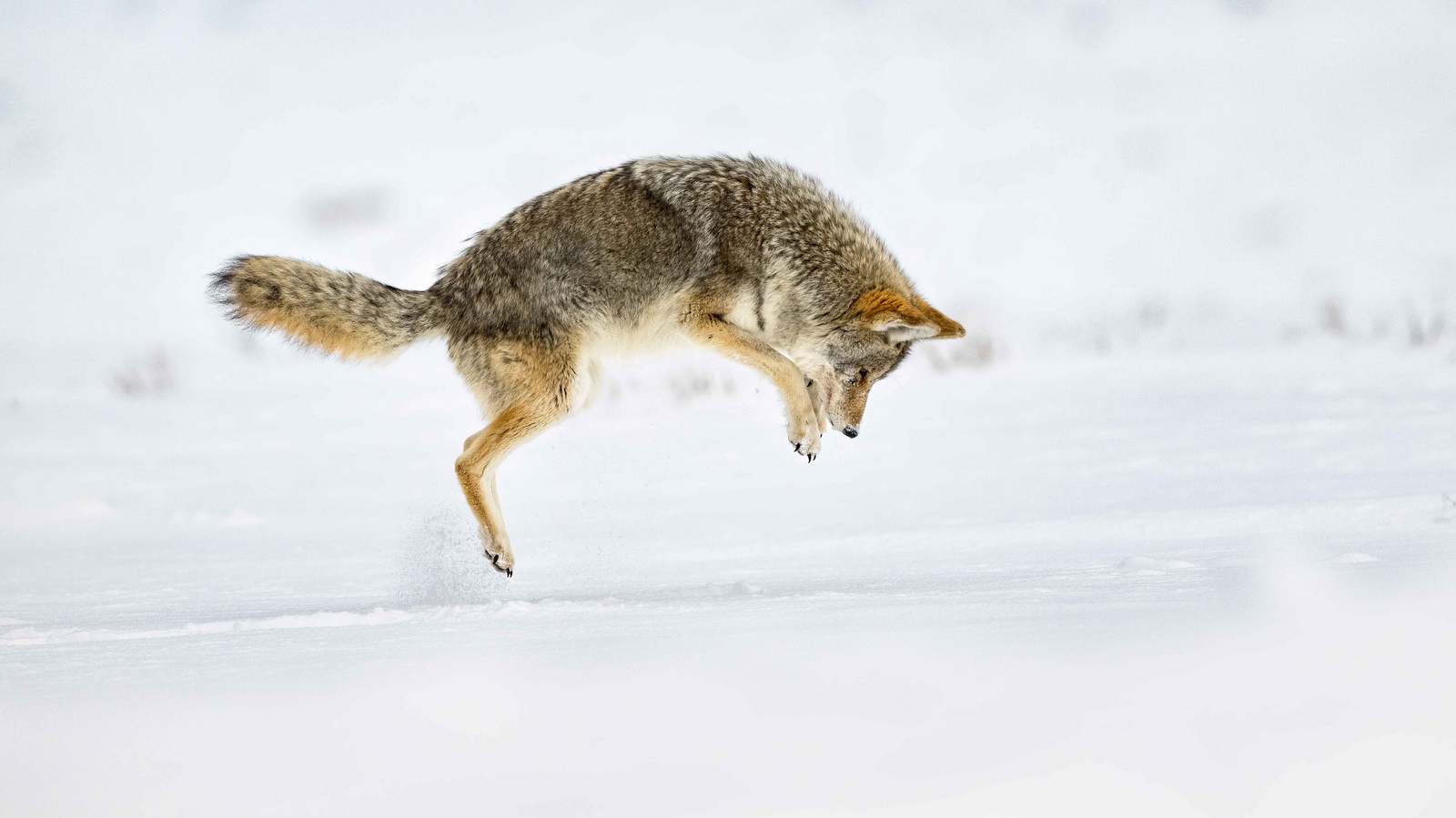
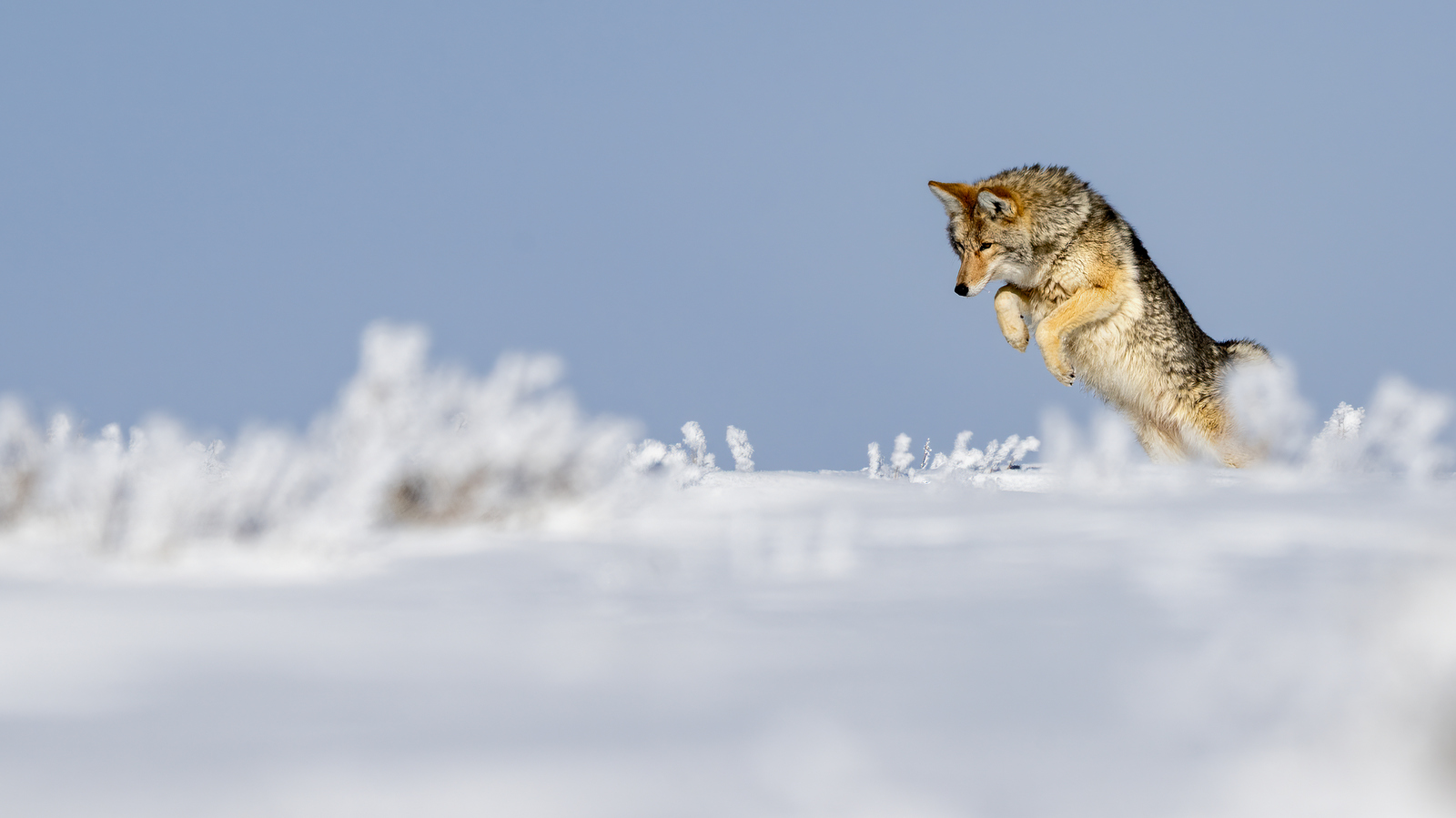
Animals that have small rodents on the menu sometimes use “mousing” as a technique to catch said rodents. How does that work? The coyote in the image above is demonstrating the maneuver. It usually goes something like:
Listen for prey hiding under snow or other cover;
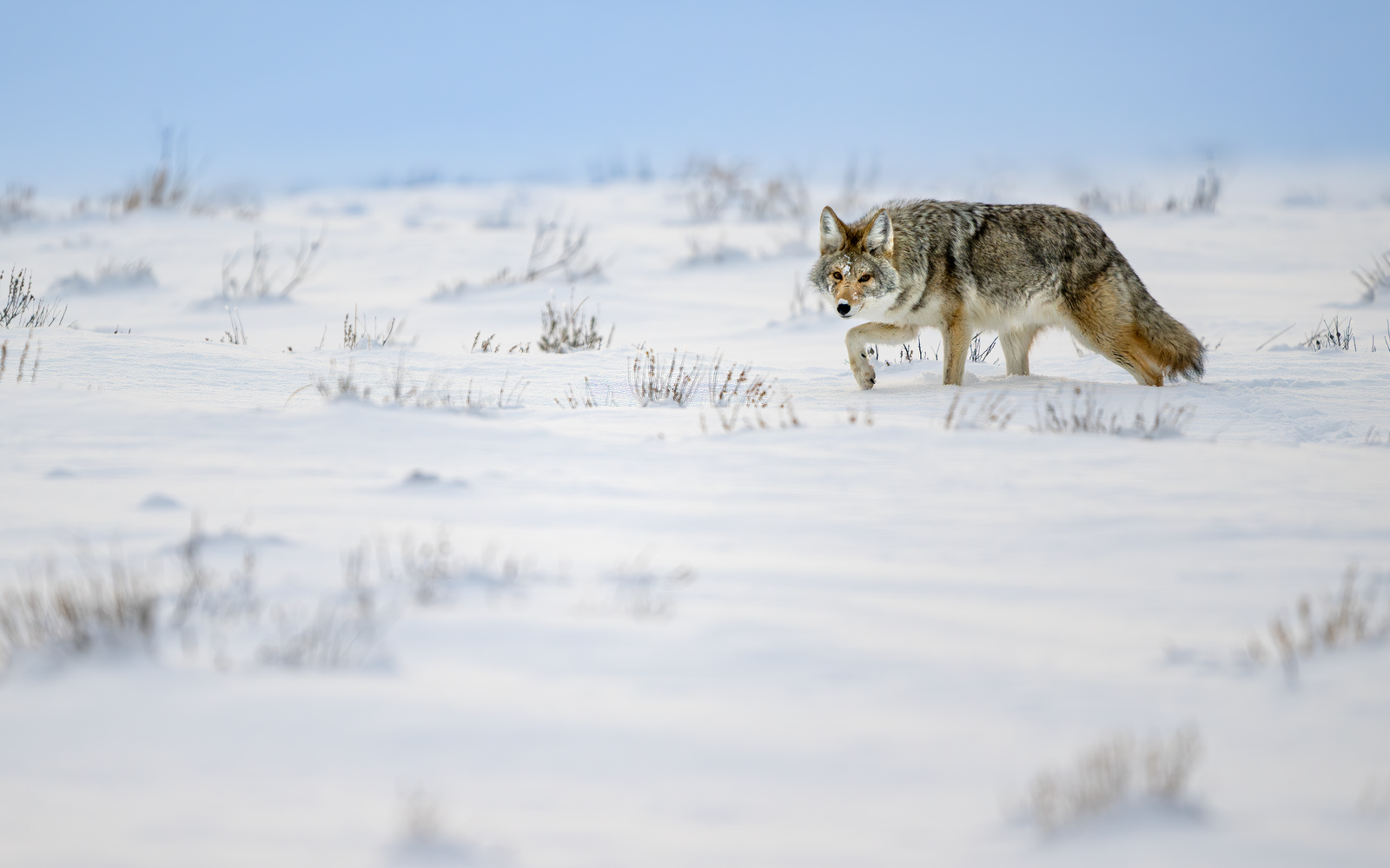
Stalk quietly
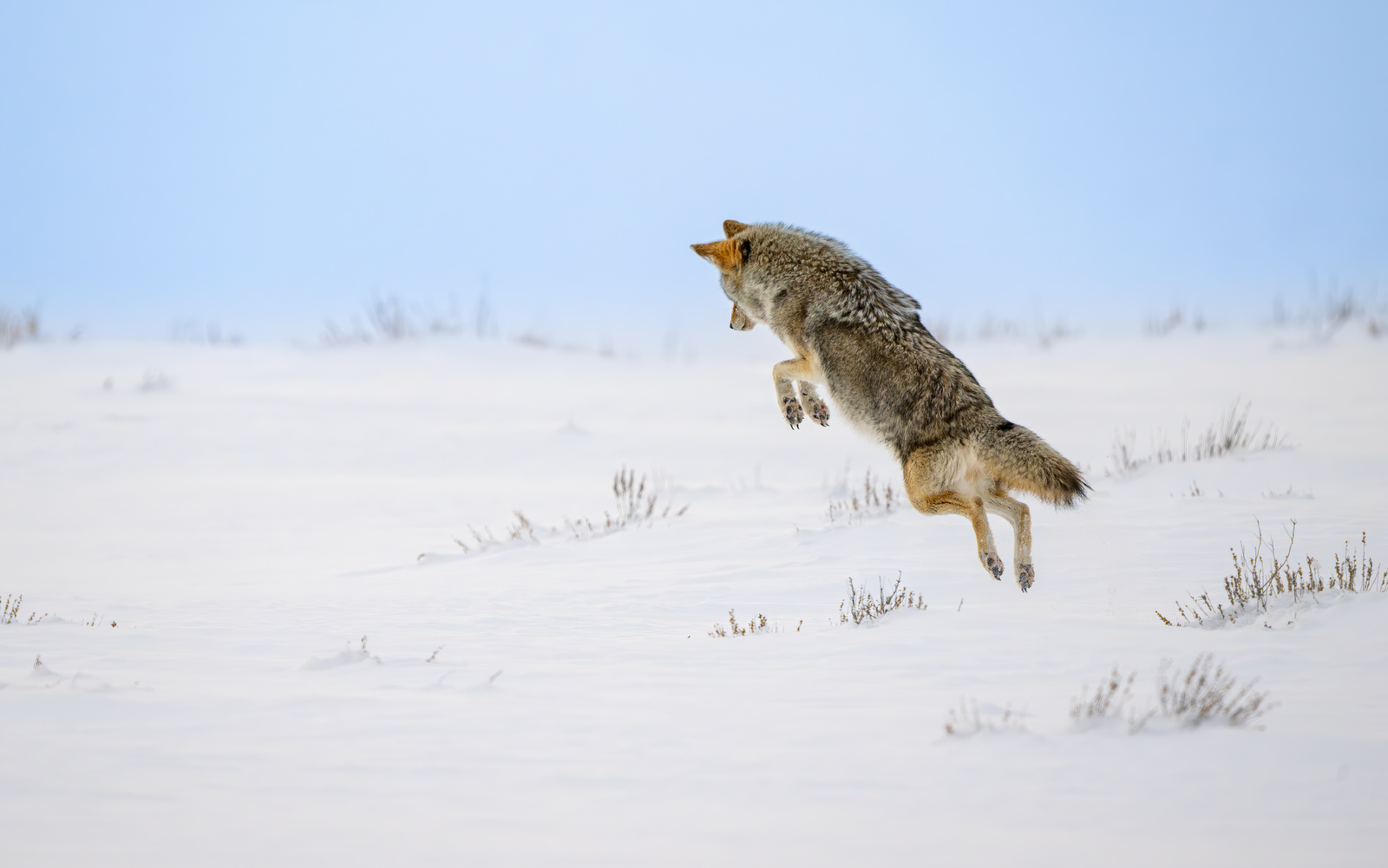
Listen. Triangulate. Leap!!
Drive front paws and muzzle downward to grab the unsuspecting prey.
During the winter, mousing is a vital survival skill for coyotes in Yellowstone National Park when large prey is scarce. Because wolves often dominate kills of larger animals, coyotes avoid direct competition by focusing on smaller prey, such as mice and voles, that wolf packs typically ignore.
In the image above, I caught this Yellowstone coyote at peak leap while mousing.
No luck on that last leap, let’s try again:
Drat. Missed. Let’s keep looking…
Hmmn. He can hear faint rustling noises as the mice run through their tunnels under the snow.
Launch:
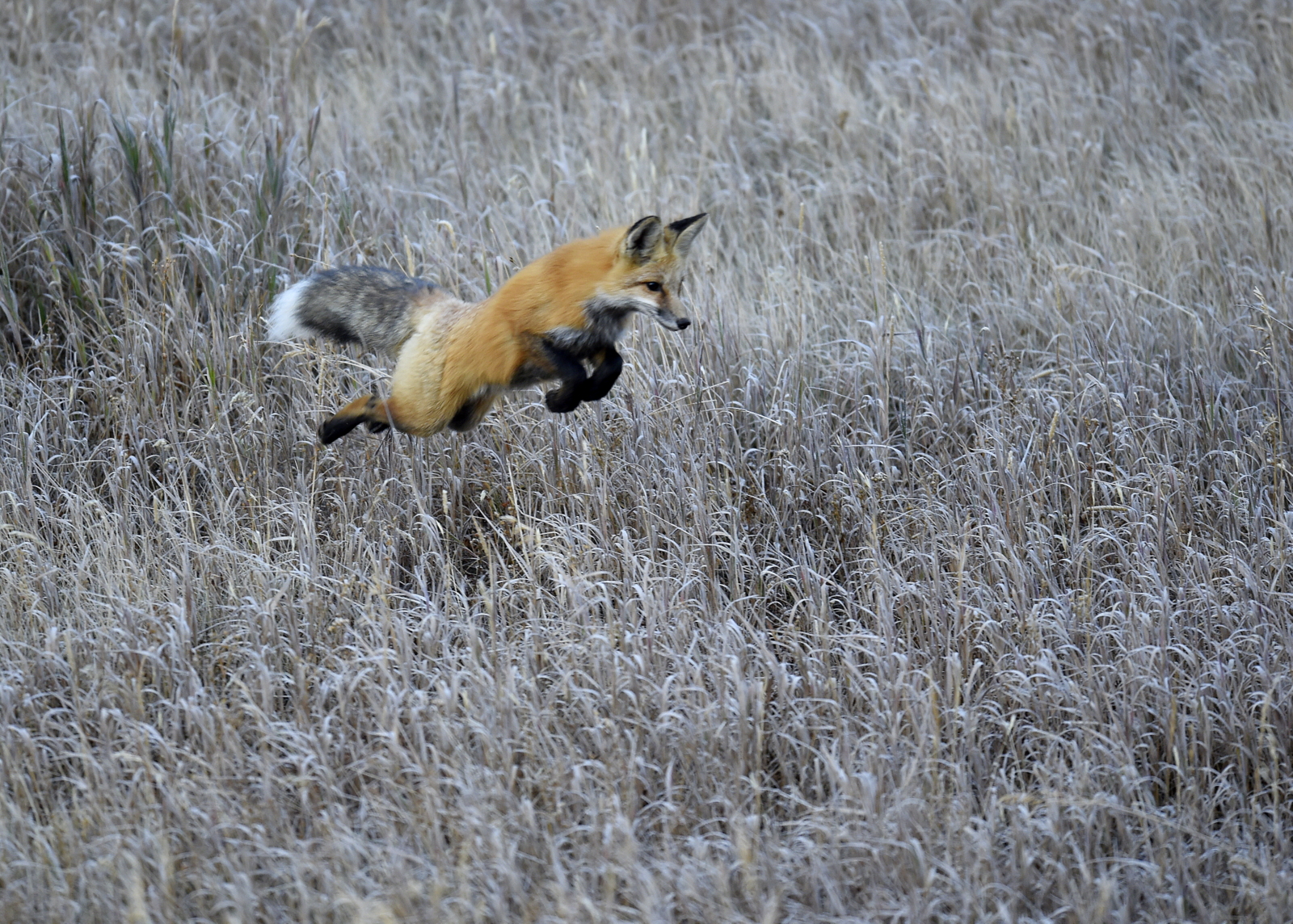
Foxes are famous for their mousing. I photographed this fellow also in Yellowstone one fall:
Here the BBC captured mousing at its finest…the music, the setting…glorious:
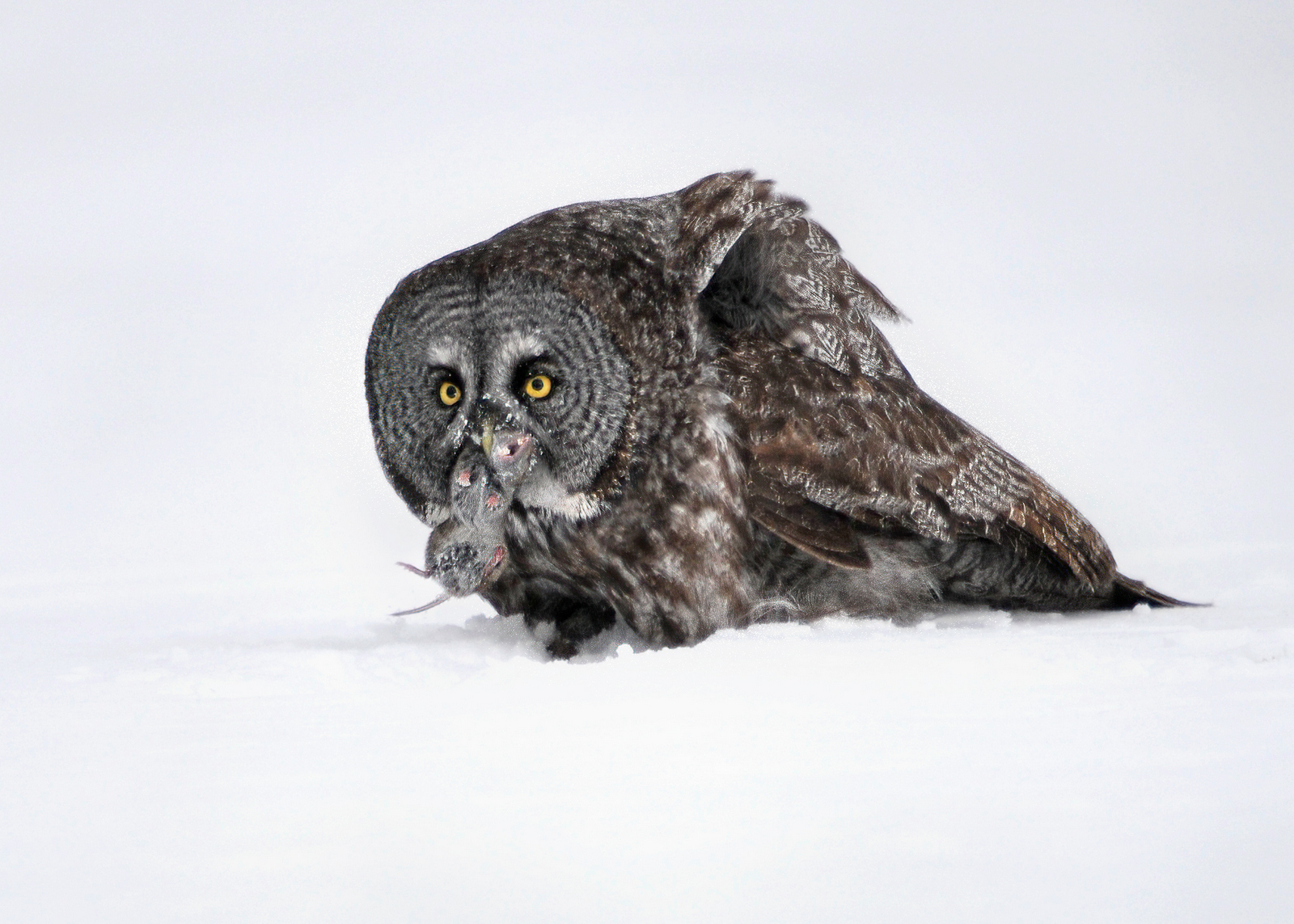
And many owls use a similar approach. Here is a Great Gray Owl with a catch:
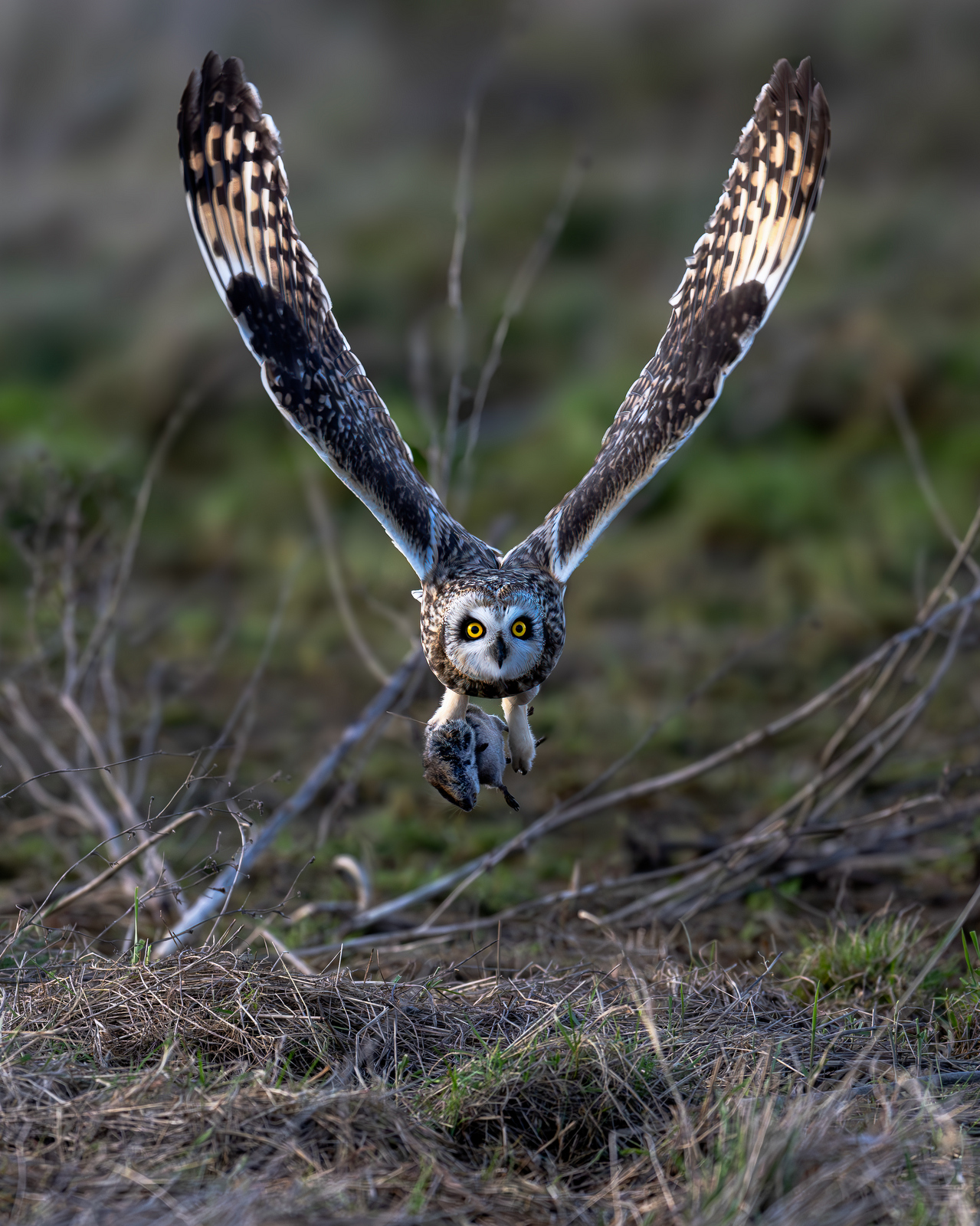
Using an aerial approach to mousing, short-eared owls often glide silently above the grass, listening below. Here is a successful catch:
Other predators that use the mousing technique include weasels, lynx, jackals, some bears, other raptors, servals, and other small felines. Mousing is so popular because small rodents (mice, voles, pocket gophers, etc.) are:
Abundant
Energy-rich
Relatively easy to catch compared to large prey
Are available year-round
And for many predators, mousing is:
An efficient “daily calories” strategy
A way for younger animals to practice hunting skills
An important survival behavior during the lean seasons
Who knew that “mousing around” was such a vital skill?
Until next month…..michael
Nikon Z9, Nikon 600mm, f/7, 1/2000 sec, ISO 800, EV +0.2/3
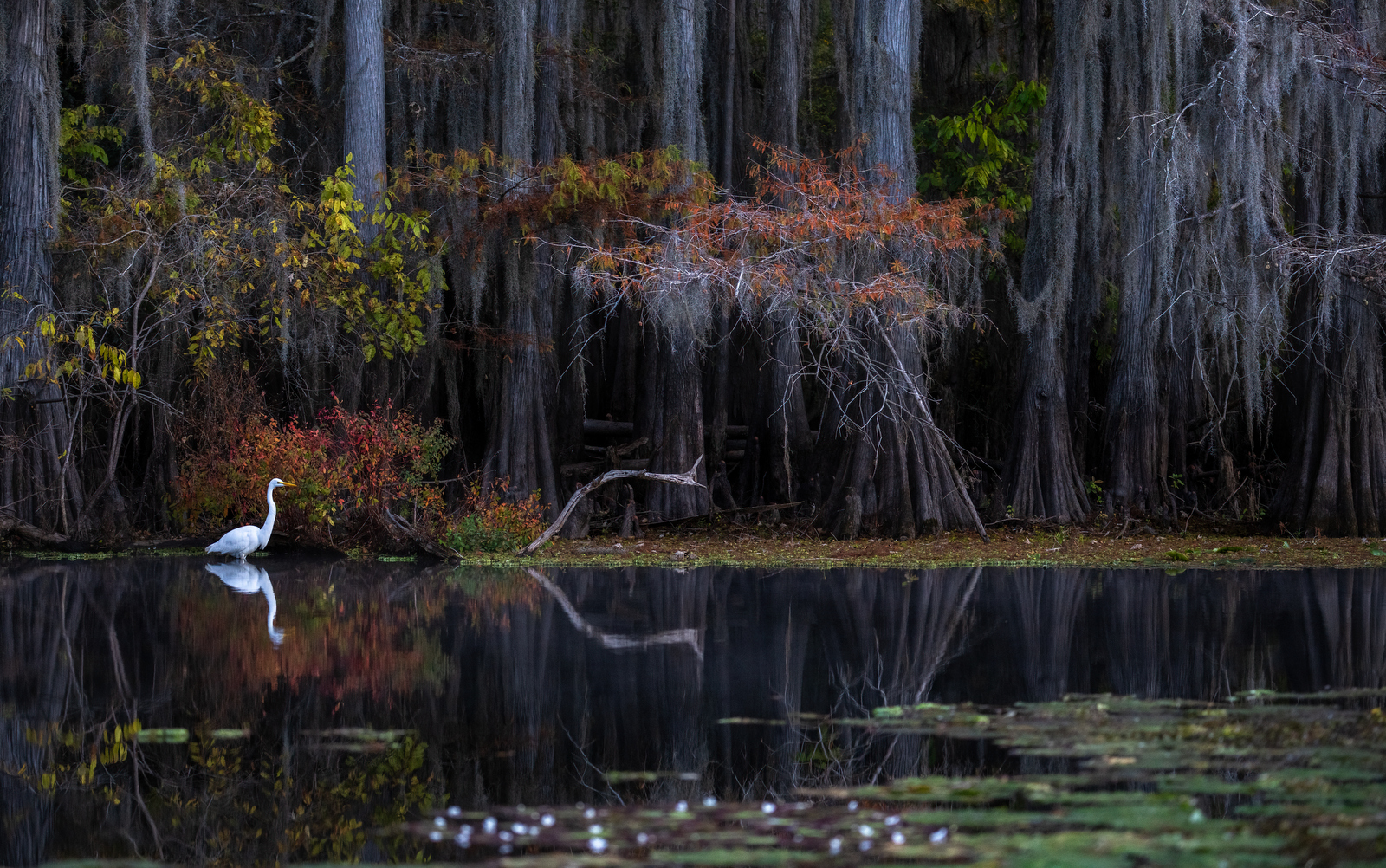
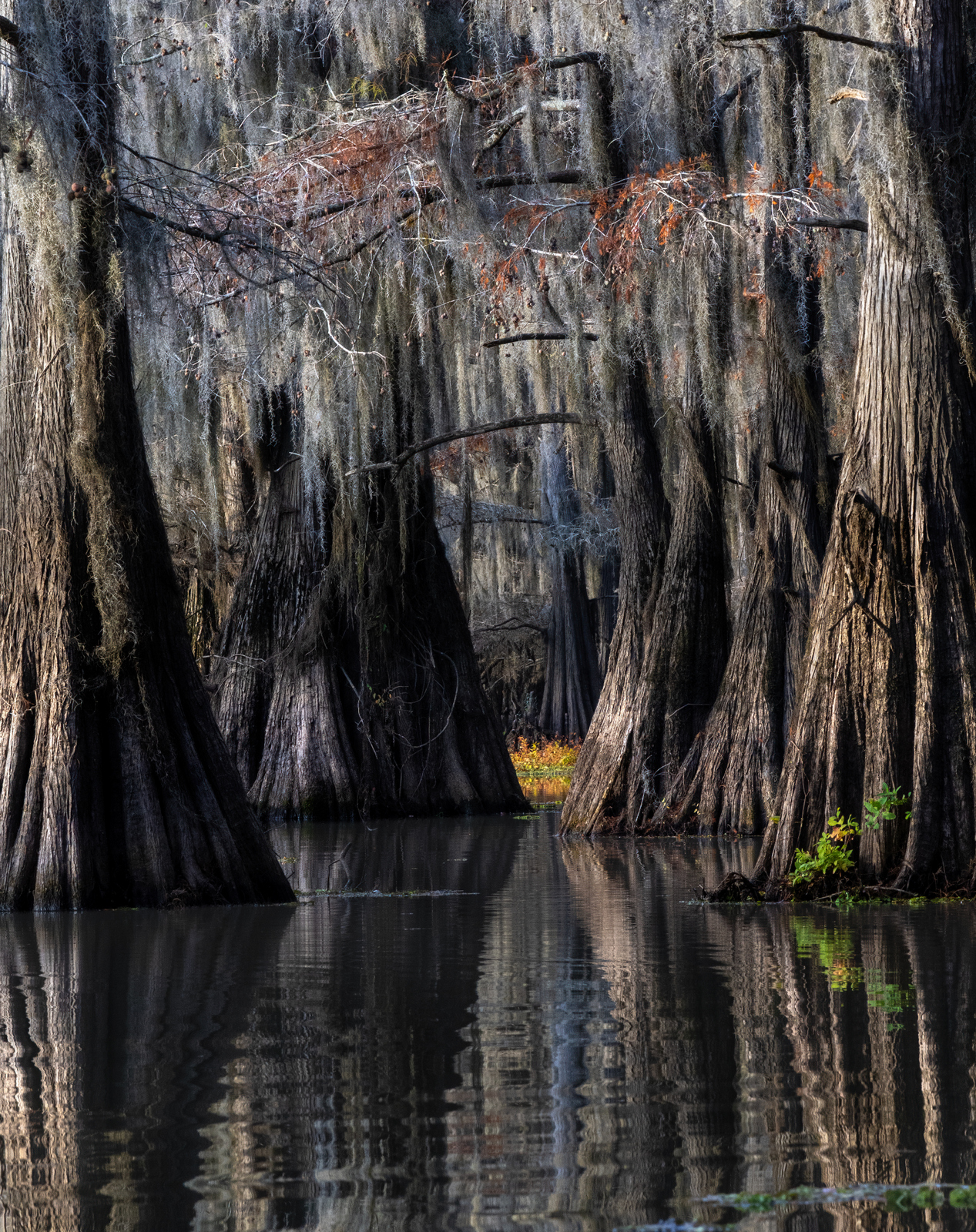
Up long before dawn, I paddled slowly as my kayak cut across the blackened water. Caddo Lake was eerily quiet, and the air was crisp and still. The water’s surface became an ebony mirror. As I glided across the water, I scanned the scene drifting by — this was a landscape photographer’s paradise if you could sharpen your eye and cut through all the visual clutter.
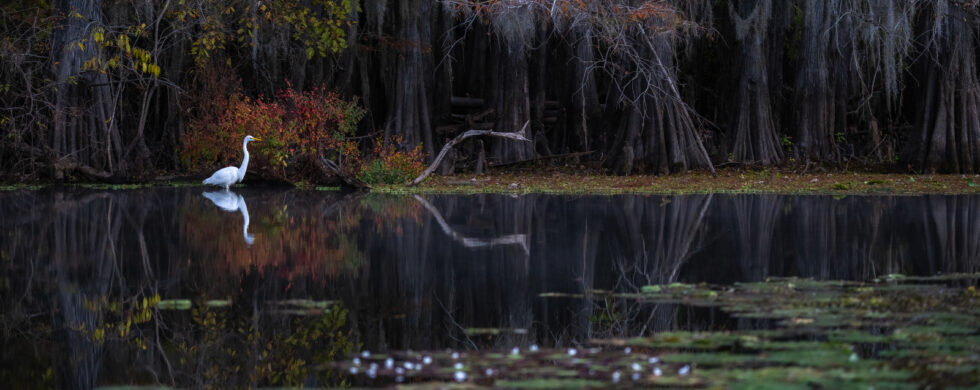
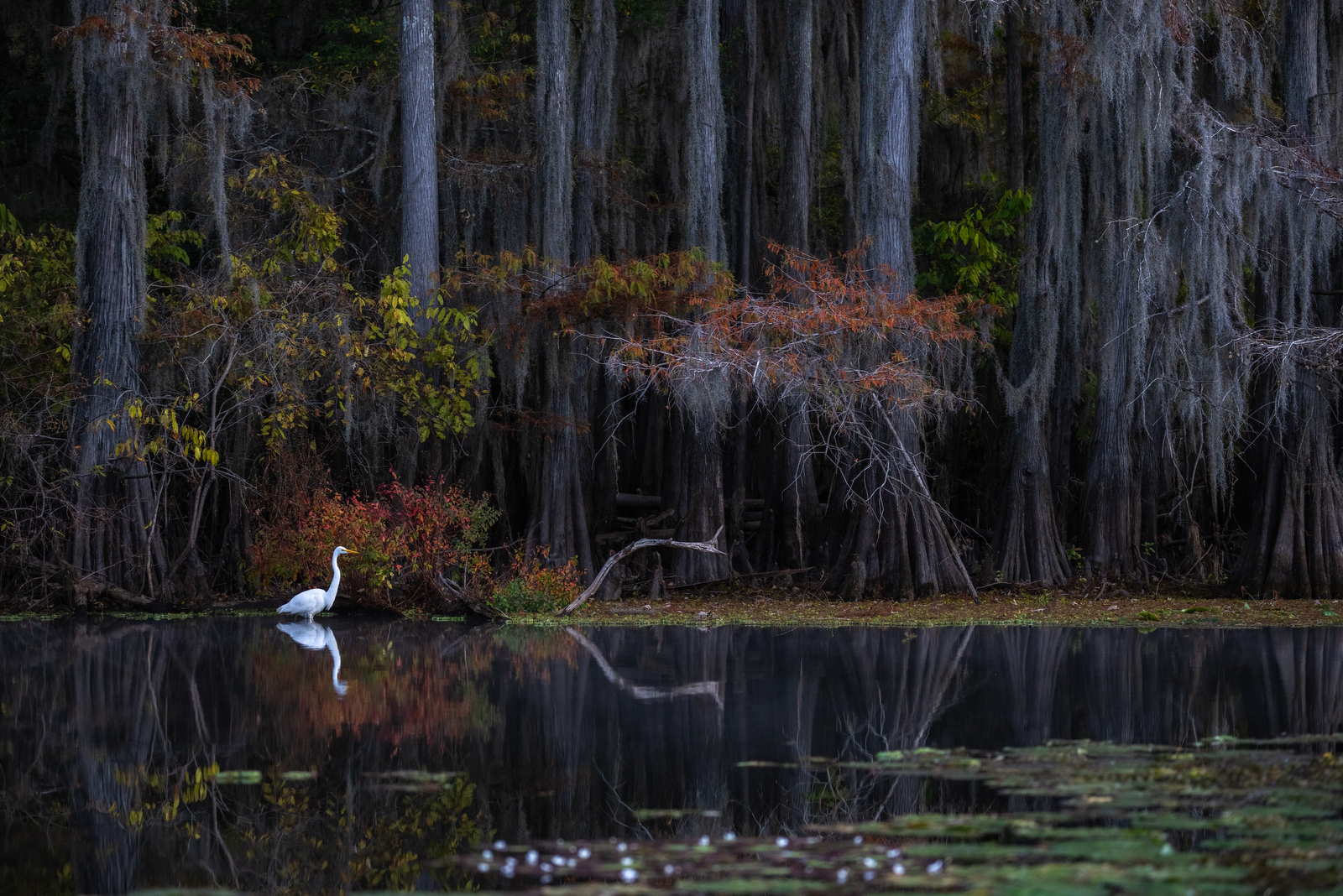
As I came around a corner, I found a Great Egret sitting along the shore waiting for the sun to breach the horizon to begin fishing for a meal. Yes!! I am first a wildlife photographer, so I always feel more comfortable photographing critters. I knew the key here was to compose an image that celebrated both the lovely egret and this magical setting.
For such a complex scene, I wanted to keep both the bird, the foreground, and the background in sharp focus – similar to a classic landscape image. However, shooting from a kayak made this task quite difficult. To have a deep depth of field I needed to use a small aperture. But smaller apertures allow less light to reach the camera so to properly expose the image I would have to leave the shutter open longer (slower shutter speed). On a tripod, this is no problem. But now I was in a kayak that was always moving, even if only a little. To overcome this challenge, I would start each sequence with “faster” shutter speeds, with a corresponding wider aperture (with less depth of field), and then quickly shift to slower and slower shutter speeds, allowing for smaller and smaller apertures (and greater depth of field) until I could no longer hand-hold the camera and get a sharp image. I also experimented with ISO levels – the higher the level, the more sensitive the image sensor, allowing for faster shutter speeds, but at the risk of adding more noise into the image.
As the egret sat near the shore, I paddled along the entire bank, looking for the best composition and lighting. Once spotted, I circled back and found my spot. Ooops, drifted too far. Paddle back. No, too far again. Now I am drifting in the other direction. Ok, quick, put the paddle down! Compose and fire off as many shots as possible while shifting aperture and shutter speeds. Ok, now we have drifted too far. Camera down and paddle back to the best shooting location. I repeated this over and over and over…it was exhausting.
Over time, the egret would fly a bit further down along the shoreline. The good news was that I now had a fresh composition to work with. The bad news was that I had to repeat the entire composition process again…oy vey.
I easily spent more than 45 minutes observing and photographing this egret until he moved into the lovely scene you see above. I had been starting to feel guilty about spending so much time doing “wildlife photography” when I was here to do landscape photography. But then it all came together.
I love this composition. The white egret is perfectly highlighted as he stands in front of the colorful bush. We see the fall colors bursting in sharp contrast to the otherwise dark and somber mood of this pre-dawn scene. The colorless bald cypress trees in the background, draped in Spanish moss, add a mysterious gothic overlay and perfectly capture the unique feel and atmosphere of Caddo Lake. The somber water mirrors the shoreline and subtly conveys the tranquility of the scene. The lily pads in the front, right corner lead the eye into the frame and add visual balance to the composition.
In short, it is a nice picture. Feeling exhilarated, I paddled off deeper into the bayou in search of more traditional landscape scenes…
Caddo Lake? See last month’s post for the deets on this wondrous locale.
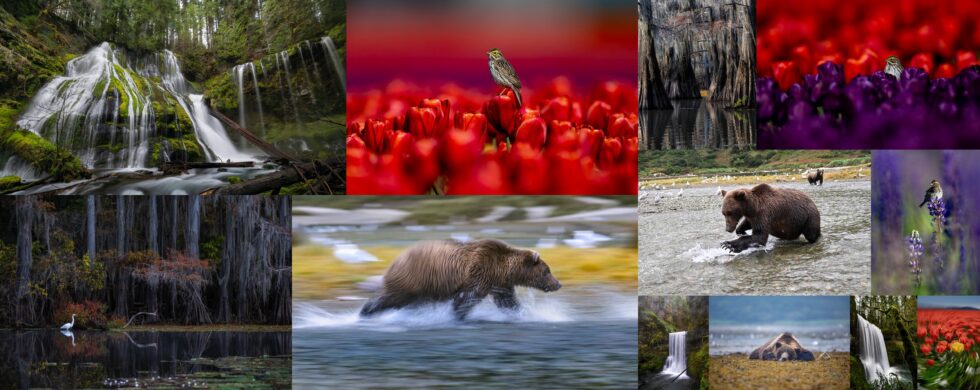
One final look back at 2025 before we go barreling ahead into 2026 with hope and vigor. Let’s visit with some of my favorite images that I captured over the last 12 months. The list is in chronological order.
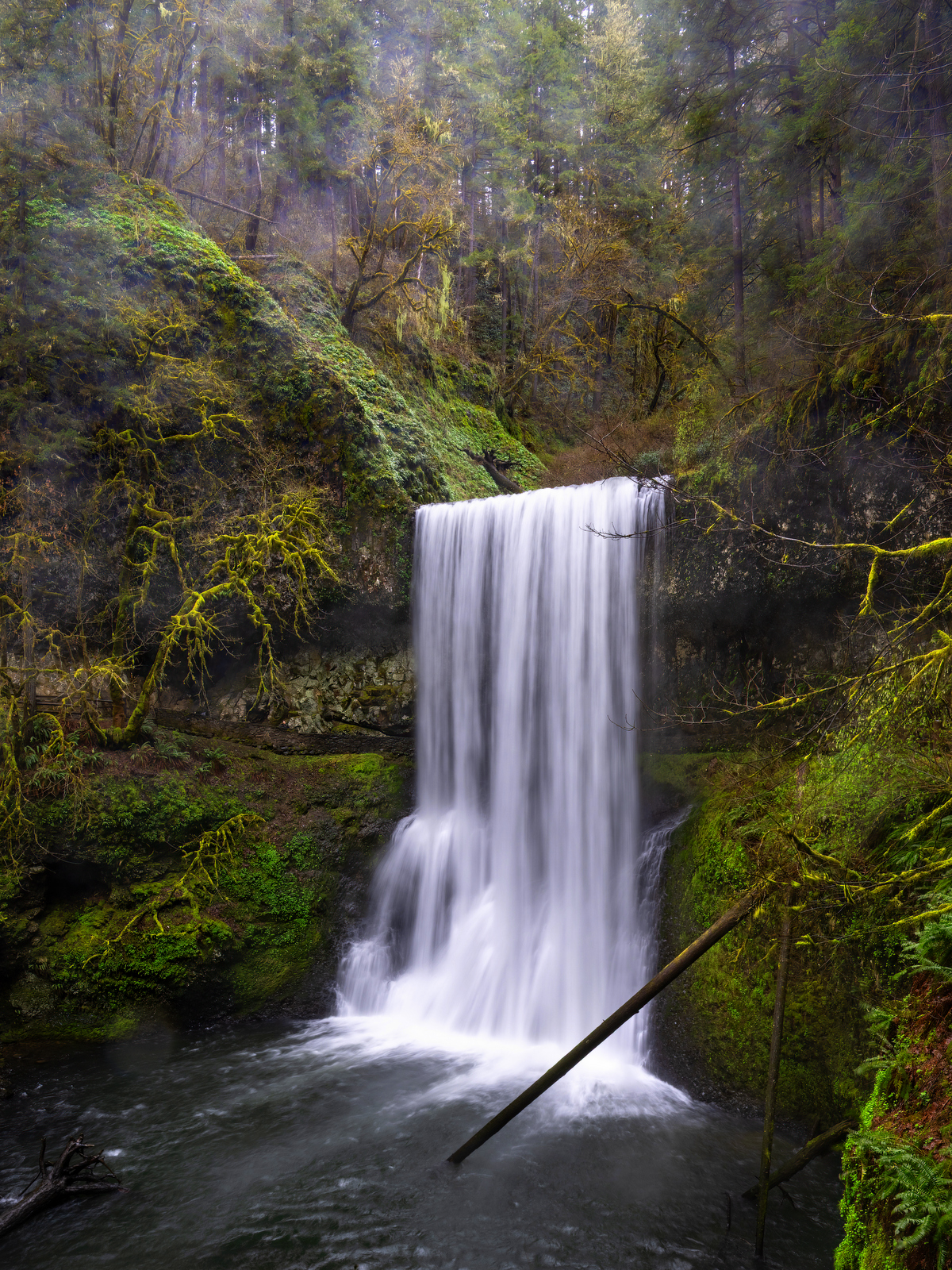
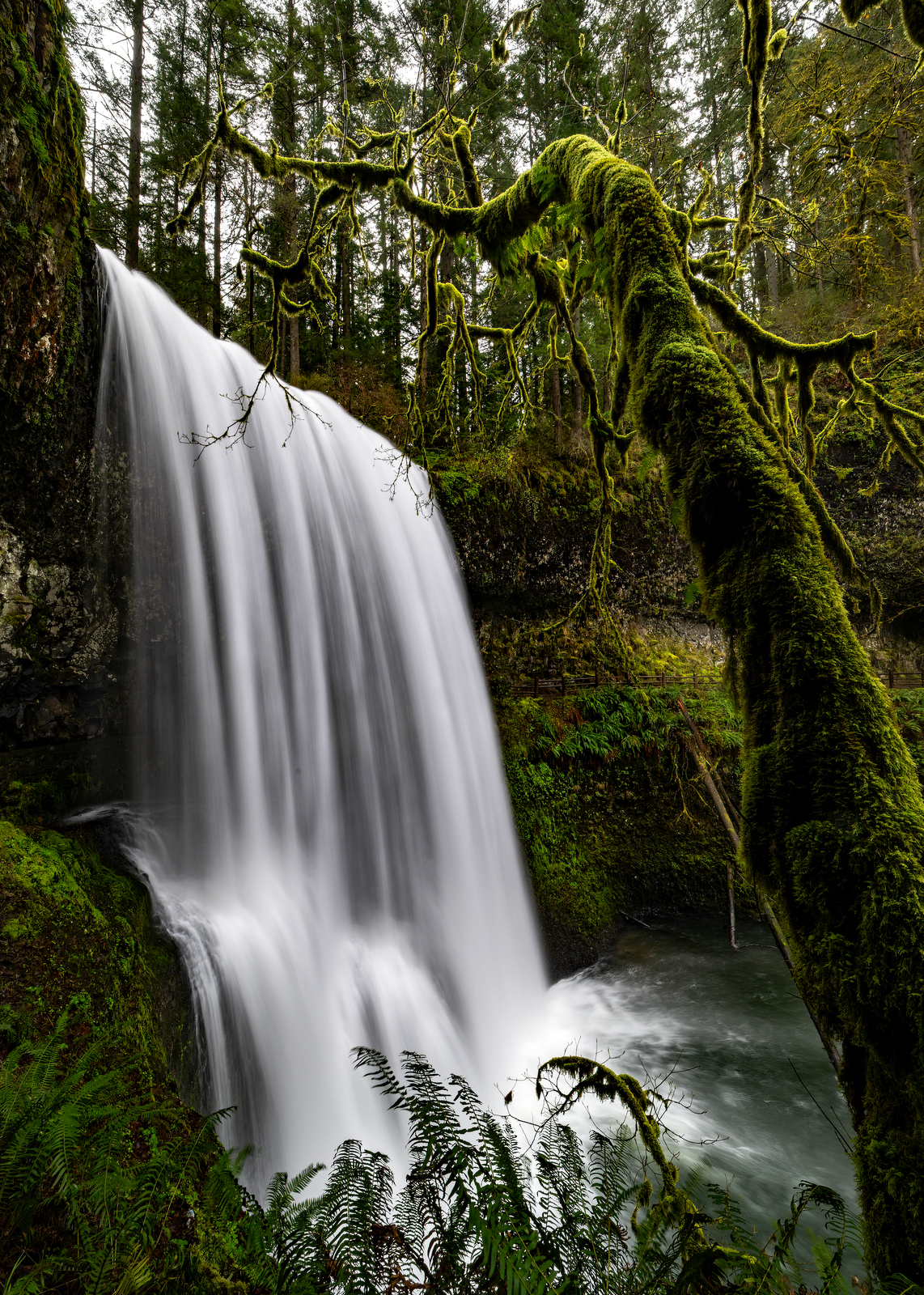
In March, I visited Silver Falls State Park in Oregon to wander among the 10 waterfalls found there. I had particularly good luck with Lower South Falls. There are two good vantage points to admire this waterfall:
Just a month later (April), I spent several days exploring waterfalls in Southern Washington and a few more located just over the border in Oregon (Columbia River Gorge). On this trip, I discovered the stunningly beautiful Panther Creek Falls in the Gifford Pinchot National Forest, as shown below.
3. Panther Creek Falls
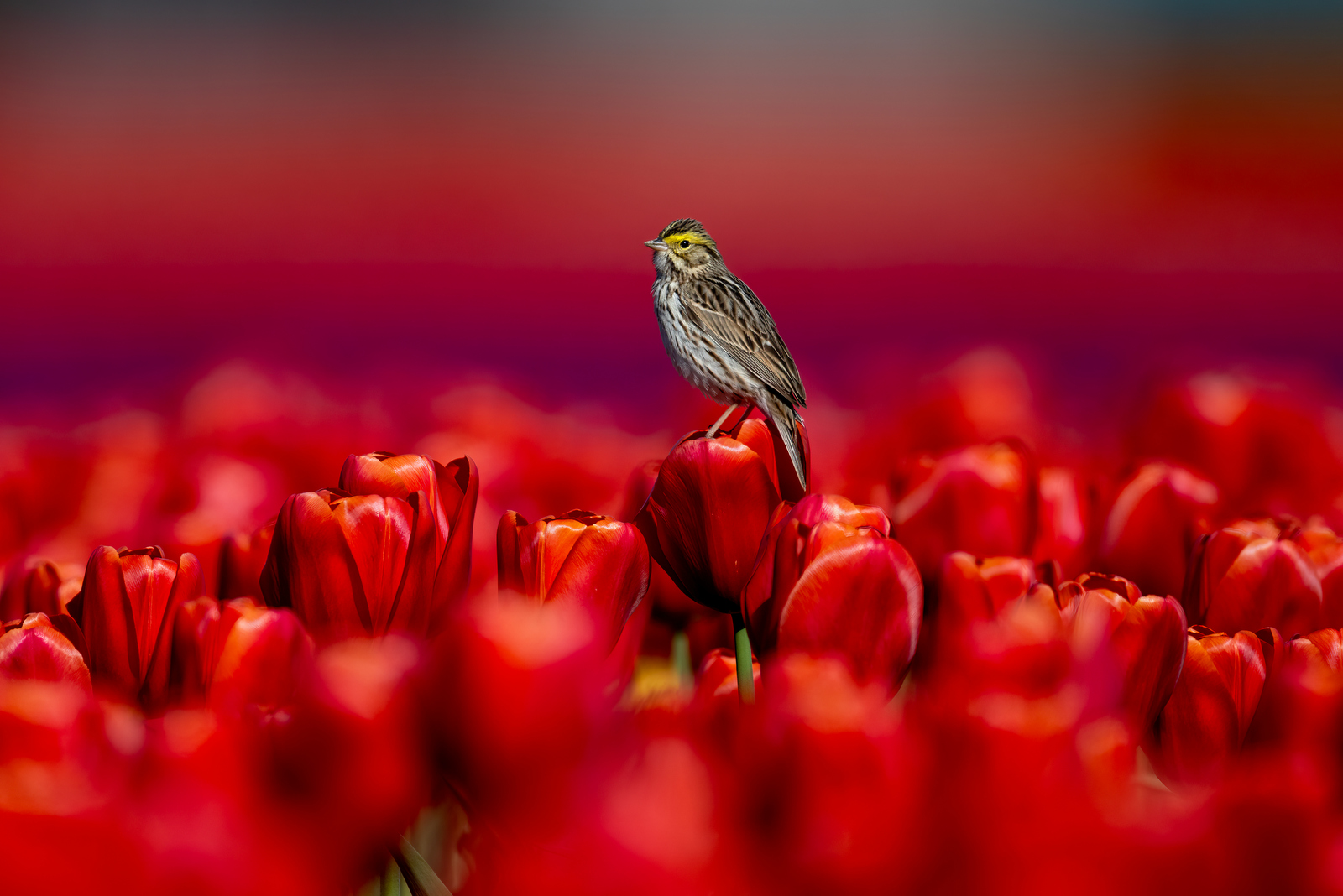
Later in April, I visited tulip fields in Skagit County (Washington) for a completely different color palette:
4. Savannah Sparrow in Red
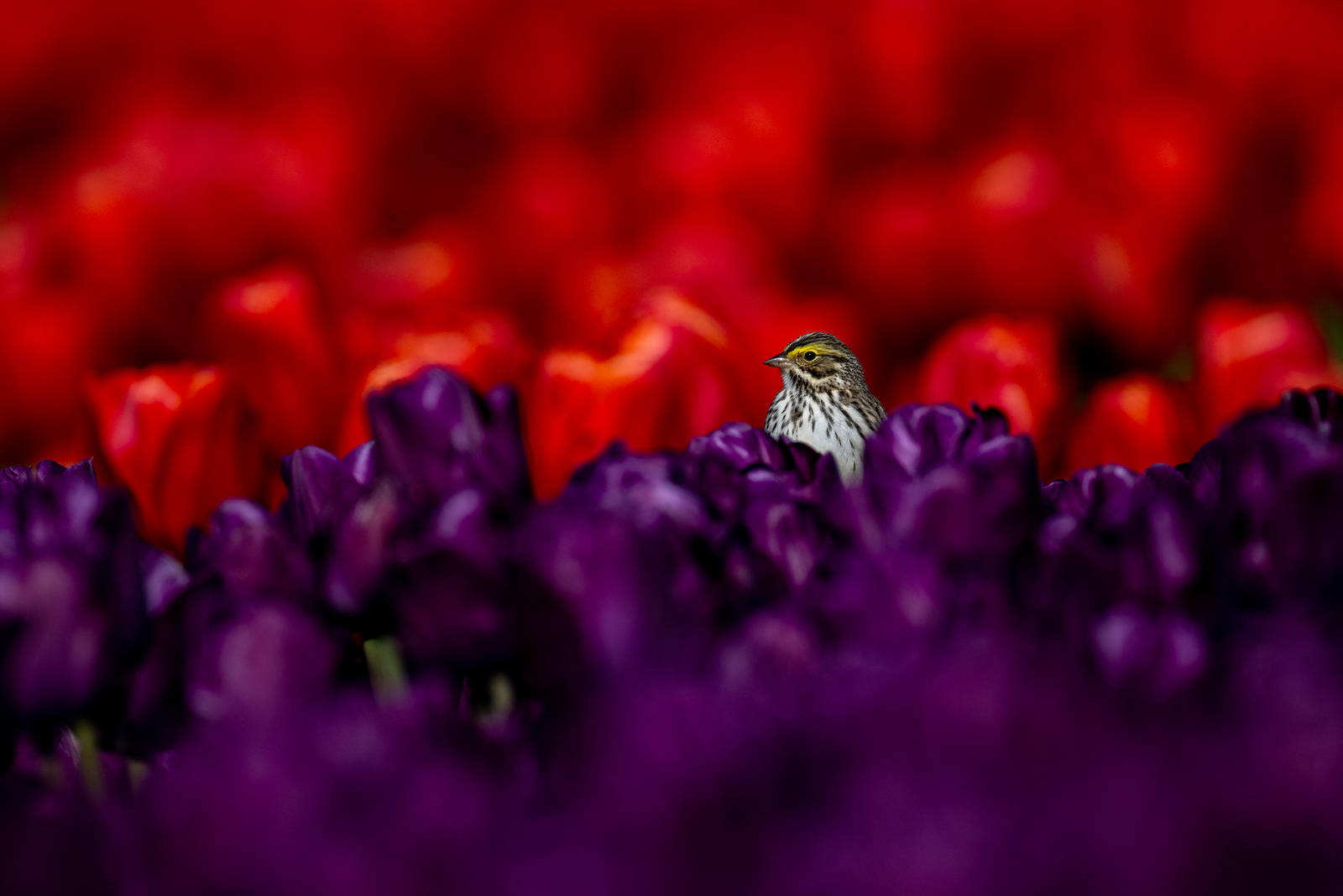
5. At the Border
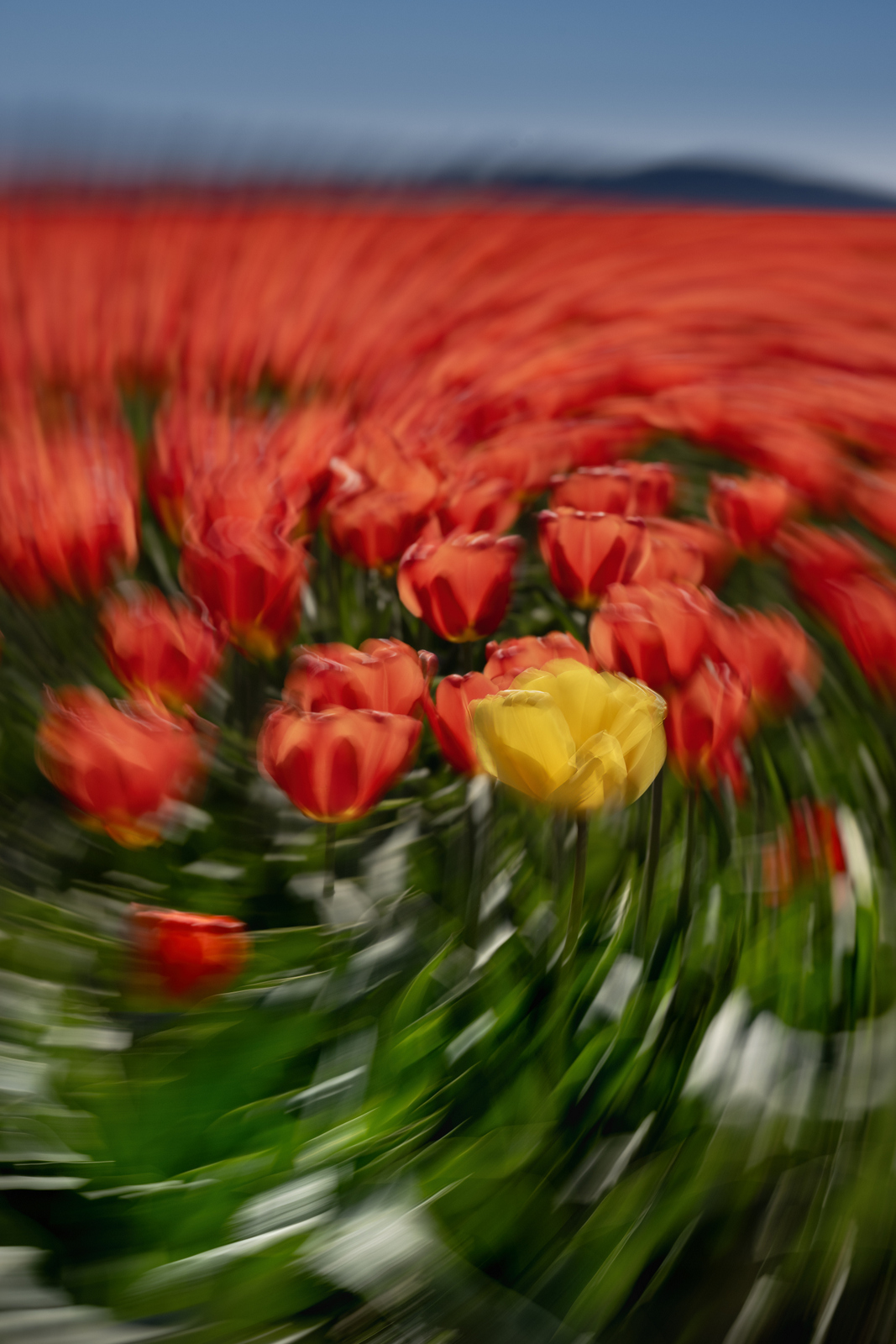
While exploring the tulip fields, I also experimented with some abstract takes on the flower scene:
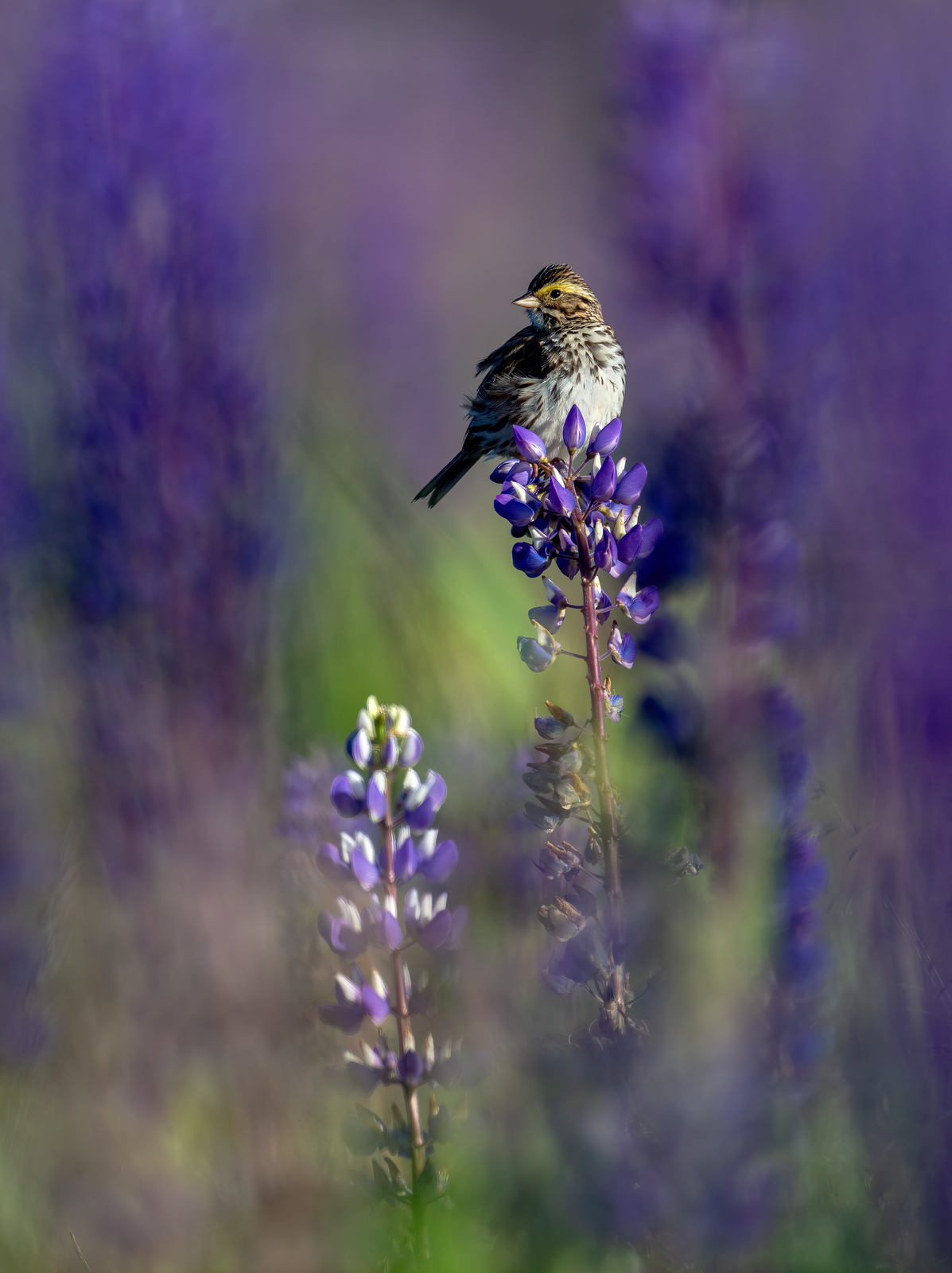
In June, I visited a field of lupines and captured this dreamy meadow scene.
7. Meadow Dream
Did you notice that the bird was yet again a Savannah Sparrow?! I seem to find them everywhere i go!
In September, I visited Katmai National Park in Alaska to photograph Brown Bears. The weather was awful on this trip and our photo opportunities were quite limited, but I was pleased with these images:
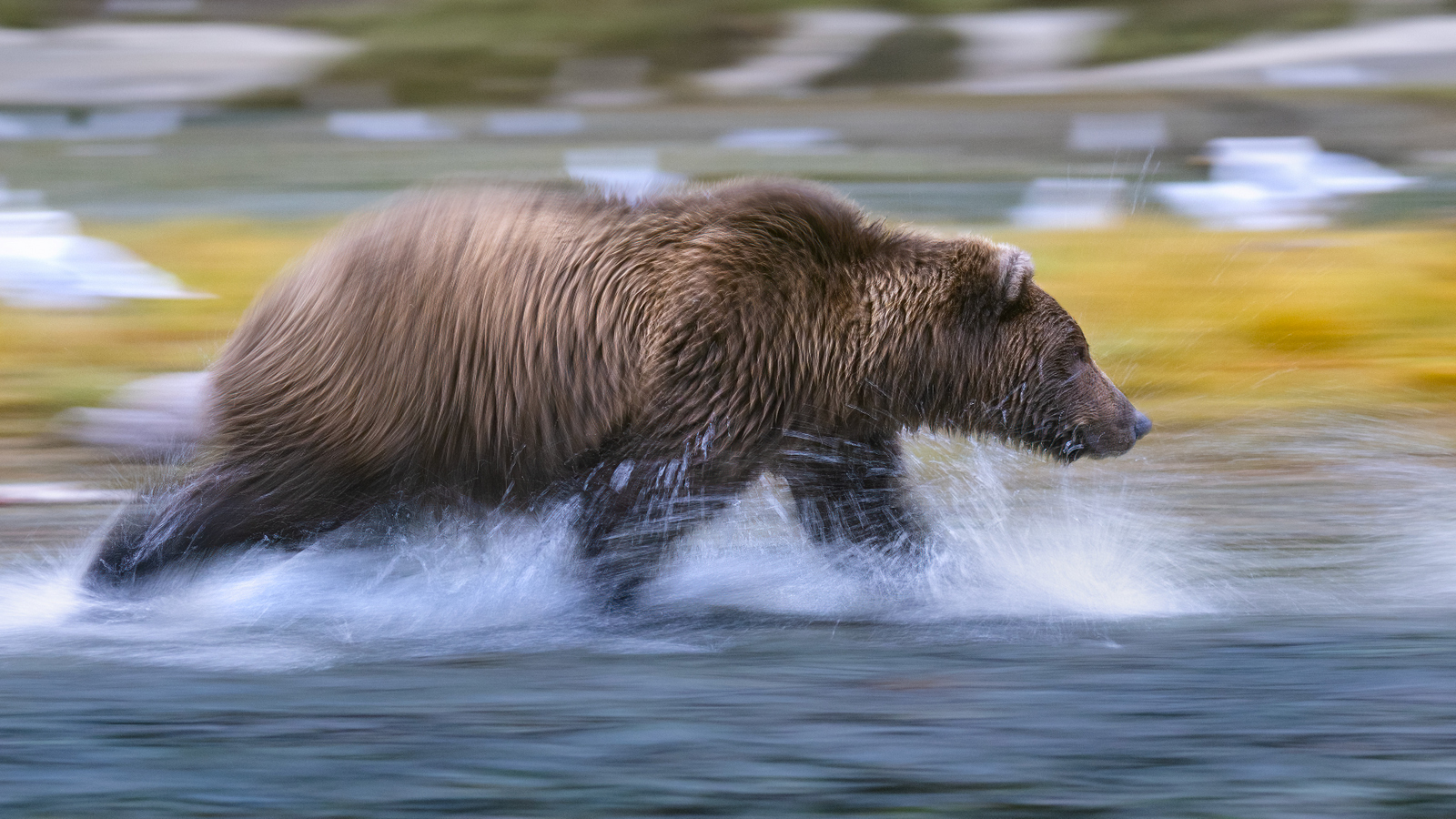
8. Brown Bear Splash
In the image above, I experimented with a slow shutter speed to give a sense of the chaos as the bear barreled through the water in pursuit of a fish. I really dig how his fur seems to swirl…
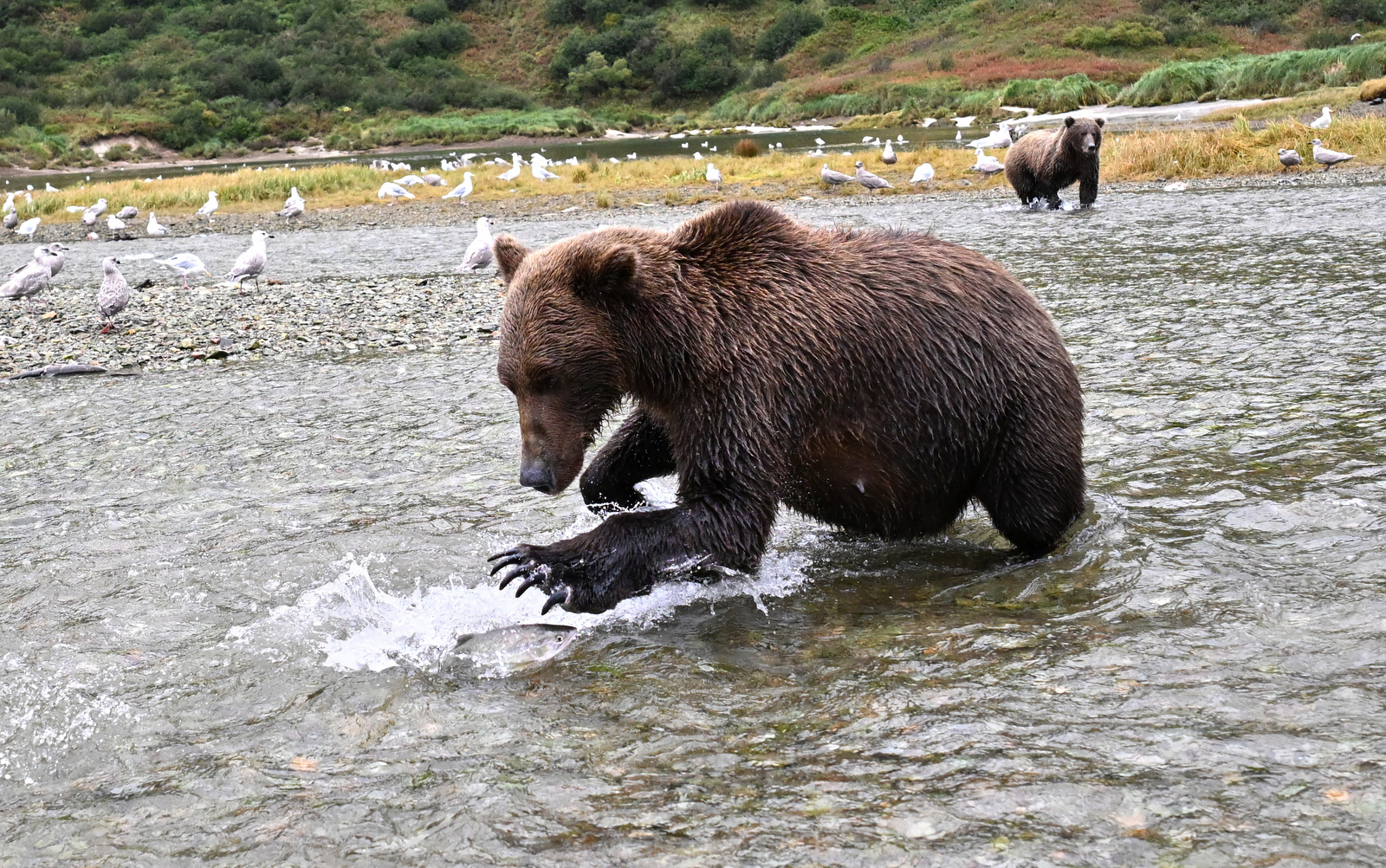
9. Salmon Paw
Above, a dramatic action shot as a brown bear lunges for a salmon.
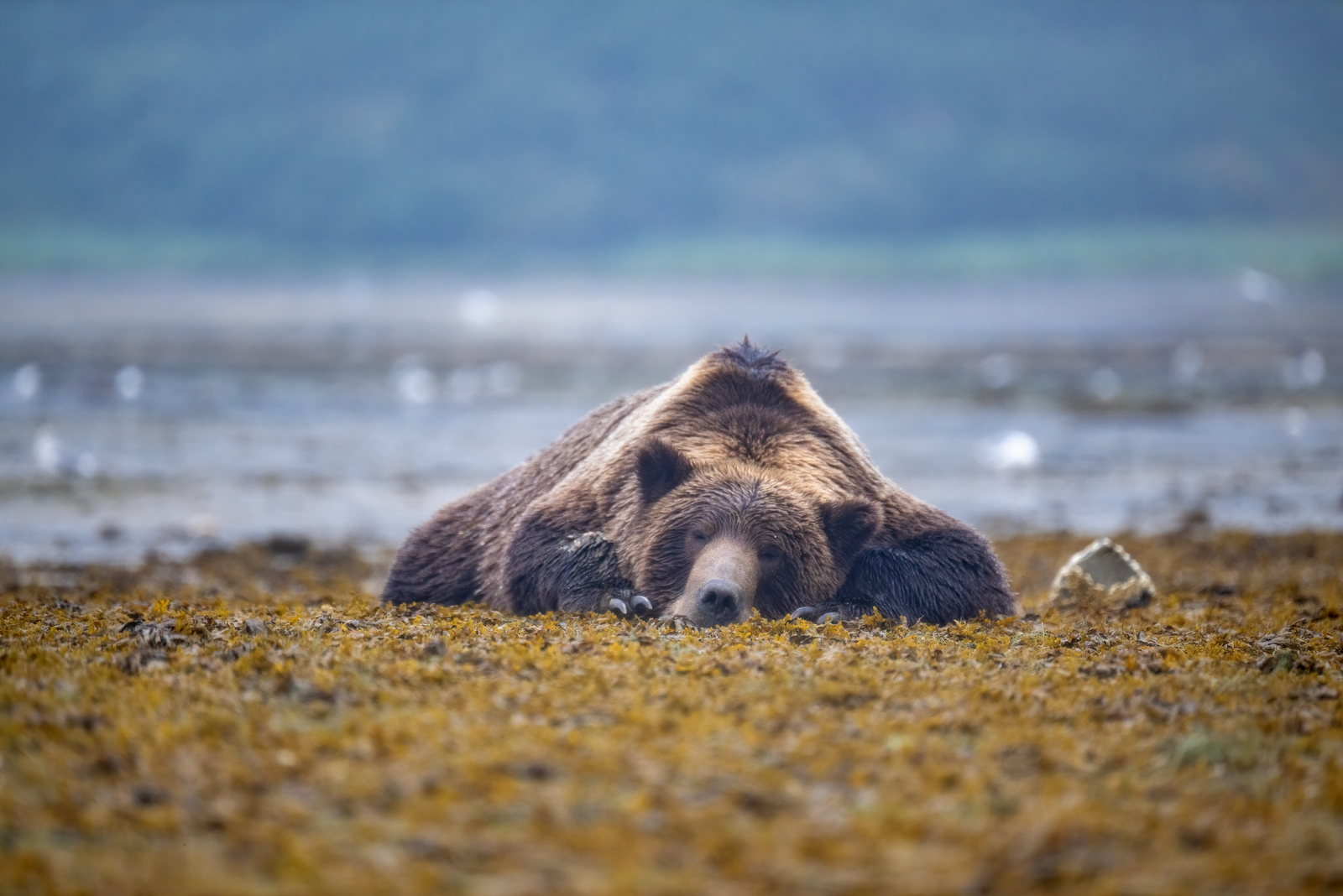
10. Mood
Could this image capture the post-holiday mood any better? He has obviously overindulged on the salmon buffet.
And speaking of bears, here is a video I captured of a bear in hot pursuit of a salmon:
11. Caddo Lake
My last photo foray of the year was in November when I visited Caddo Lake for the first time. I spent a glorious week paddling in a kayak through a surreal landscape that combined Texan swamps with autumn colors, creating an environment unlike anything I had seen before.
12. Great Egret
This is probably my best and favorite image of the year. I captured this from my kayak before sunrise, and the setting was sublimely serene. The scene oozes tranquility – “ommmmm.” The image wonderfully highlights the unique mix of swamp life and autumn colors found here. I love it. It will be on my wall soon.
So that was the top 12 images of the year. A few bonus images for sticking around:
Latecomers:
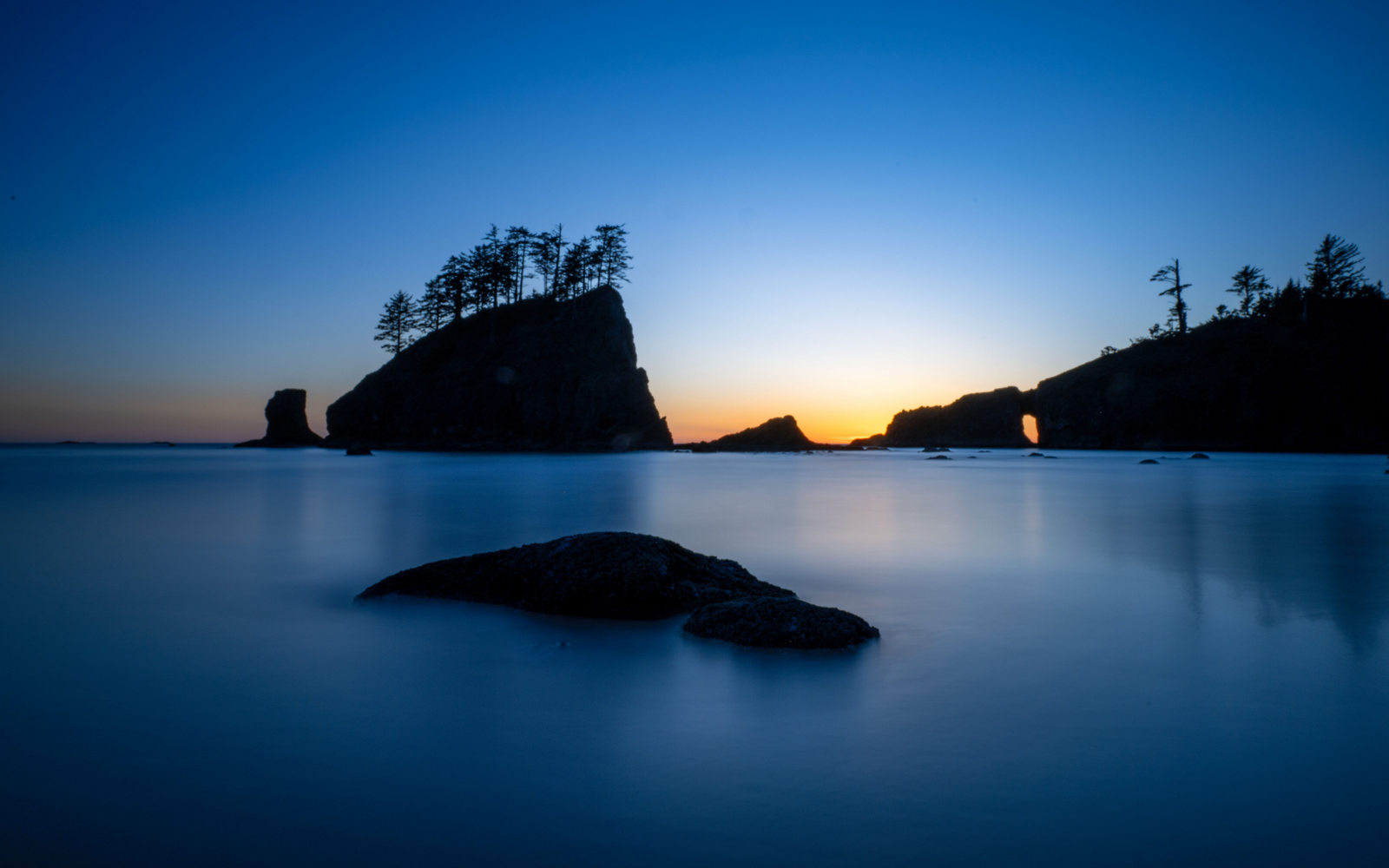
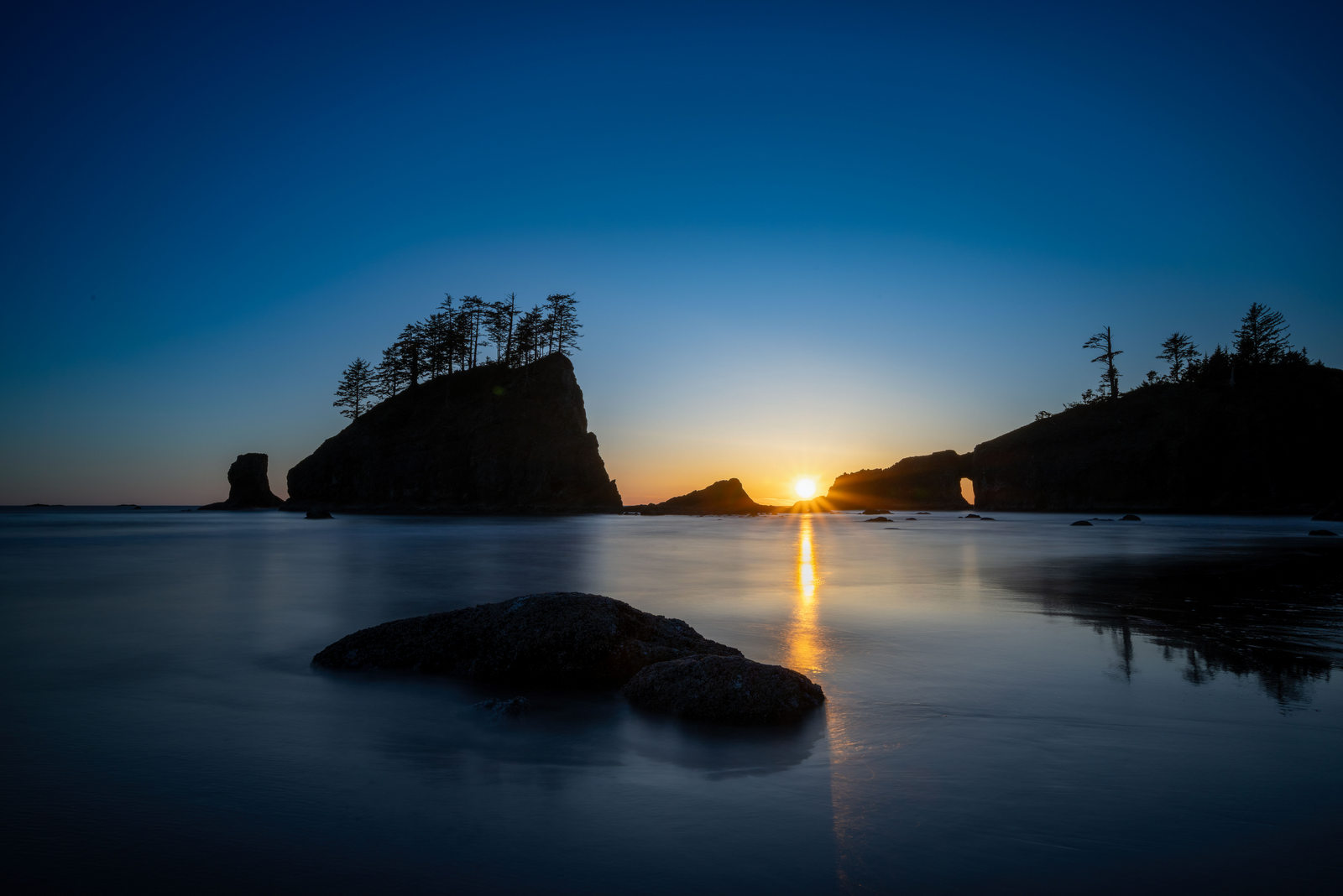
These two sunset images were taken at Second Beach in the Olympic National Park in 2024, but I didn’t process them until 2025:
13. Beach Blues
14. Second Beach #2
Favorite Iphone Shots
The cameras on smartphones keep improving, and when in a pinch (or too lazy), I will use mine instead of my “real camera.”
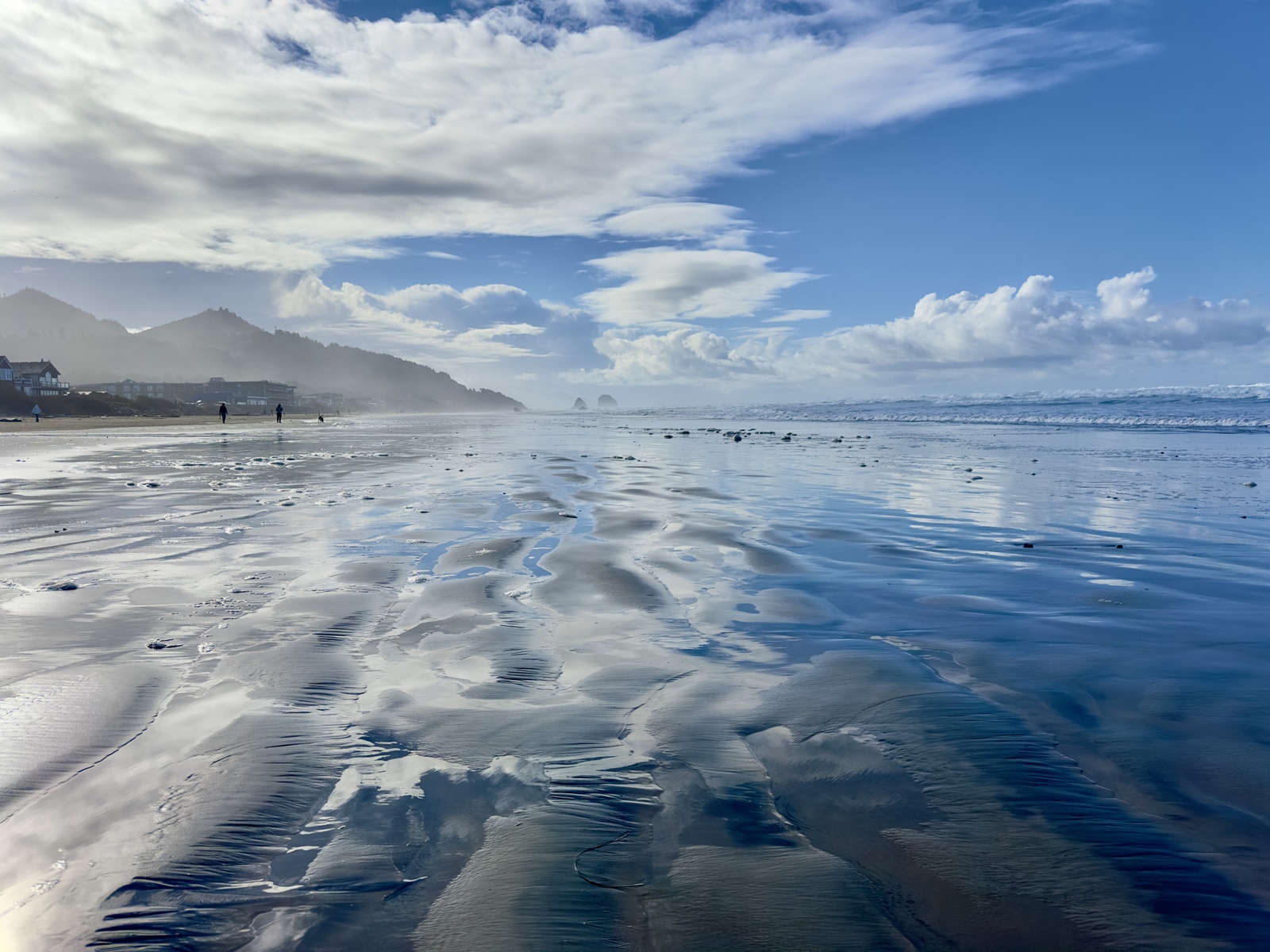
Iphone #1
I visited Cannon Beach in Oregon a couple of times to try and get a great sunset image, but no luck so far. But one morning, I took this groovy shot with my iPhone. Where does the sky stop and the beach begin??
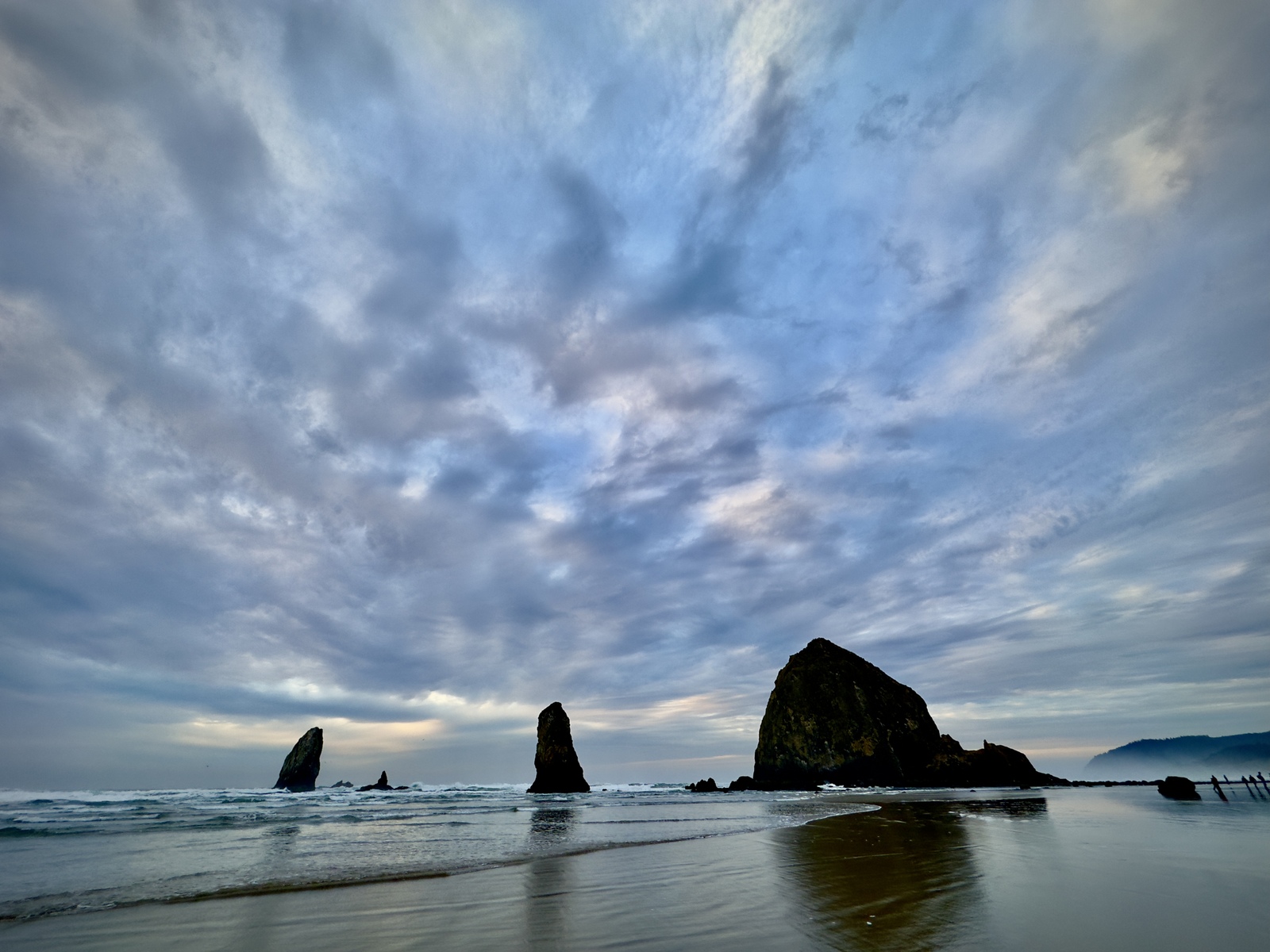
Iphone #2
The same morning on Cannon Beach with a dramatic sky by the Sea Stacks.
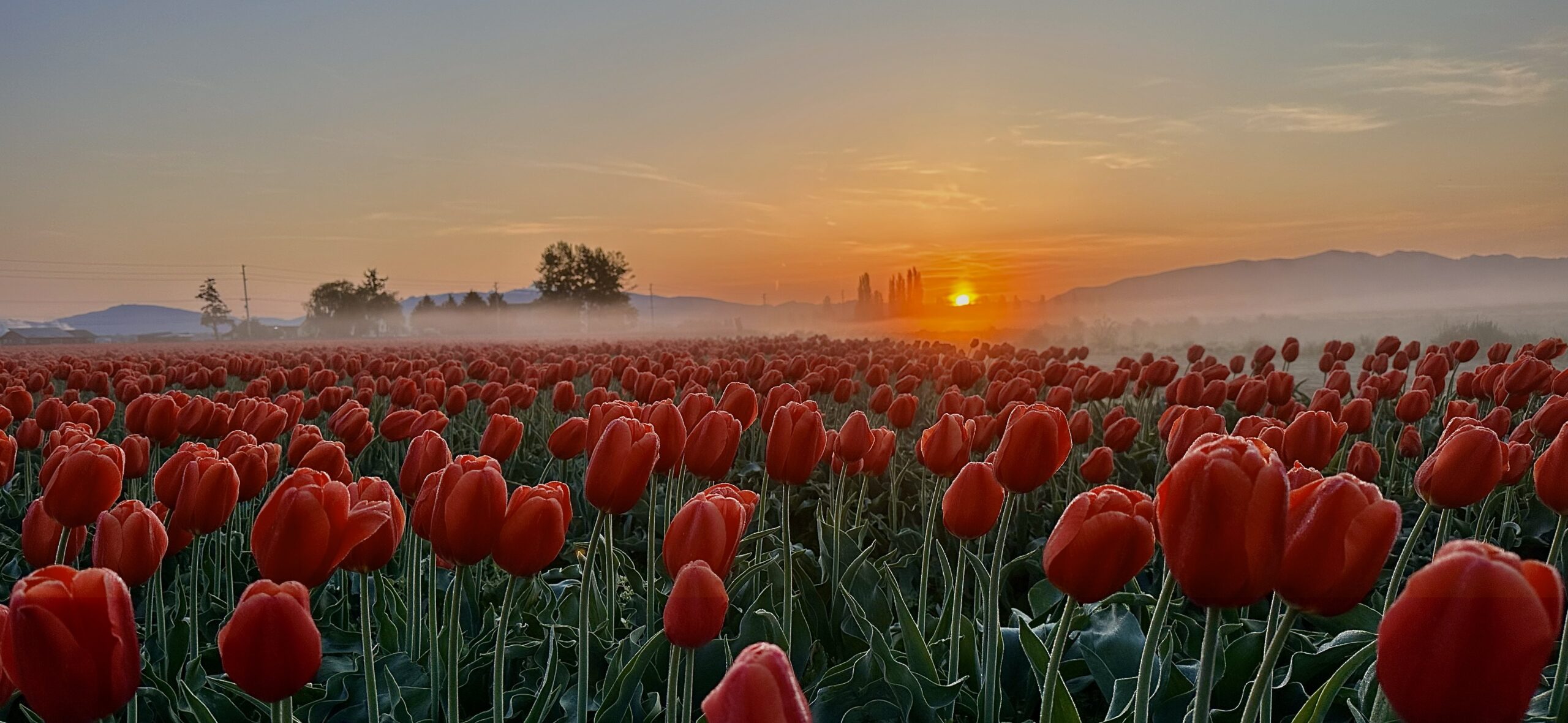
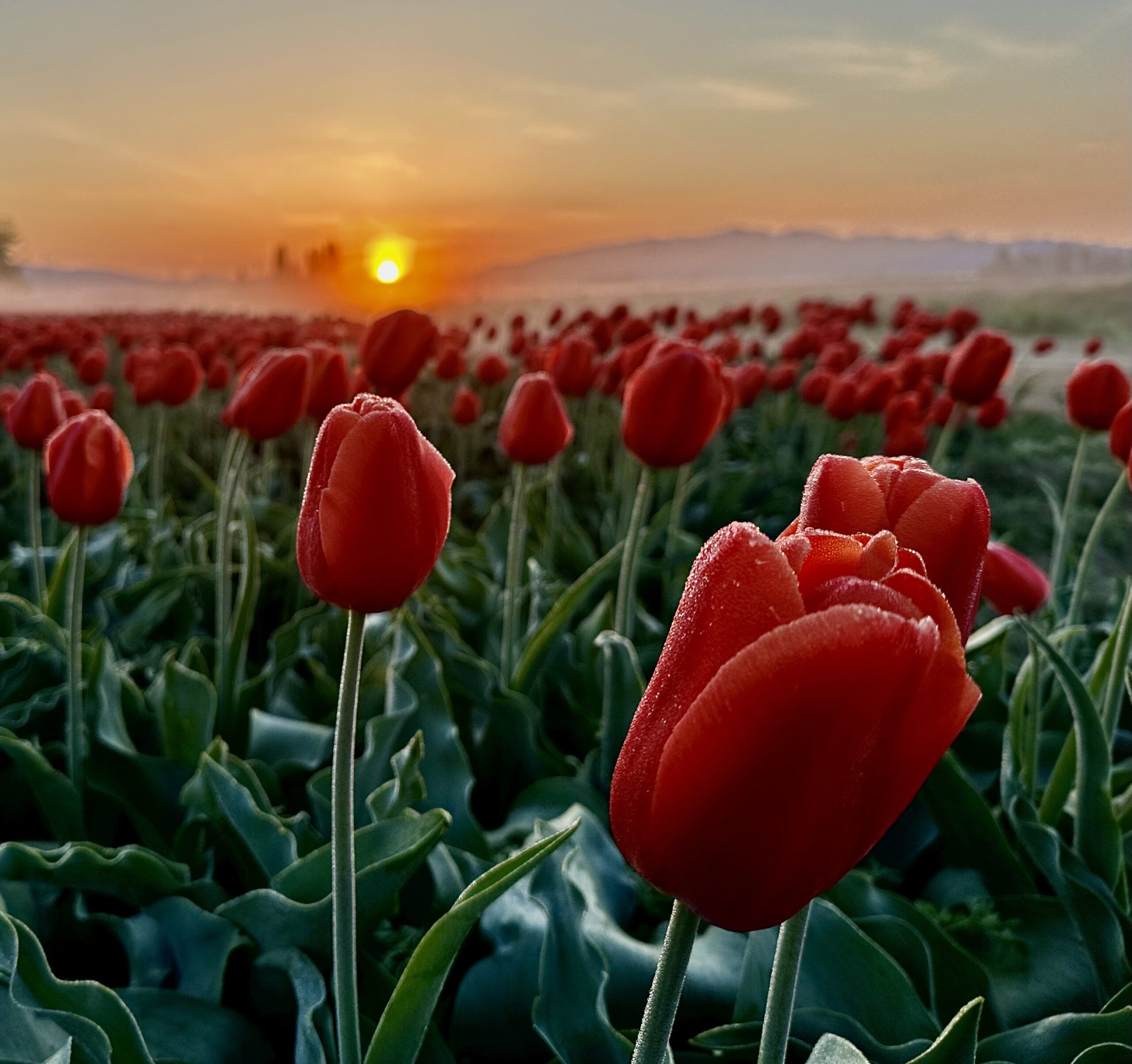
And finally, a couple of sunrise images from the tulip fields
Iphone #3
The image above is cropped to fit nicely on my phone as a background image.
Iphone #4
Got any favorites from this year’s roundup?
And what didn’t make the list?
Bald Eagles: I made 18 day-trips to photograph bald eagles….Sadly/oddly, I didn’t capture anything worthy of this list (the good news is that I have a pretty good portfolio of Bald Eagle images already, so the bar is pretty high)
Tufted Puffin: I went out on two day-trips (on a boat) to see tufted puffins. I saw those adorable birds for the first time, but no photos were worthy of showing. I am working on a plan…
Cannon Beach Sunset: As mentioned, I made a couple of trips to Cannon Beach in Oregon to capture an epic sunset scene — so far, no luck in getting the right mix of clouds, weather, and sun. The quest continues.
Pika: I photographed pika at two different locations but….meh. But I still need to really go through the images in greater detail. Perhaps one shot will make next year’s “Latecomer” list.
Mt. Rainier: The fall colors were a bit late, and when we visited, it poured incessantly, and there was no color to be seen. Complete wash.
Ok, that’s a wrap on 2025. Thanks for sharing in my adventures and “listening” patiently to my ramblings.