
31
2026Morning Calm
Shot of the Month – January 2026
Up long before dawn, I paddled slowly as my kayak cut across the blackened water. Caddo Lake was eerily quiet, and the air was crisp and still. The water’s surface became an ebony mirror. As I glided across the water, I scanned the scene drifting by — this was a landscape photographer’s paradise if you could sharpen your eye and cut through all the visual clutter.
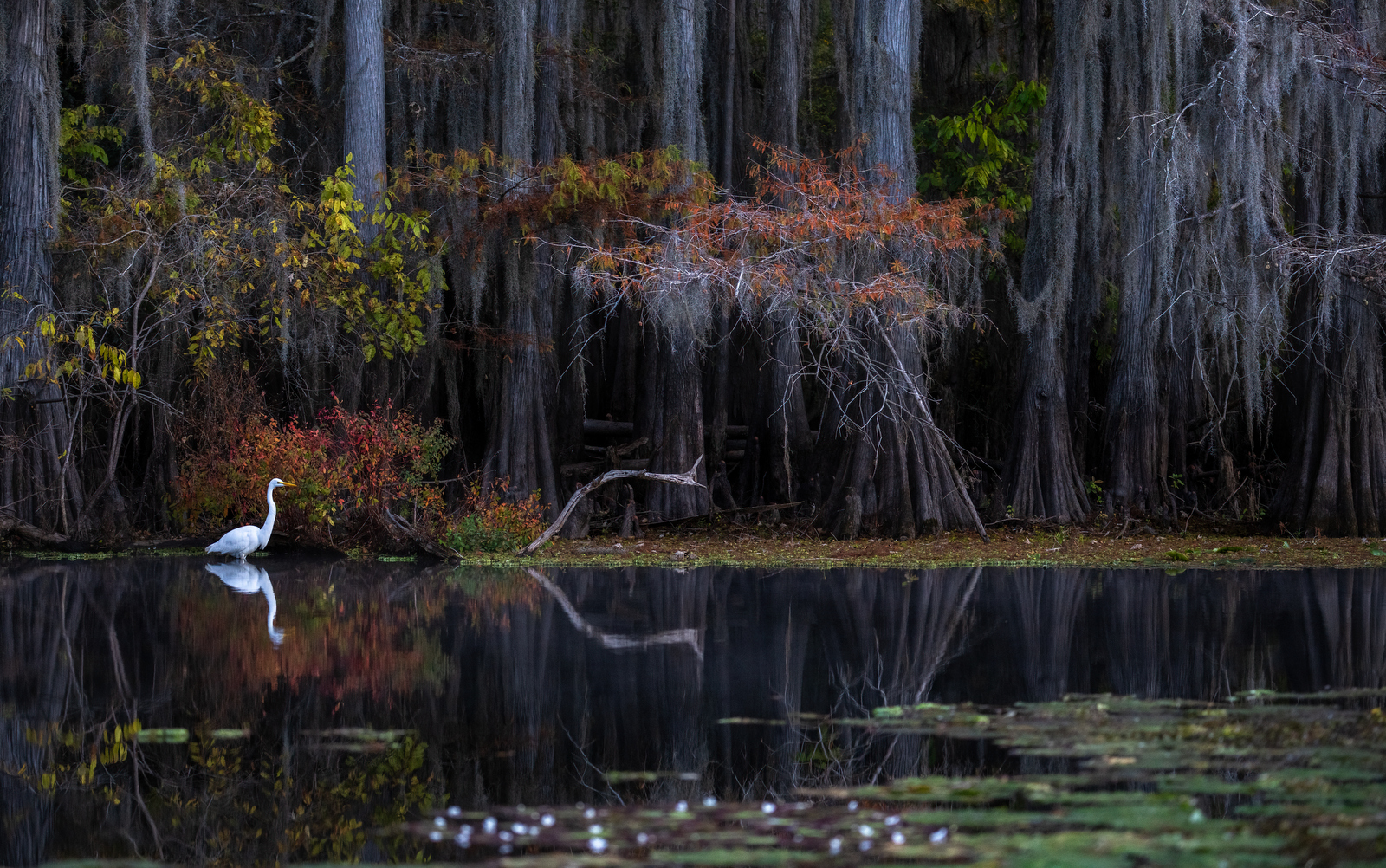
As I came around a corner, I found a Great Egret sitting along the shore waiting for the sun to breach the horizon to begin fishing for a meal. Yes!! I am first a wildlife photographer, so I always feel more comfortable photographing critters. I knew the key here was to compose an image that celebrated both the lovely egret and this magical setting.
For such a complex scene, I wanted to keep both the bird, the foreground, and the background in sharp focus – similar to a classic landscape image. However, shooting from a kayak made this task quite difficult. To have a deep depth of field I needed to use a small aperture. But smaller apertures allow less light to reach the camera so to properly expose the image I would have to leave the shutter open longer (slower shutter speed). On a tripod, this is no problem. But now I was in a kayak that was always moving, even if only a little. To overcome this challenge, I would start each sequence with “faster” shutter speeds, with a corresponding wider aperture (with less depth of field), and then quickly shift to slower and slower shutter speeds, allowing for smaller and smaller apertures (and greater depth of field) until I could no longer hand-hold the camera and get a sharp image. I also experimented with ISO levels – the higher the level, the more sensitive the image sensor, allowing for faster shutter speeds, but at the risk of adding more noise into the image.
As the egret sat near the shore, I paddled along the entire bank, looking for the best composition and lighting. Once spotted, I circled back and found my spot. Ooops, drifted too far. Paddle back. No, too far again. Now I am drifting in the other direction. Ok, quick, put the paddle down! Compose and fire off as many shots as possible while shifting aperture and shutter speeds. Ok, now we have drifted too far. Camera down and paddle back to the best shooting location. I repeated this over and over and over…it was exhausting.
Over time, the egret would fly a bit further down along the shoreline. The good news was that I now had a fresh composition to work with. The bad news was that I had to repeat the entire composition process again…oy vey.
I easily spent more than 45 minutes observing and photographing this egret until he moved into the lovely scene you see above. I had been starting to feel guilty about spending so much time doing “wildlife photography” when I was here to do landscape photography. But then it all came together.
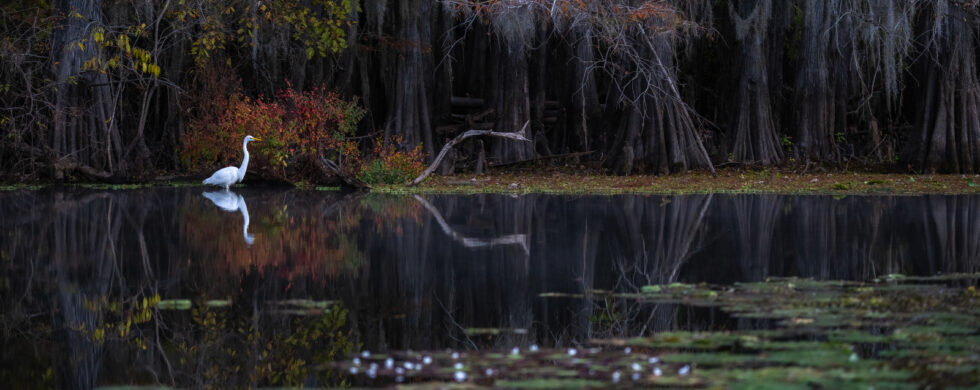
I love this composition. The white egret is perfectly highlighted as he stands in front of the colorful bush. We see the fall colors bursting in sharp contrast to the otherwise dark and somber mood of this pre-dawn scene. The colorless bald cypress trees in the background, draped in Spanish moss, add a mysterious gothic overlay and perfectly capture the unique feel and atmosphere of Caddo Lake. The somber water mirrors the shoreline and subtly conveys the tranquility of the scene. The lily pads in the front, right corner lead the eye into the frame and add visual balance to the composition.
In short, it is a nice picture. Feeling exhilarated, I paddled off deeper into the bayou in search of more traditional landscape scenes…
Caddo Lake? See last month’s post for the deets on this wondrous locale.
Until next month….michael
Nikon Z9, Nikon 100-400 f/4.5-5.6 (@105mm), f/5, 1/320 sec, ISO 1000


Sherry Lawson
Spectacular photograph!
jj
Beautiful
Craig Koppelman
I really like this one. It must have been tough to not make ripples everywhere you went and were ready to shoot.
Martine
Great