Knock Knock, Who’s There? – December 2011

Shot of the Month – December 2011

Woodpeckers are the avian jackhammers of the wild.  When at work, looking for food, or building a new home, their telltale sound is unmistakable.  Rat-a-tat-tat.  Rat-a-tat-tat.  Rat-a-tat-tat.  Rat-a-tat-ouch–that-makes-my-head-hurt-just-thinking-about-it.  Tat.

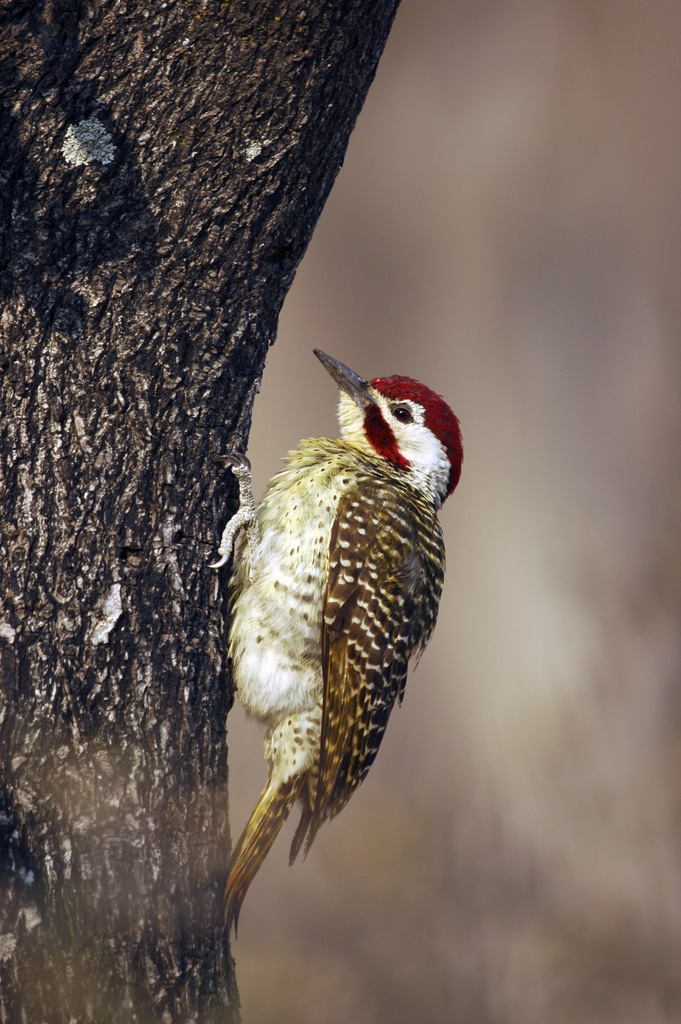
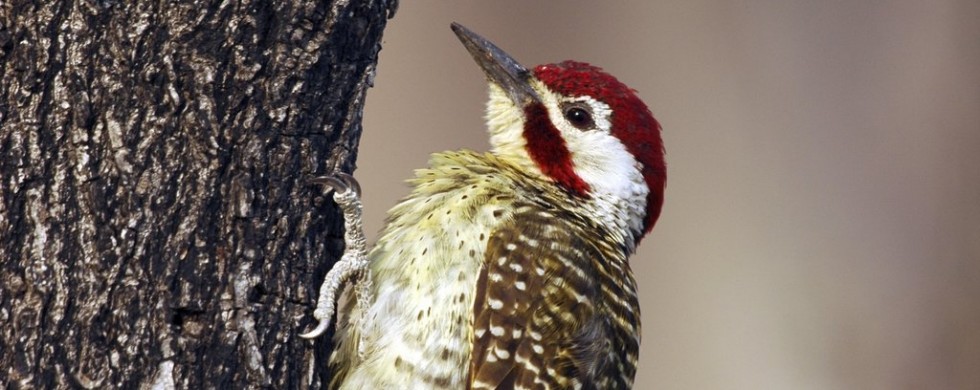
There are about 200 species of woodpeckers distributed around the world, though oddly, none are to be found in Australia.  I photographed this Golden-tailed woodpecker in Botswana.  This African species can be found across much of Southern Africa and in some isolated pockets of East Africa.

On a given day a woodpecker may strike a tree with his beak 8,000 to 12,000 times (up to 20 times/second).  With each blow, the woodpecker experiences 1200 g of force.  Is that a lot?  For reference, humans pass out at 4 to 6 g’s of force.  We get a concussion with a deceleration of about 100 g.  (Geek Note:  One g is the acceleration due to gravity at the Earth’s surface and is the standard gravity (symbol: gn), defined as 9.80665 meters per second squared, or equivalently 9.80665 newtons of force per kilogram of mass. Yawn)

How exactly do woodpeckers move around so easily in the trees and do what they do without knocking themselves out?  Seems that woodpeckers have developed some nifty adaptations:

Avoiding Brain Damage (always a good idea)

  1. Thick Skull:  Woodpeckers have a thick skull with spongy cartilage at the base of their beak.  This spongy base absorbs much of the force.
  2. Strong Muscles:  Woodpeckers have developed very strong muscles that attach the upper and lower jaws to the skull.  By contracting these muscles a millisecond before contact the woodpecker diverts some of the impact to the base and rear of the skull.
  3. Accurate Strike:  The woodpecker does a very good job of whacking (yes, that is the technical term for it) his target at a very precise ninety degrees.  This perpendicular strike reduces torque which could cause a concussion.
  4. Small Brain:  Woodpeckers have relatively small brains for birds of their size.  The small ratio of brain weight to brain surface area allows for the impact to be spread over a large area, reducing the risk of damage.

Hmmn, thick-skulled and small-brained…make your own joke here ____________

Other nifty adaptations:

  1. Safety goggles:  Just before contact a nictitating membrane (a transparent third eyelid) closes, protecting the eye of the woodpecker from flying wood chips.  This membrane also acts like a seatbelt holding the eye in place – given the tremendous deceleration of the head the bird’s eye could literally pop out without this extra support.
  2. Kick Stand:  Woodpeckers have a stiffened tail that is useful for climbing and foraging.  They can use the tail as a prop.
  3. Knarly feet:  Woodpeckers have zygodactyl feet, allowing them to walk up a tree easily.  If you look closely at the image you can see these feet in action.  Zygodactyl feet have 2 toes that point straight forward and 2 that point backward.

The wondrous woodpecker.  Probably not the bird to call if you need help with your homework, but definitely look him up if you want help remodeling the kitchen.

Until next month… 🙂
Zen Jackal – November 2011

Shot of the Month – November 2011

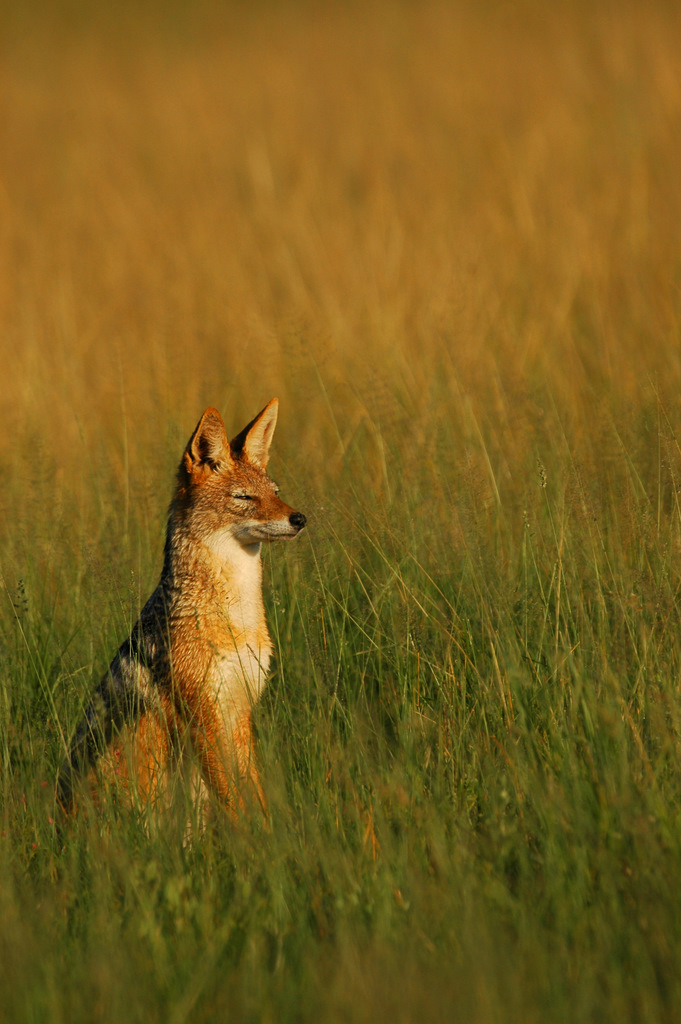
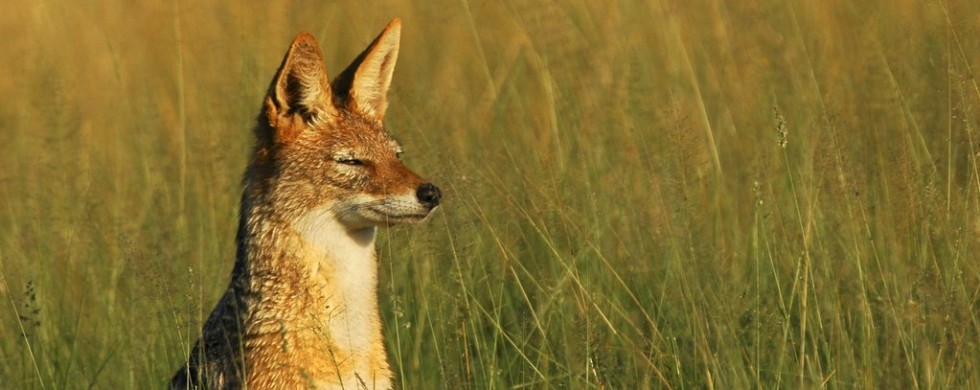
This month we visit with one groovy, chillin canine – a Black-backed Jackal (BBJ) sitting in the sun in the Kalahari Desert in Botswana.  Look closely at his face.  His serenity appears sublime.

I have seen many black-backed jackals and such moments are rare.  More typically I have seen them, usually two, as they tend to form life-long partnerships, scampering along with great purpose.  No time to spare.  Looking for the next meal.  Perhaps hurrying home to feed the pups.  Other times scampering to avoid danger from a leopard or other predator.  Occasionally a restive jackal, but more often than not — scampering.

BBJs are cunning and exceptionally quick.  They can dash in and steal a morsel of food before a dining lion has noticed what happened.  Ok, that is quick, but these guys are QUICK.  Our guide Simon told us about the time he was asked to help sedate a few jackals with a dart so a local scientist could take some measurements.  For this exercise, they had to use blow guns to deliver the darts as a rifle would generate too much force on a canine that only weighs about 20 pounds.

Simon loaded the long tube, found his target, and fired.  Pfffft.  And the dart was off – faster than anything you or I could see.  The jackal, hearing the sound, looked over and at the last instant, scooted his butt out of the way and seemed to watch the dart as it flew by.  Ok, lucky move.  Reload.

Pffft.

Again, at the last moment, the jackal stepped aside like a matador as the raging bull dart missed its mark.  (Is he the “One?”)

They never managed to dart a single jackal.

Life on the plains is rarely restive, nor predictable.  Dozens of times over the years I have seen lions feeding at a kill – many of those times BBJs watched from a few feet away, waiting their turn at the scraps.  The lions never seemed to notice, let alone care, except one time in Tanzania several years ago.  We watched as the lions finished off a carcass and then sauntered off for a nap.  A BBJ finally moved in for a snack.  To my amazement, one of the lions got up and began to stalk the jackal.  The jackal was unaware.  The lion launched his attack, but the jackal, using the above-aforementioned quickness, managed to escape.  But boy, was that one annoyed jackal.  He barked up a storm in the direction of that lion as if some unwritten code had been violated.

Stalking lions.  Dart-zinging humans.  It’s a jungle out there.  When scampering along in your own jungle, remember to seek out Zen moments like the one captured here where you can.

Let’s try.  Oooommmm.  Oooommmm.  That’s right, stop and relax.  Light a candle.  Sit lotus style (if your joints will allow it).  Deep breath.  Clear your mind.  Innnnnhaaaaale.  Exhaaaaaaale.

If you get it right, the only sound you might hear is that of your soul catching its breath.  (I’ll keep my eye on the lion for you…)


Until next month…

Hartebeest – October 2011

Shot of the Month – October 2011.

Is it just me or when you read the name of this antelope does it make you think of a bumper sticker that might look something like:

Yeah, ok.  Probably just me.

(For those of you playing at home, the “beast” in my bumper sticker is Dr. Henry Philip “Hank” McCoy, the Beast from the X-men comics.)

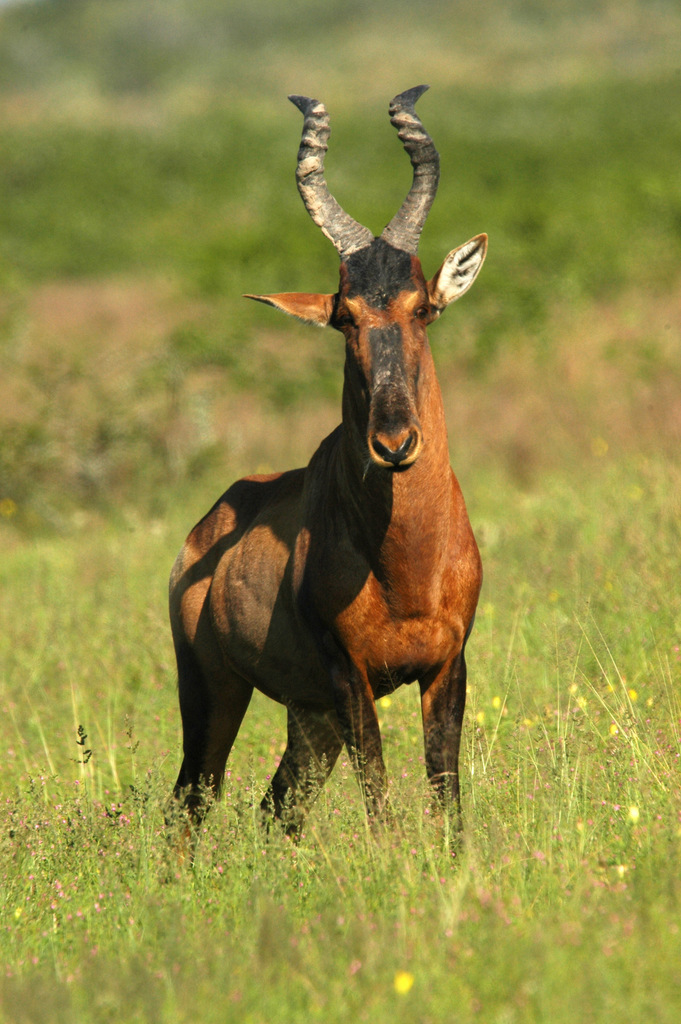
I grant you that the hartebeest is a bit odd looking but the reviews out there are tough.  One site said that hartebeests are “ungainly antelopes, readily identified by the combination of large shoulders, a sloping back, a glossy red-brown coat and smallish horns in both sexes.”  Another commenter said that the hartebeest, “ …at first glance seems strangely put together and less elegant than other antelopes.”  Yes, all true, but not something we really say in polite company.

The taxonomy of this grass eater is complicated as it seems to be for many animals.  There are about 6 sub-species and 2 separate species of hartebeest spread out in generally isolated pockets across Africa.

Roll call:

Subspecies: (this might be a good time to break out your atlas)

  1. Bubal Hartebeest:  They used to live in Algeria, Egypt, Libya, Morocco and Tunisia.  Yes, used to.  We killed the last one around 1923. (Extinct)
  2. Coke’s Hartebeest:  Found in Kenya and Tanzania
  3. Lelwel Hartebeest:  Found in Central African Republic, Chad, Democratic Republic of Congo, Ethiopia, Kenya, Tanzania, Uganda (Endangered)
  4. Western Hartebeest:  Found in limited numbers in West Africa (Benin, Burkina Faso, Cameroon, Central African Republic, Chad, Cote d’Ivoire, Ghana, Guinea, Guinea-Bissau, Mali, Niger, Nigeria, Senegal, and Togo.
  5. Swayne’s Hartebeest:  Ethiopia (Endangered); Somalia (Extirpated)
  6. Tora Hartebeest: Found in Eritrea and Ethiopia (Critically Endangered); Sudan (Extirpated)

Separate Species:

  1. Red Hartebeest:  Found in Namibia, Botswana, South Africa
  2. Lichtenstein’s Hartebeest:  Found in Malawi, Mozambique, Tanzania, Zambia, Zimbabwe

I photographed this Red Hartebeest in the Makgadikgadi Pans National Park in Botswana.

So what is the difference between a species and sub-species?  Animals from different subspecies (of the same species) are capable of inbreeding and producing fertile offspring.  They usually don’t interbreed due to geographic isolation.  For example, Coke’s Hartebeest, the most prevalent version found in Kenya and Tanzania, could breed with Swayne’s Hartebeest, found only in Ethiopia, but they don’t as their territories do not overlap and these antelope do not move around much.

I think the hartebeests have developed a bit of chip on their shoulder about what us humans have been saying about them.  Time for a little payback from a Red Hartebeest.  (Note:  A male hartebeest can weigh up to 350 pounds).

Follow this link

http://www.youtube.com/watch?v=S2oymHHyV1M

or watch here:

Ouch.  How is that for elegance?  Now that’s one badass even-toed ungulate.


Until next month…. J

Identity Crisis – September 2011

Shot of the Month – September 2011

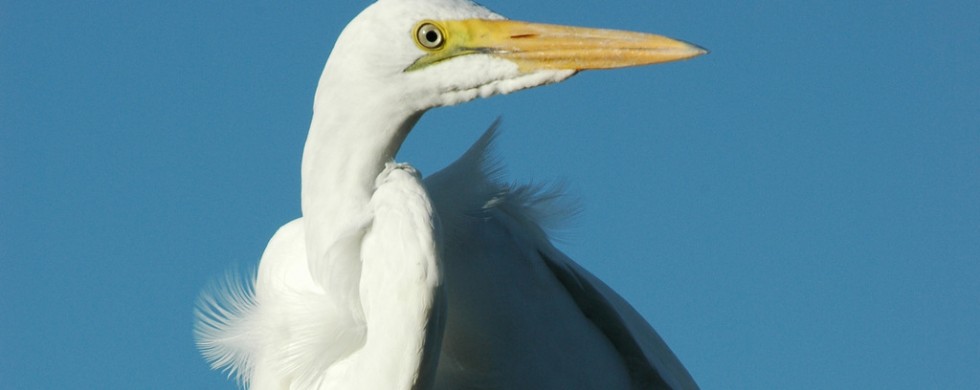
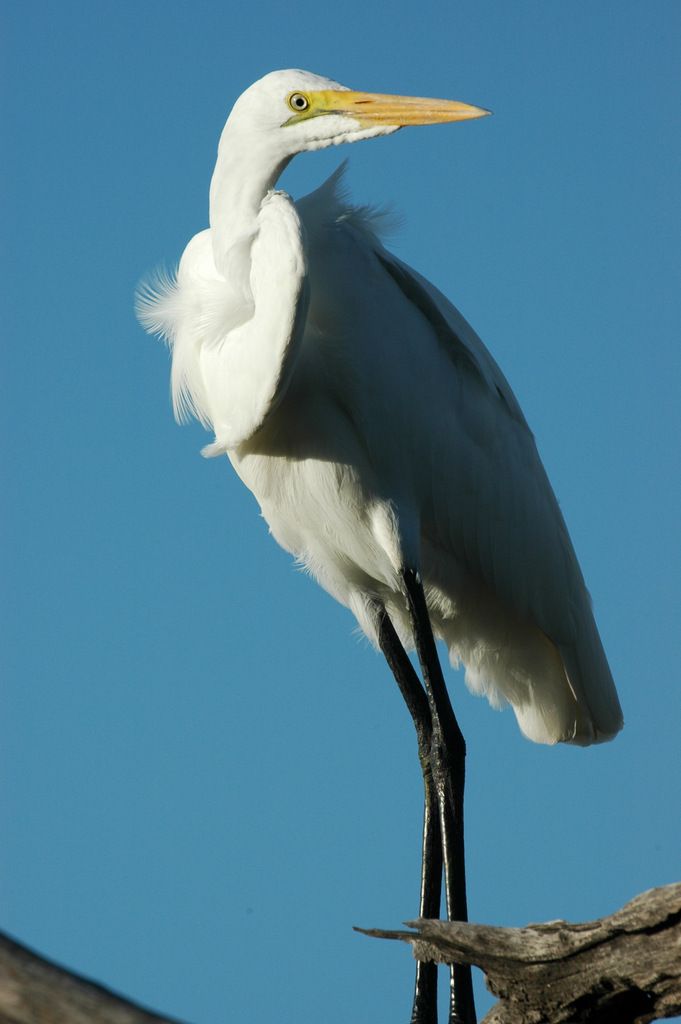
I never could really keep it straight in my head what the difference was between a stork, heron, egret, and, well, between just about any other tall and lanky feathered thing.  I have just done a bunch of reading on the subject and I would like to say that it is now all perfectly clear.  It isn’t.  I have learned however that the whole naming-of-animals thing is a rather messy affair.  Here is what I know.

There are 64 species of birds that are considered herons.  We call some herons, others egrets, and the rest bitterns.  But they are all herons.

I photographed this elegant heron in Botswana.  Given that it is predominantly white we call it an egret, even though there is no real biological distinction between a heron and an egret.  But if a heron is white, or has some decorative plume feathers, we usually call it an egret.  For the record, this is the Great Egret, aka, Great White Egret.  There are four sub-species of Great Egret spread across the globe with one in Europe, one in the Americas, another in Africa, and the fourth found in India, Southeast Asia, and Oceania.

And what about bitterns?  “ Webster says that they are “any of various small or medium-sized usually secretive herons.”  LOL.  Well, that sounds pretty scientific.  Probably more useful for identification, bitterns tend to have shorter necks than most “typical” herons.

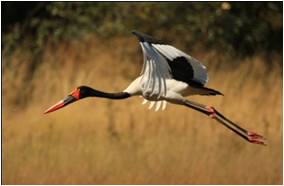
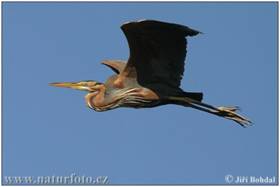
Another useful tidbit.  Herons fly with their necks retracted as opposed to storks, ibises, and spoonbills which fly with fully elongated necks

Stork (source)                                                                                                   Heron (source)


And remember, when all else fails, “Look at that pretty bird” works just fine.

Until next month… 🙂

Historical Footnote? – August 2011

Shot of the Month – August 2011

No introduction is required for this fellow.

The tiger is one of the most widely recognized animals in the world.  Humans have been mesmerized by this apex predator for thousands of years.  You could spend a lifetime cataloging all the historical, mythological, religious, literary, and cultural references to the tiger.

The tiger is one of 12 Chinese zodiac animals.  It is an earth symbol. Tigers are the national symbol for at least 6 countries and are found on many national flags.  Tigers are an important symbol in Buddhism.  Tigers play every sport you can imagine: the Detroit Tigers (baseball), the Balmain Tigers (Australian Rugby), the Sunipret Ice Tigers (German Hockey), the UANL Tigers (Mexcan soccer), and well, there are hundreds more.  Elvis thought they played a bit rough and the “Eye of the Tiger” gave Survivor a #1 song in 1982.  A tiger was an important character in The Jungle Book, was a buddy of Pooh, and a tiger was found on a lifeboat in the Life of Pi.  Calvin’s best friend was a tiger and a tiger named Tony helped sell a lot of cereal.  From cultural god to Wall Street hawker, the tiger has been voted, at least in one poll that included 73 countries, as the world’s favorite animal.  Yes, even more popular than Lassie and her canine brethren.

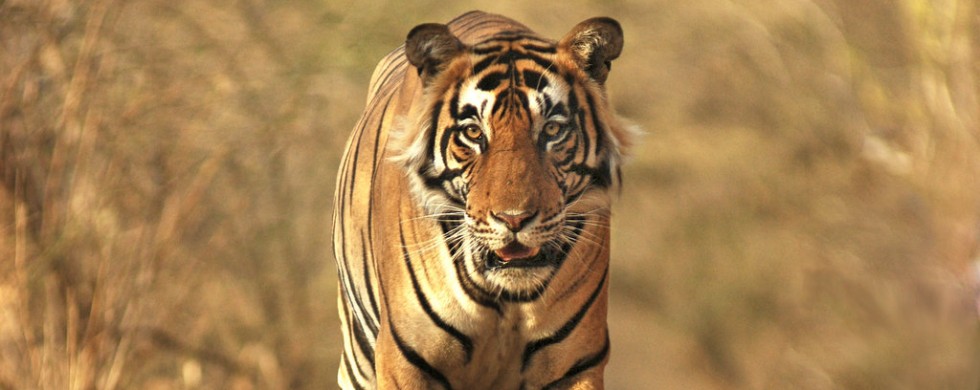
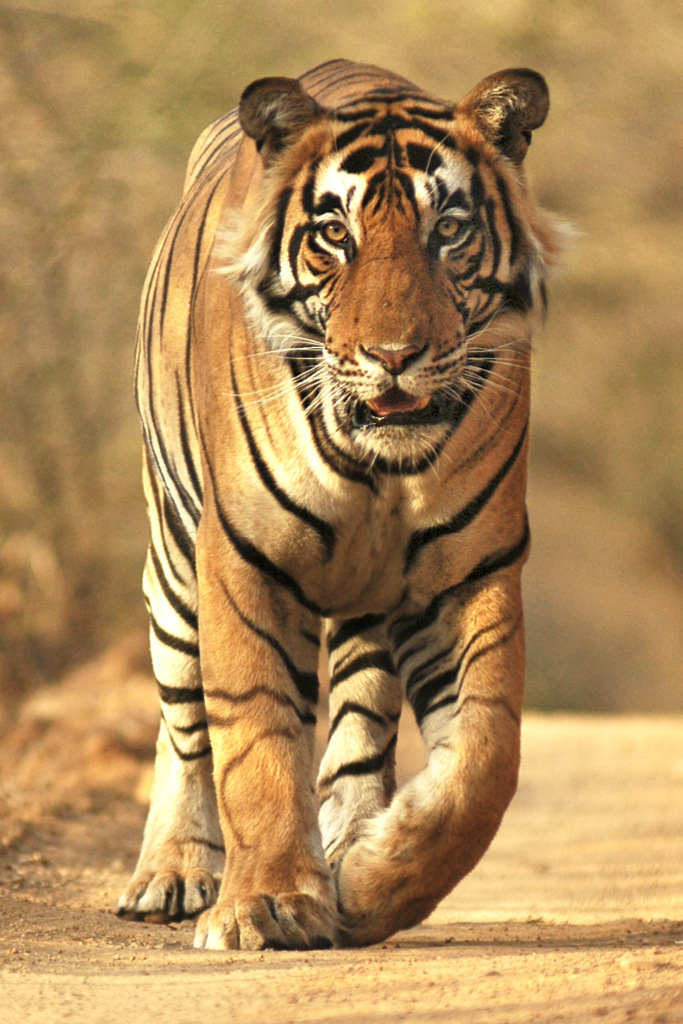
Normally from here, I would attempt to beguile you with a host of fascinating facts and tidbits about the tiger’s amazing physical traits or abilities.  Or regale you with the challenges and risks of getting this photo of a Bengal Tiger in Ranthambore National Park in India –there were a few.

But none of that matters.  What matters is that you understand how completely and utterly we have destroyed a species that we seemingly love and admire so much.  Take a marker and color in most of Asia on a map – a huge swath of the land mass of our planet.  That is where tigers used to live.  Now tape that map on the wall and throw 6 or 7 darts at that colored area.  That will give you a sense of the space where tigers now have to live.

In 1900 there were 100,000 tigers in the wild.  There are now around 3,000.

In just more than a lifetime 97% of tigers have been wiped off the planet.  The Bali tiger went extinct in the 1940s.  The central Asia tiger vanished in the 1970s.  We killed the last tiger in Java in the 1980s.  The South China Tiger was killed off in the 1990s (a few still exist in zoos).  The six remaining subspecies are struggling to survive.

We are destroying the forest they need to live in.  We hunt and kill them to make aphrodisiacs.  We kill them to make coats.

Wow, imagine how we would treat the tiger if it wasn’t our “favorite” animal!

People are finally starting to notice.  Leaders from the 13 countries where tigers still exist attended the Global Tiger Summit in St. Petersburg, Russia in late 2010 to launch a campaign to try and double the population of tigers by 2022.  India has been working for quite a few years to try and protect its tigers from poaching and has been increasing the areas that are protected for tigers.  The World Wildlife Fund (WWF) has been working tirelessly to raise awareness.

Unless we take action soon, tigers will become our favorite memory.

Want to do something to help?  Click here for ideas from WWF on actions you can take.