Looner Flight – No Small Feat

Shot of the Month – September 2014

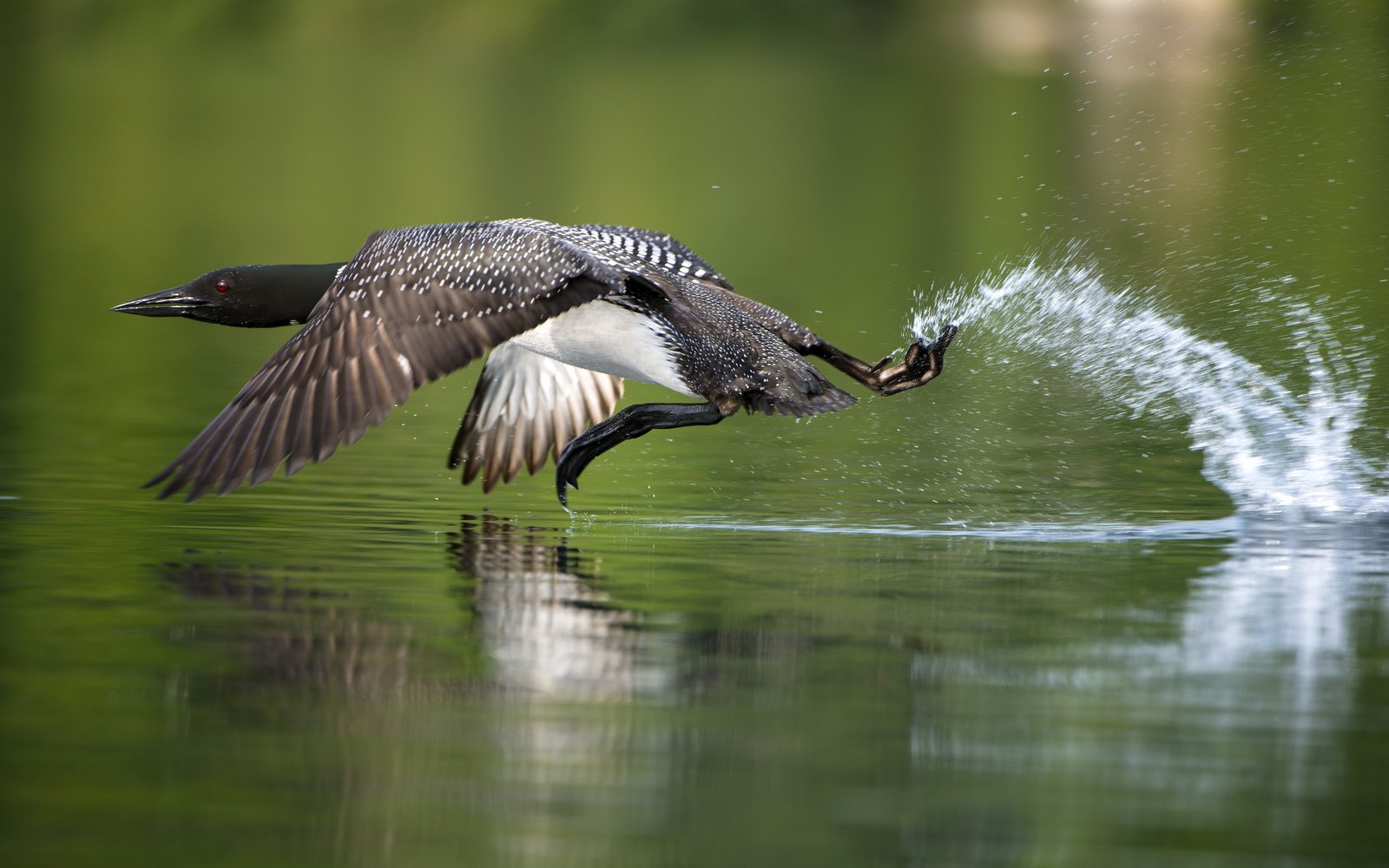
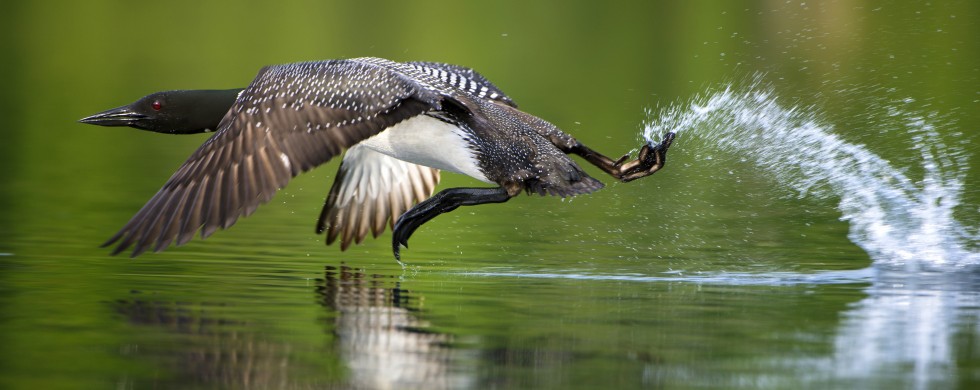
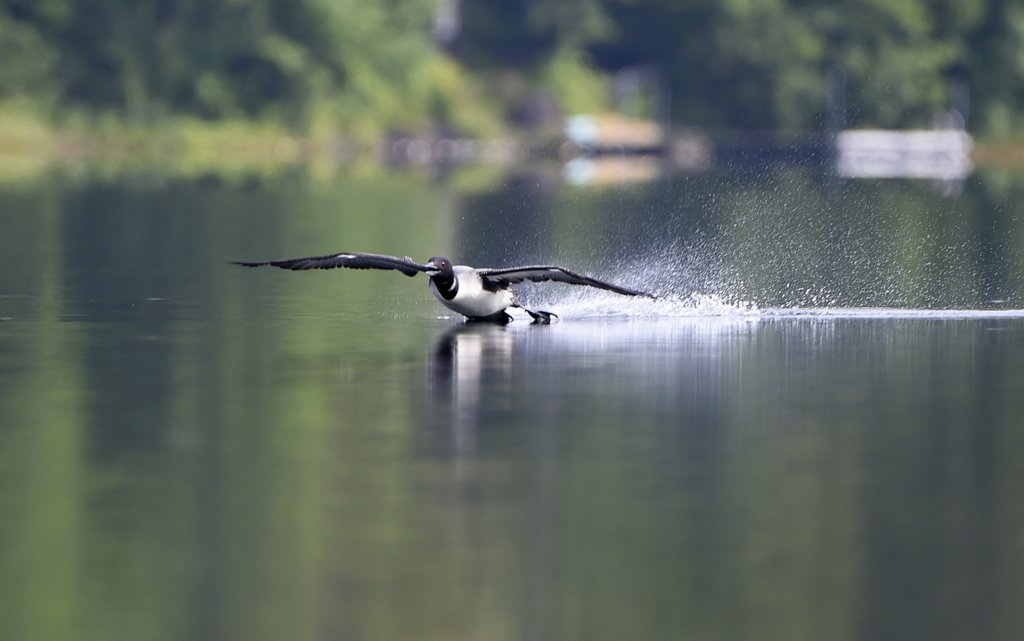
Common Loon, Vermont-USA (9398)

The Common Loon is the epitome of style and grace — most of the time.  Loons spend most of their time on water and their bodies are exquisitely designed to make them powerful and effective swimmers and divers.  Most birds have hollow bones while loon bones are solid.  This extra weight enables loons to dive to depths of 250 feet in search of fish – the mainstay of their diet.  They have large, powerful feet that propel the bird through the water like a torpedo. The bird’s feet are located unusually far back on the body which enable powerful underwater thrusts (imagine the avian version of Michael Phelps and his size 14 feet ).  In the air loons are regal athletes that can fly hundreds of miles and reach speeds of more than 70 mph.

Now for some of those less stylish moments in loon life.

Loons have a very difficult time walking on land given the placement of their feet on their bodies.  In fact, the name, “loon” most likely comes from either the Old English word lumme, meaning lummox or awkward person, or from the Scandinavian word lum, meaning lame or clumsy.  Both of these names refer specifically to how loons look when hoofing it on land.  To avoid such embarrassment loons rarely venture on terra firma except to nest and even then their nests are usually found only a few feet from the water’s edge to make for a short commute.

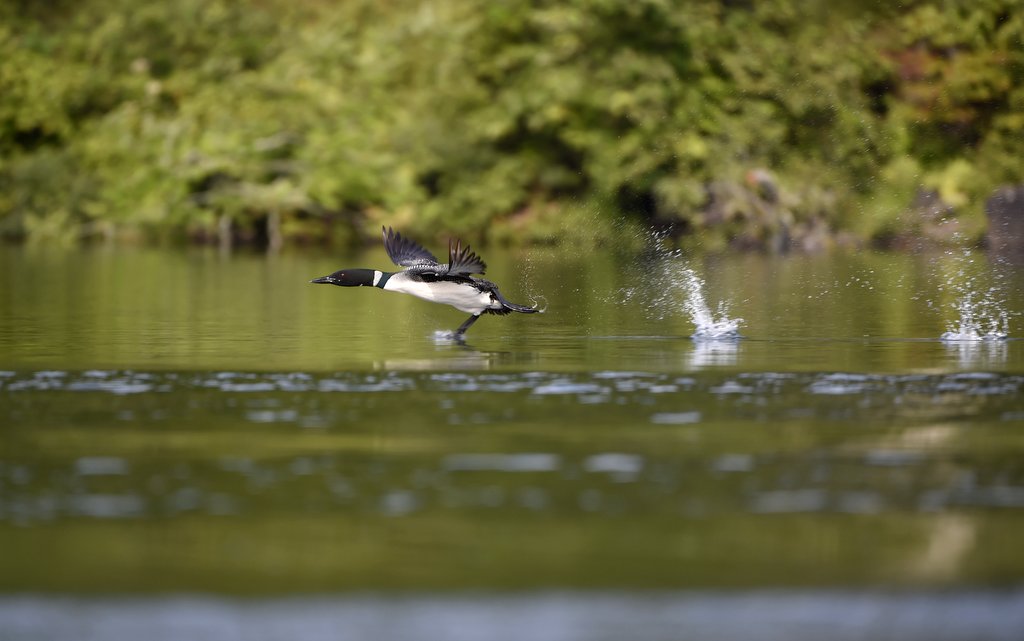
And while loons are powerful flyers they have a bit of a struggle in the transition up and down.  Loons are unable to take off from land and on the water they need a long distance as they run across the surface building up momentum.  Loons need anywhere from 30 yards to a quarter-mile of running and flapping before liftoff.  In my photo above you can see those large feet in full force as he runs for the sky.  The need for such space for takeoff means that you will never find a loon in a very small pond or lake as they do not provide enough of a runway for Loony Airlines.

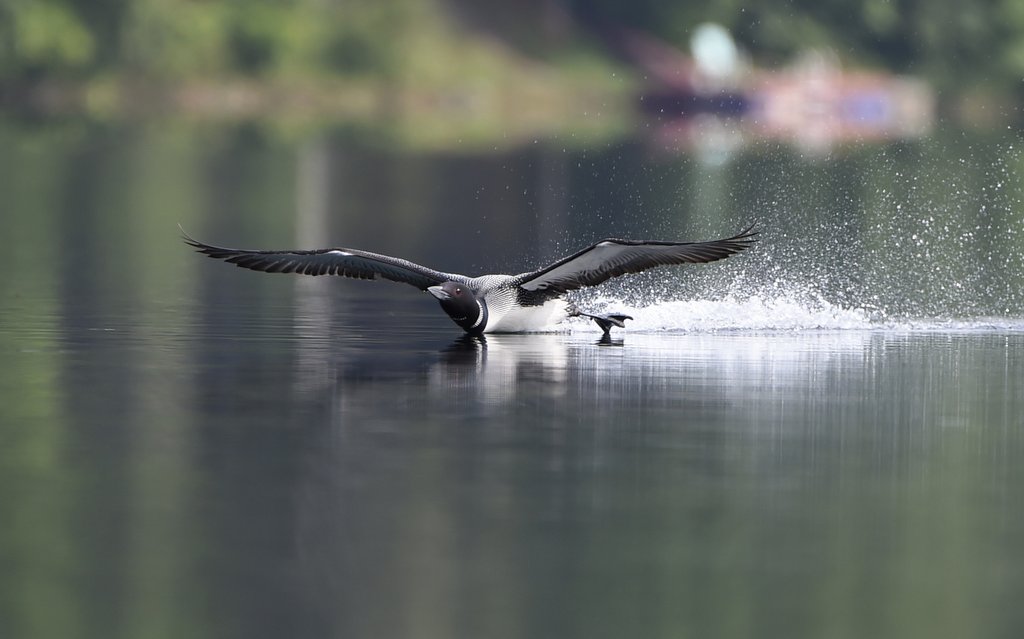
And then there is the landing.  Oh boy.  Again, as the feet are so far backward loons are unable to land feet first like your typical bird.  When they land on water they fly in head first and skim along on their bellies until they slow down.  It is a sight to behold.

Incoming…….                                                                                                                                                                     ……Outgoing
Loon Landing (9648)  Loon Landing (9656)  Loon Take Off (9455)

In their formal black and white dress and powerful moves, the common loon has a James Bond mystique.  I have to admit a certain schadenfreude in knowing that these superstars also have their Mr. Bean moments like the rest of us.

Until next month…


Exposure:

Nikon D4S, Nikon 200-400mm f/4 (@400mm), f/4.8, 1/1000 s, -0.5 EV, ISO 400


The Warbler Wave

Shot of the Month – August 2014

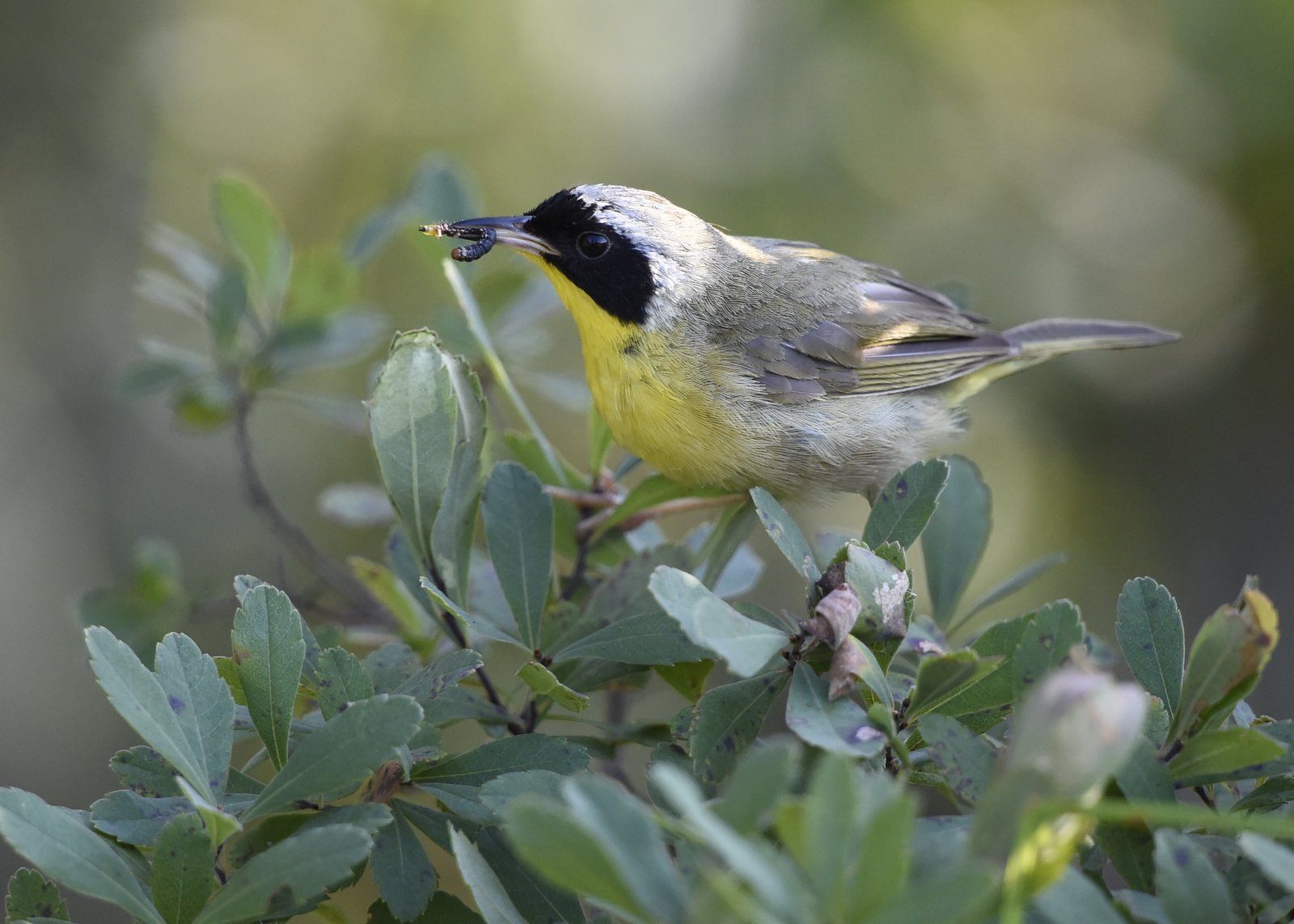
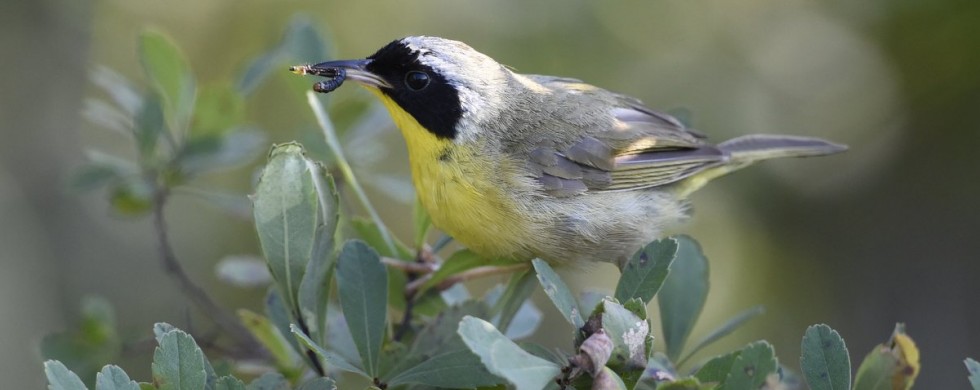
Common Yellowthroat, Baxter State Park-USA (3004)

If bird watching was like surfing, then in mid-to-late August wise birder dudes and dudettes would start paddling hard to catch the rising crest of the next big wave that is coming.  (Click here for the appropriate soundtrack for this posting)

Birding?  Surfing?  Huh?  Let me elaborate on my strained analogy.

In late summer (if you are living in Vermont like me) or early fall if you are living further south, the fall migration of warblers is taking off (so to speak).

What’s a warbler?  Well my dear non-ornithologically minded friend, warblers are a group of tiny (smaller than a sparrow), winged jewels of the bird world.  In the New World we have about 113 species of warblers; of these 56 species can be found in the United States and Canada.  Many of these fellows have striking colors and patterns.  The visual treat is often fleeting as these guys are insectivores –  they are always on the go darting from tree to tree, from leaf to limb, in search of the next bug to munch on. Trying to photograph these minute, energetic fellows is a recipe for hysteria as they flit hither and thither.  By the time you snap the shutter they are gone (I have lots of shots of empty branches if you would like to buy one or ten).  At best you tend to catch a glimpse of a wing, or a tail, or other assorted bird bits….

Back to the wave.  The warbler diet requires that they stay on the move.  There are no insects to feed on in areas that experience winter so warblers spend the cold months in Central or South America (the other 60 or so species of warblers live there year-round).  This constant movement results in two glorious waves of warblers each year in the US — first there is the spring migration as the birds move north to their breeding sites; and then again in the fall as the birds head south before the chill sets in.  The spring migration is a source of rapture for birders who have been suffering through long, mostly avian-free winter landscapes.  The fall migration is also fun as it is like a lottery as you never quite know what migrant might stop by from one day to the next.  This wave is bittersweet however as it is also a signal of the exodus of wildlife from the area for months to come.

Already by mid-August, we started to see the trees in our backyard come alive with shaking branches and flashes of color as warblers began to arrive.  A bird may stick around a day or two but then they continue on their way.  This wave will hit its peak in September and then the action will quickly fade away into October.

In the above photo, we have a Common Yellowthroat (CYT), the masked bandito of the warbler world.  The CYT was one of the first warblers cataloged when a specimen in Maryland was recorded in 1766.  I photographed this fellow in Baxter State Park in Maine.  I made dozens and dozens of attempts to capture this guy before he finally sat in one spot long enough to get this image.  While still numerous, the CYT population has been dropping by 1% per year since 1966 – so the population has declined 33% during this relatively short timeline (source).  This trend is sadly, generally true for many songbirds across the US.

Here is a nice video of a CYT and a chance to hear his song:


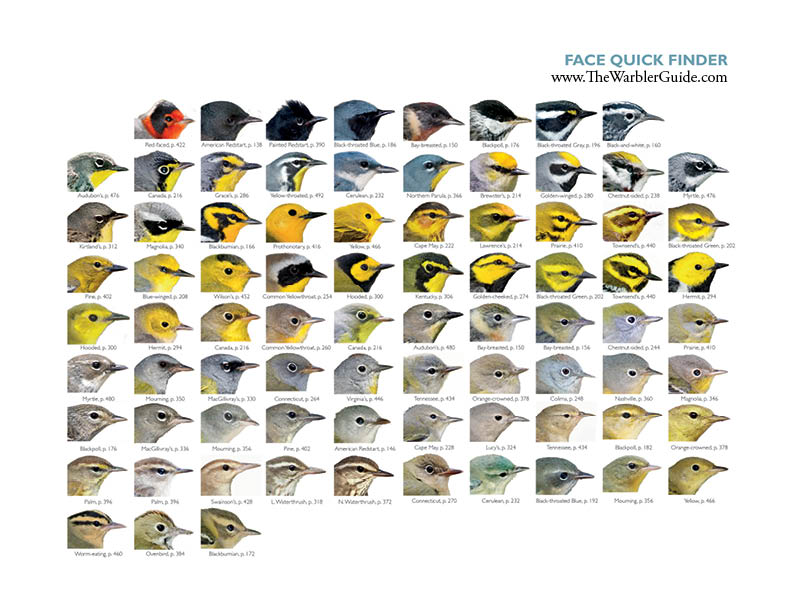
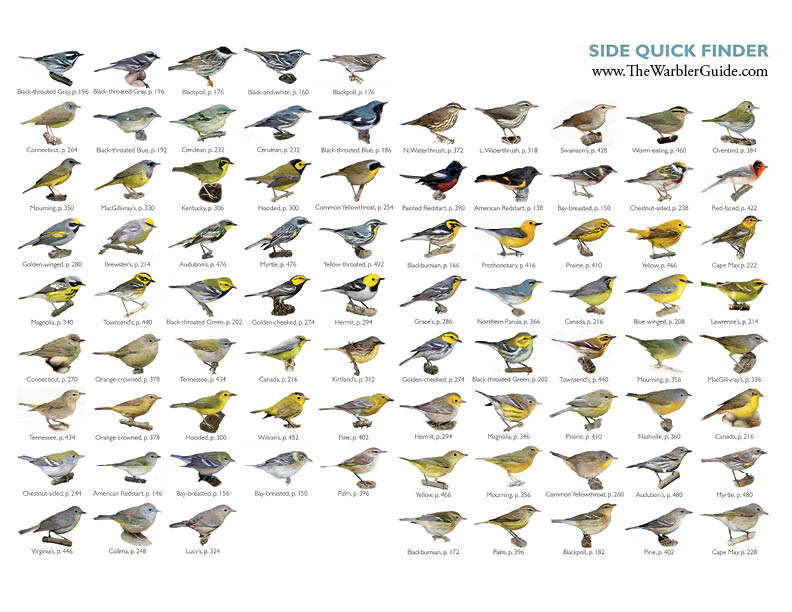
Below is a quick guide on the breadth of warblers you might see.  If you are really interested in learning more check out The Warbler Guide.  It is an insanely detailed book on warblers and probably the definitive guide on identifying which bird is which.

Face Quick Finder

Side Quick Finder


Surfs Up!  The crest is peaking as I write this.  Grab your board, uh binoculars, and get out there and ride this colorful wave while you can.


Nikon D4S Nikon 600mm f/4; 1.4x TC (850 mm), f/5.6, 1/1000 s, ISO 2800

Fleeting Magic

Shot of the Month – July 2014

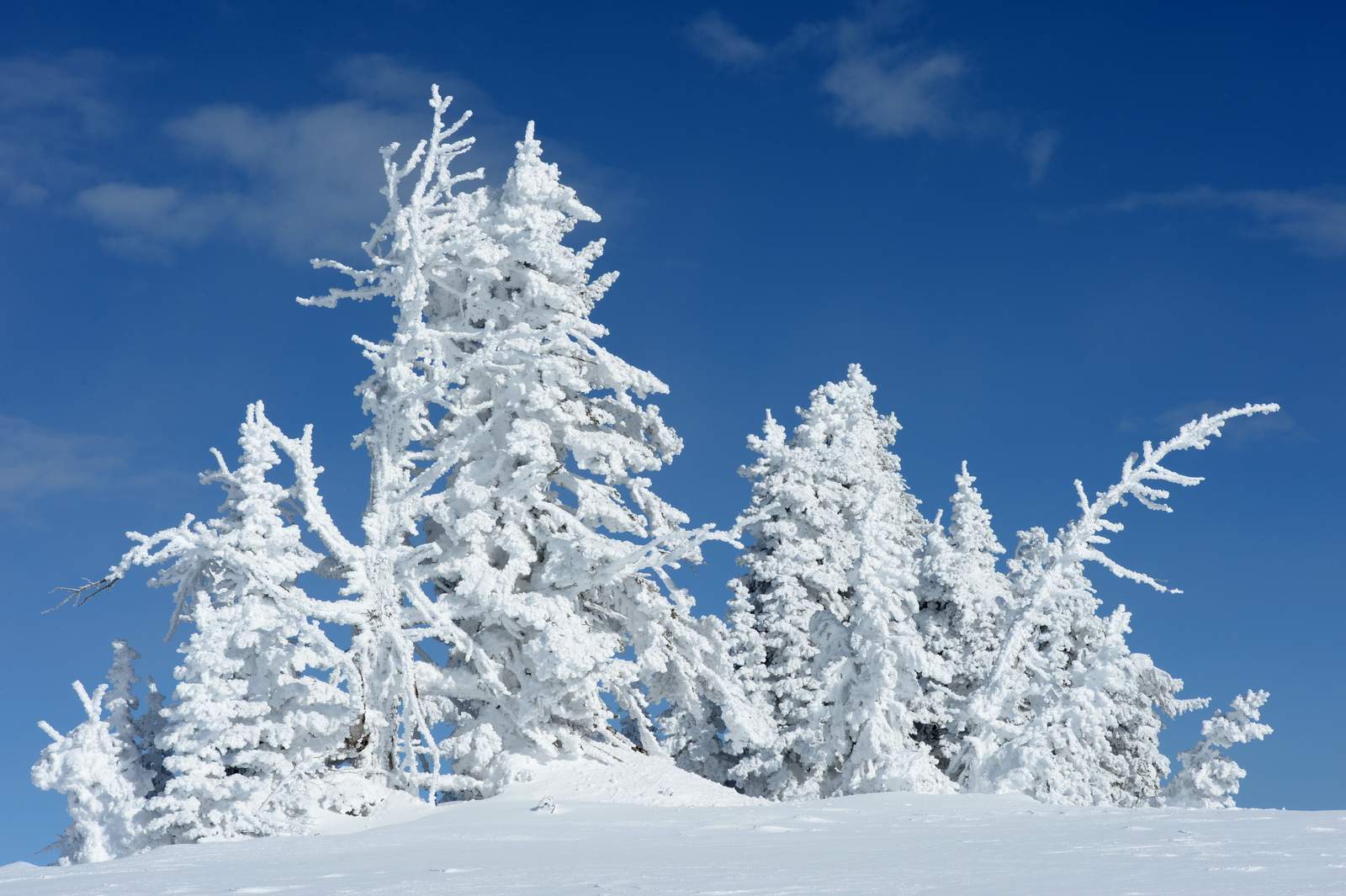
Snow Sculpture, Targee National Forest-USA (2598)

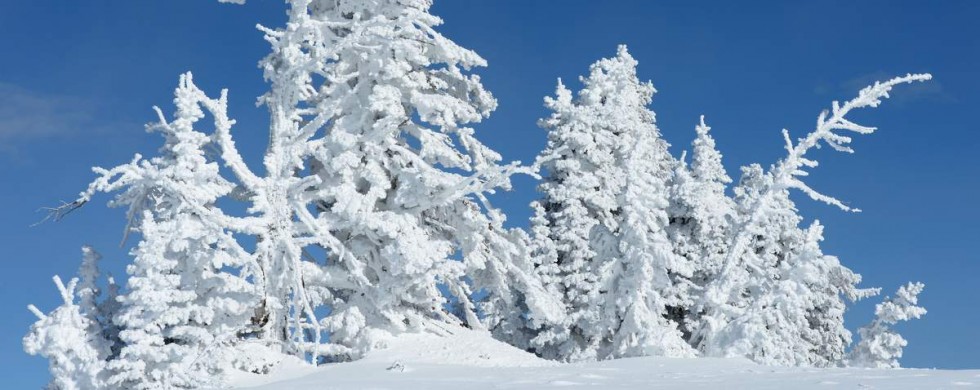
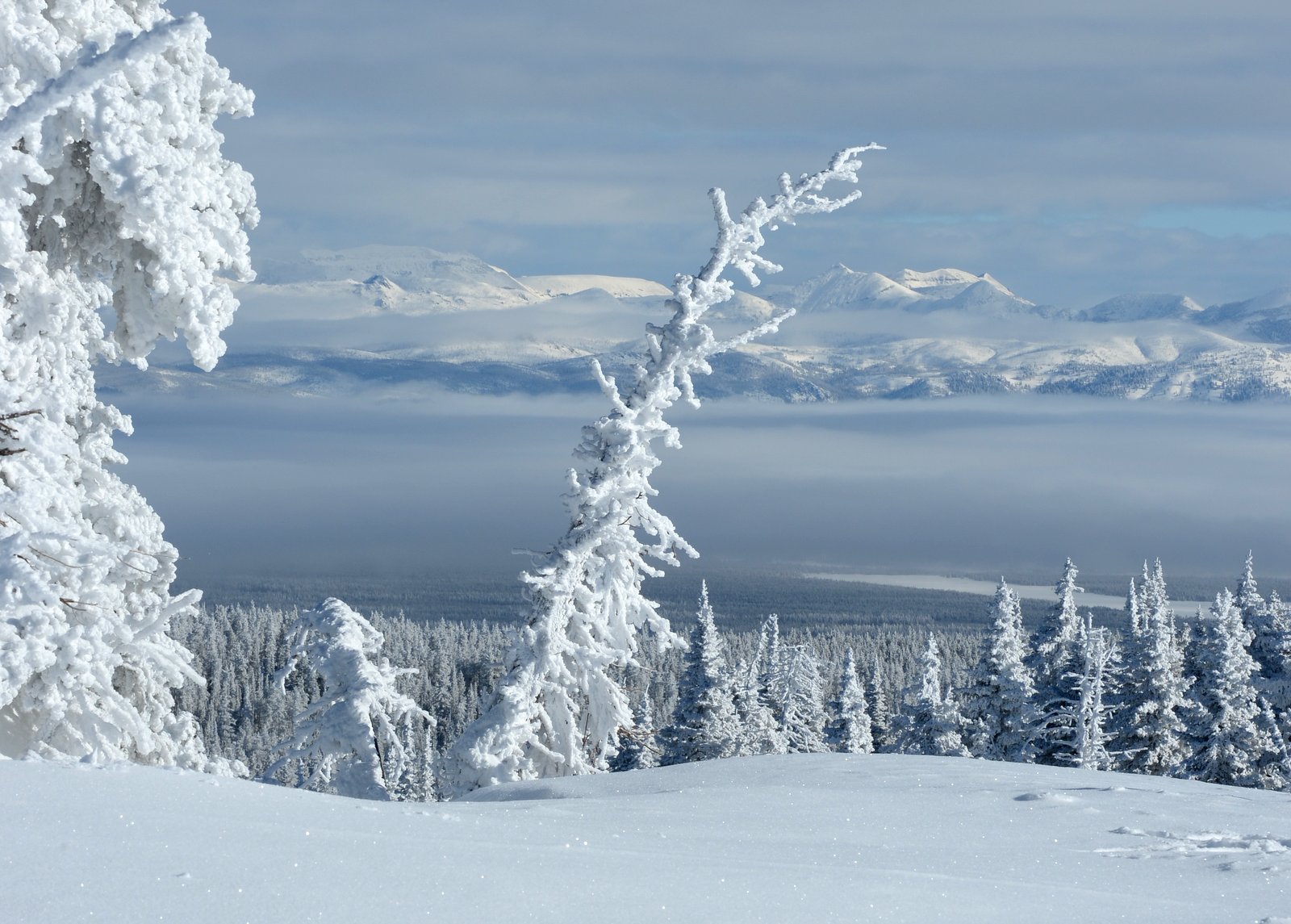
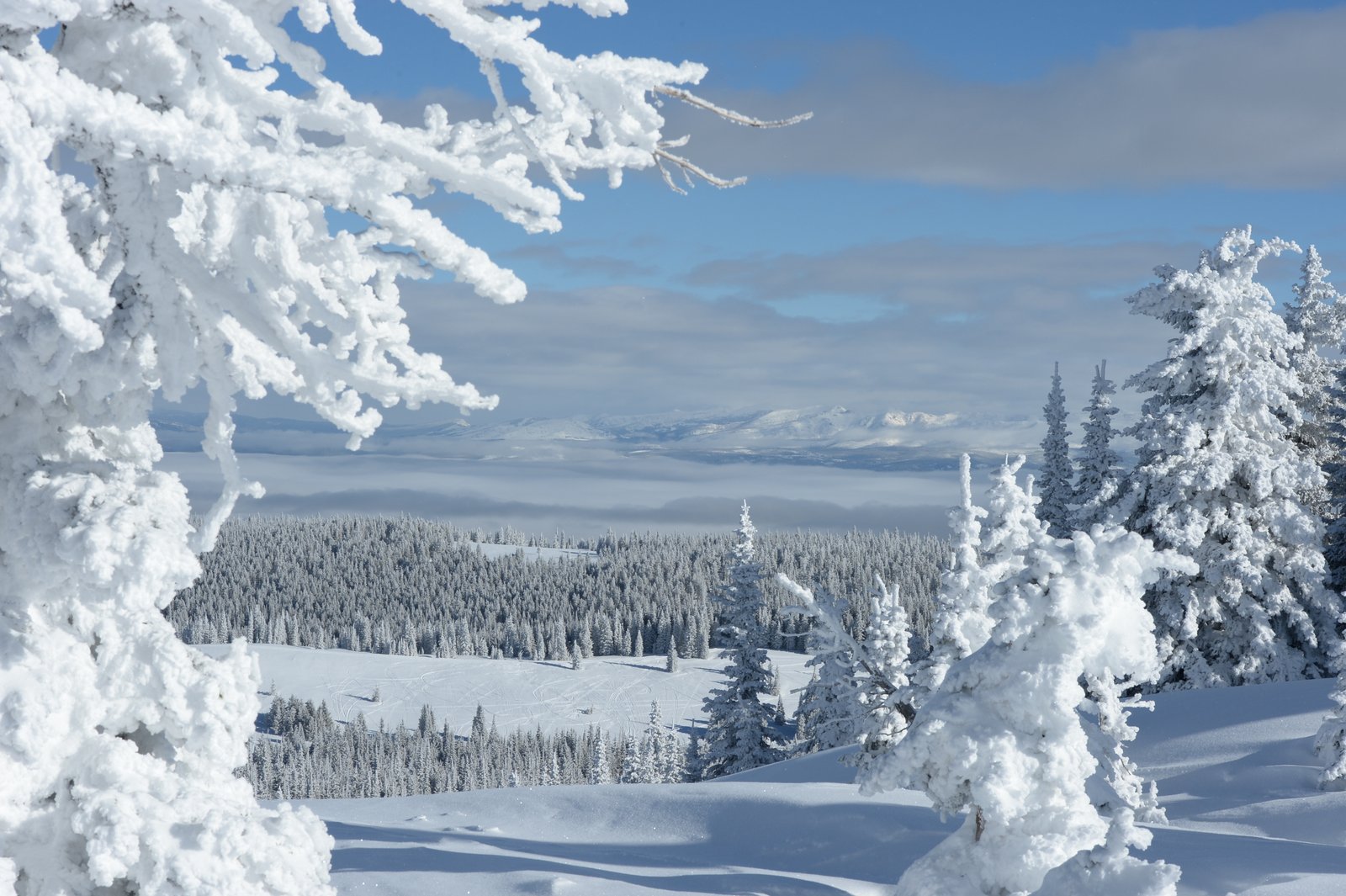
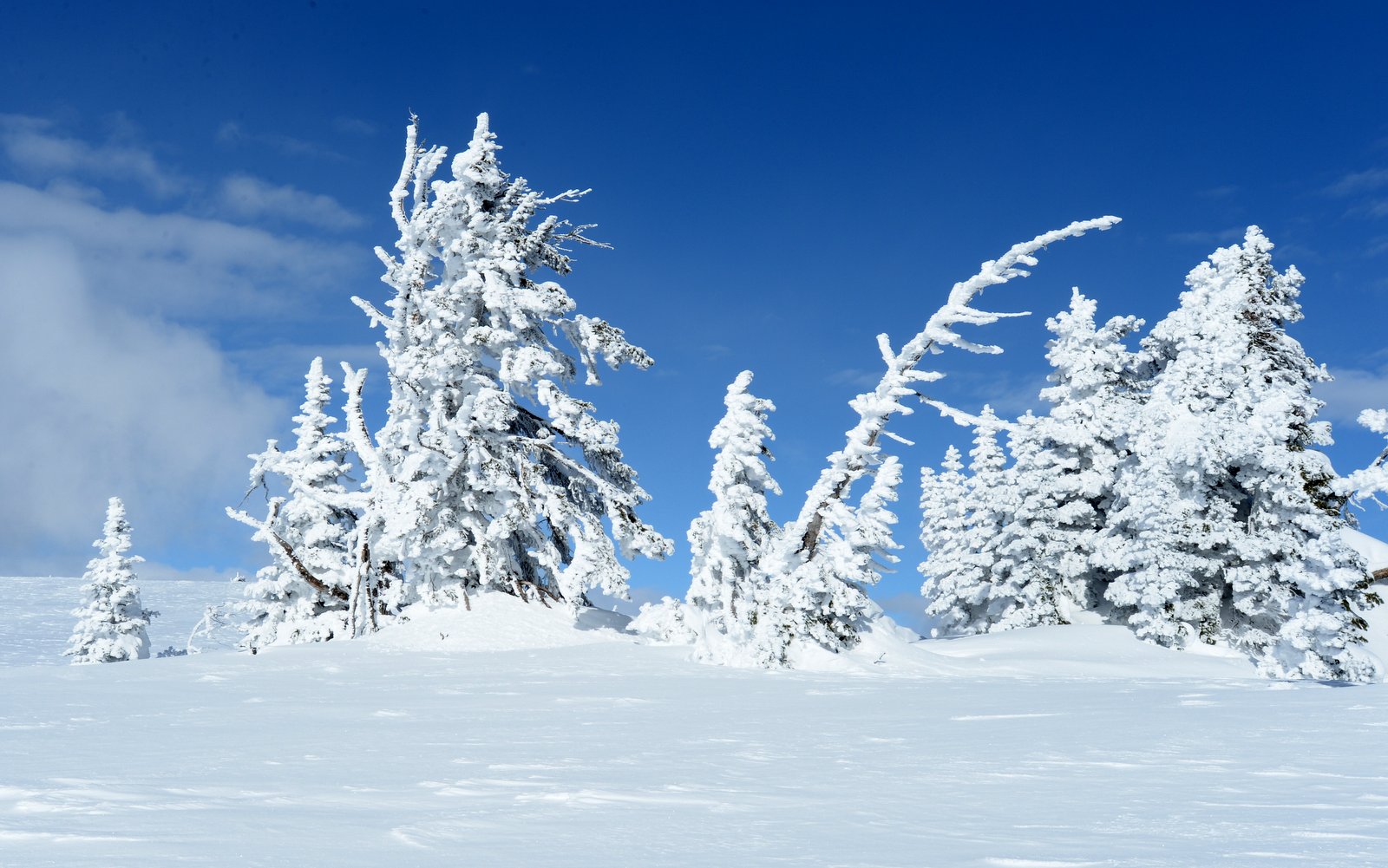
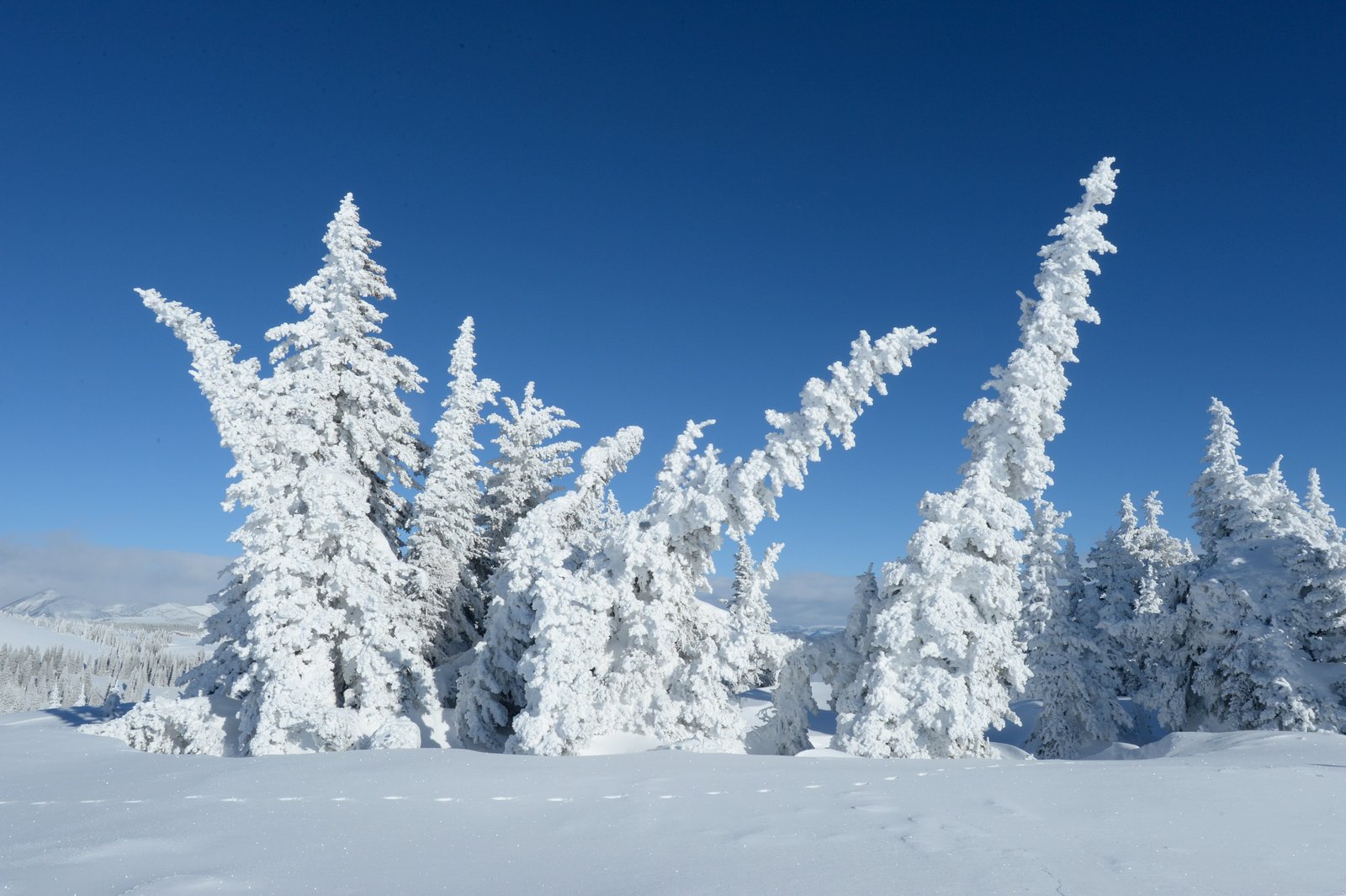
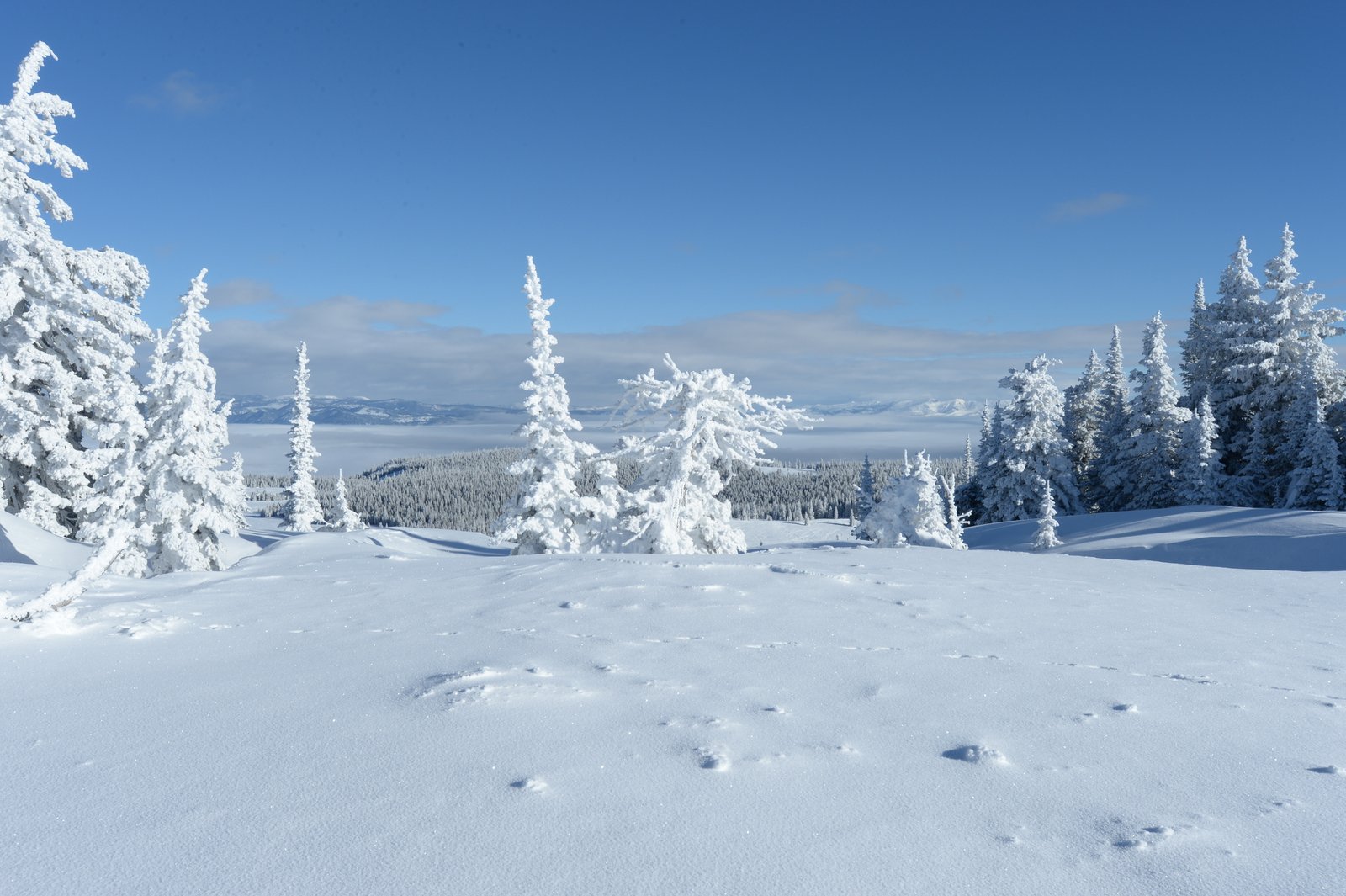
This month a visual “snow cone” to help get you through the dog days of summer.  As the sweat runs down your back, soak in this image and let the cooling begin.

Creating snow sculptures out of trees requires juuust the right sequence of weather events.  First, you need a lot of snow.  This image was taken at Targhee National Forest in Montana which is right next to Yellowstone National Park so the snow part was not too hard to come by in January, when this photo was captured.

Next, you need the temperatures to stay below freezing to keep the snow from melting.  And lastly, you need the clouds to move off so you can have clear, blue skies.

Mother Nature smiled upon us and the elements all fell into place near the end of our one-week stay.  On the last day of our trip, we climbed 9,000 feet to the top of Two Top Mountain and found this spectacular, Daliesque winter scene.

I have never seen a sky so Blue.  Nor Whites, so white.  As the morning sun rose, so did the temperatures, and the magic quickly began to melt away.  But for a few hours, we had the fortune of visiting a special place that only exists, ever so briefly, when imagination and meteorology become one.

Until next month…michael

Nikon D4, Nikkor 70-200mm f/2.8 VRII (@ 78mm), f/16, 1/350s, ISO 200

Redy to Fight

Shot of the Month – June 2014


 Nikon D300s, Nikon 200-400mm, 1.4 TC (@500mm), f/5.6, 1/2000s, ISO 200Whoever named the Red-winged Blackbird (RWB) didn’t take much time at the task.  Sure, the name is accurate, but come on, really?  By that measure, the American Robin would be called the Orange-bellied Thrush.  Where’s the creativity?

A more interesting nom de guerre perhaps?  How about the Spartacus Swamp Sparrow?   Yes, that has a certain ring to it.

Let’s Break it Down (Hammer style?):

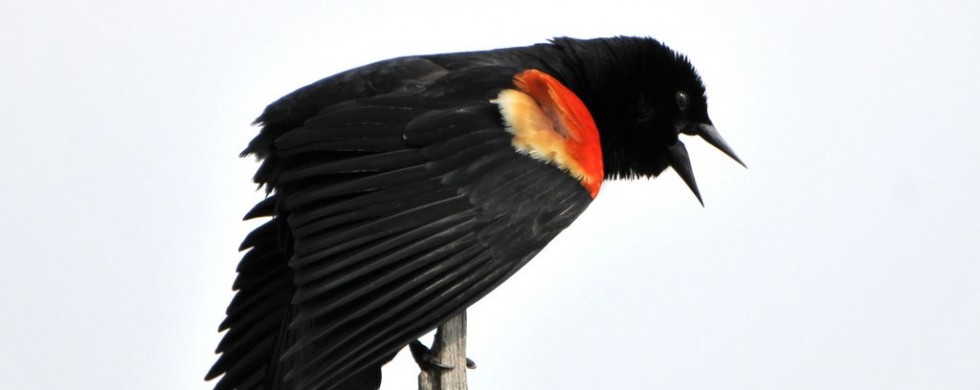
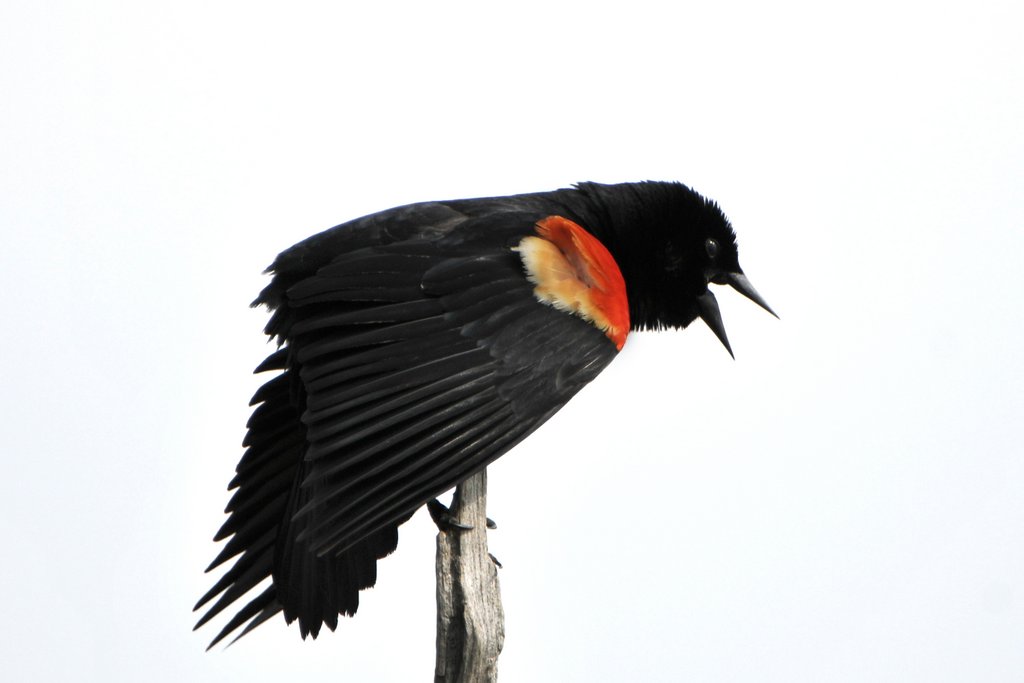
Spartacus:  RWBs are the gladiators of the cattails.  During the breeding season, a male spends at least a quarter of the daylight hours defending his territory.  Each day the male finds the highest nearby perch and rigorously calls out his claim on the surrounding little piece of the Earth as he provocatively flashes his red epaulets for all to see. (To be completely accurate, one must acknowledge that the epaulets often have a yellow or orange  border)

Check out this video to hear and see one in action.

Females are attracted to the males with the brightest and biggest epaulets (hmmp, typical).

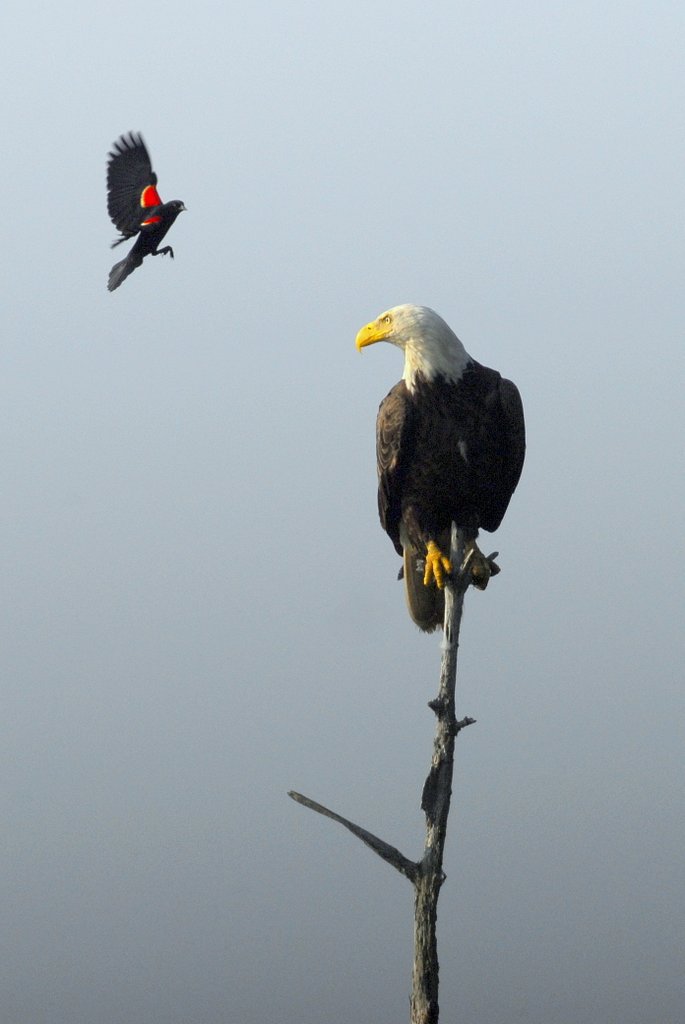
Red-winged Blackbird and Bald Eagle (7807)

From his perch, the male aggressively defends the nest from all adversaries.  These guys are known to take on animals, and certainly birds, much bigger than themselves as you can see here. This bald eagle apparently came too close to the RWB’s home turf and Spartacus came at him with a vengeance – I have a whole sequence of images of the RWB dive bombing and circling the eagle.  Alas, the eagle never took notice of the robin-sized warrior.

Such an antagonistic attitude is well founded given the dangerous world RWBs live in.  Just about every North American raptor preys on RWBs — short-tailed hawks are particularly fond of dining on them.  Even barn owls who normally prey on small mammals are in on the take as are Northern Saw-whet Owls who are barely bigger than the RWB!  Crows, ravens, magpies, and herons sometimes prey on blackbird nests.  Other predators of the nest include raccoons, mink, foxes, and snakes.  Marsh wren will destroy the eggs and peck the nestlings to death.  You can see why RBWs have a chip, albeit a colorful one, on their shoulder.

Swamp:  RWBs prefer wetlands and can live in both freshwater and saltwater marshes.  That being said these guys are adaptable and can be found in just about any open grassy area and can even be found in dry upland areas where they will live in meadows, prairies, and old fields. They have a massive range and can be found as far north as southern Alaska and as far south as the Yucatan peninsula.  Those living in the north will migrate to the southern US and Central America in the winter.

Sparrow:  RWBs are not really in the same family as sparrows –  I took some artistic, alliterative license with that one. In my defense, however, the female RWB looks like a large sparrow.  The bland colors of the female allow it to blend in nicely and not draw any undue attention to the nest.


Given the relentless onslaught from predators and rivals, from both land and air, one has to admire the plucky Red-winged Blackbird.  In my book, he has definitely earned his stripes.

Until next month….m


Spin Cycle

Shot of the Month – May 2014

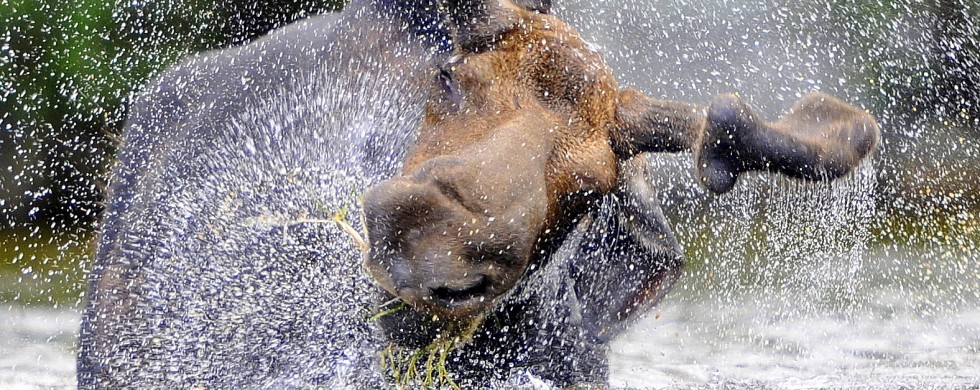
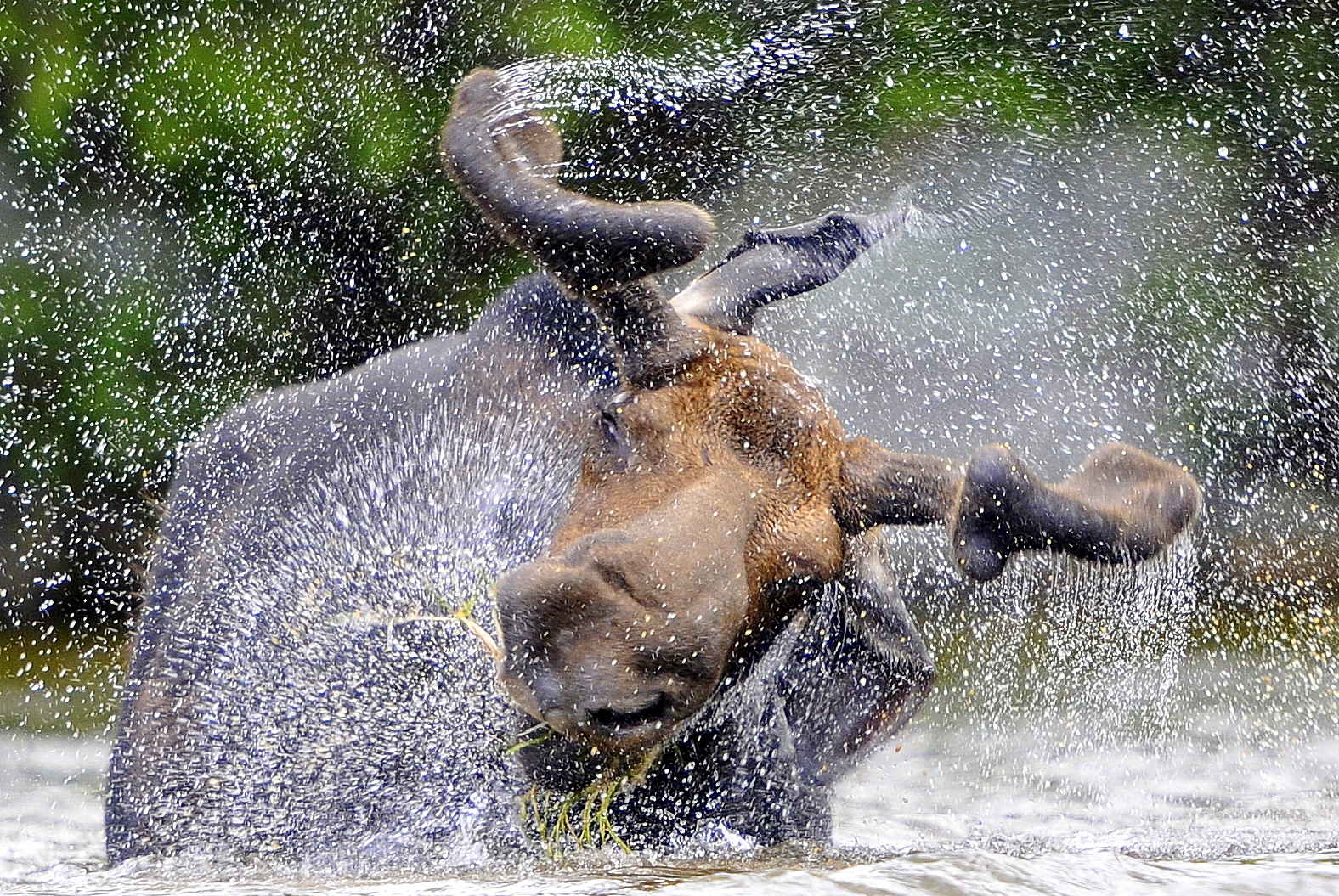
Eastern Moose, Maine -USA (6963)


Having moved to Vermont a few years ago I knew that one of my photo projects would be to try and get a decent image of one the marquee mammals of the American Northeast – da moose.   Such projects begin with desk research, or more accurately nowadays, Google search.  I scoured the internet for images of moose to get a sense of what’s possible, the best places to go, when to go, and so forth and so on.  I was surprised by how few, really interesting images that I could find.  Moose are large, rather gangly, and brown (similar to my dilemma with elephants, err, large and gray).  Moose are most active in the early morning or late afternoon so the light can often be very dark, which is not good when your subject is already brown.  A brown moose, standing still, in lackluster light. B-O-R-I-N-G.  Fun to see in person, but not a recipe for a noteworthy photo.

The best images I found were either taken with a moose in water or with a moose captured among the fall colors.

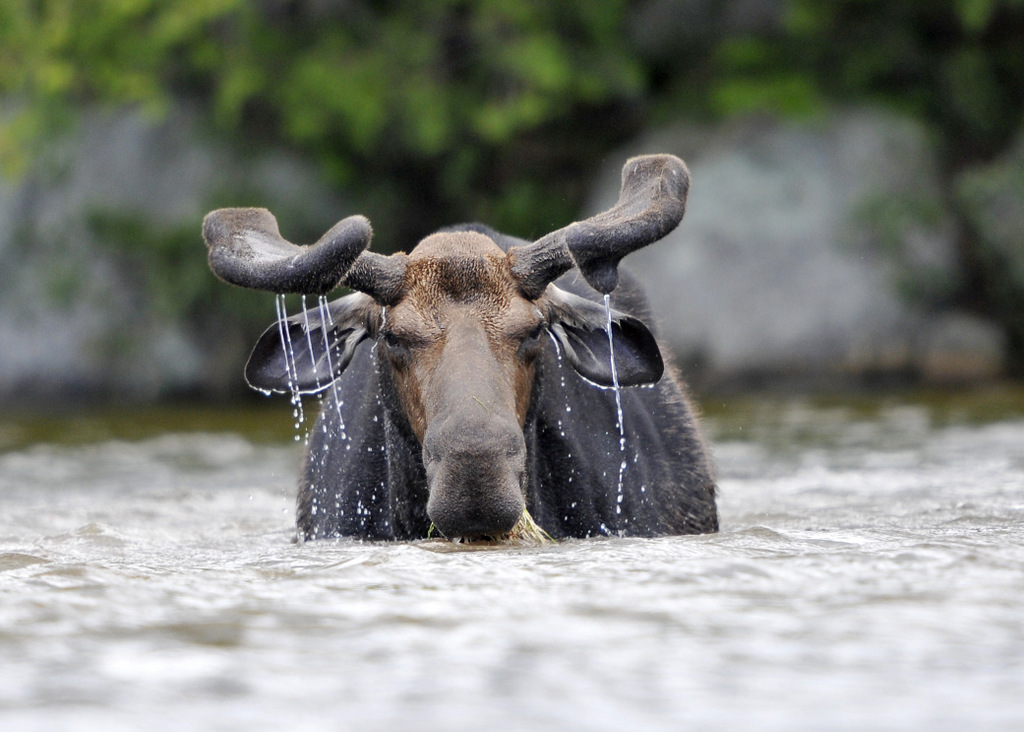
Based on my findings I imagined the “ideal” shot — I wanted to get an image of a bull moose standing in the water (lake, pond, or river would do) with water cascading off his massive antlers with a mountain forest covered in glorious autumn colors as a backdrop.  Piece of cake…

I learned that Maine was probably the best place to find moose in New England so I researched potential guides and called one to see if we could come to an arrangement.  I described my ideal shot.  The guide, admirable in his restraint, patiently explained why that combination of elements was pretty close to impossible.

What this flatlander boy didn’t realize was that Moose don’t have antlers year-round.  Bull (male) moose grow antlers starting in the spring and reach maximum size in the fall — just in time to battle other bulls for the right to mate with cow (female) moose who are coming into season.  With the rut over the antlers fall off at the beginning of winter as they are no longer needed and would be a huge burden (they can weigh 50 pounds) walking in the deep snow during a period when food is so scarce.  During the summer moose feed heavily on aquatic plants that are rich in sodium.  They will wade into a pond or lake and pull up lilies and pondweed.   Some moose will even dive underwater to reach some plants.

So here’s the rub.  Want big antlers and bright fall colors? Late September is the time to get that shot.  Want to find a moose eating in the water?  That happens during the summer, June-August.  By the time fall colors have arrived, most water lilies and aquatic plants have stopped growing so it will be really, really hard to find a moose feeding on them at that time.  Early in the summer moose can “regularly” be found in water dining but usually their antlers are fairly small and not fully developed.

Eastern Moose (6929)

A few seconds before we transcended “nice” photo status…

Reality RcAKGnLXi complete.

So, there I was in Maine’s Baxter State Park, with low expectations on an otherwise lovely June day when this bull moose walked out into the pond and began to dunk his head for a meal.  What he lacked in antler size he made up for in action.  Every once and a while the moose would shake his head like a dog to shake the water off (Note:  This was the ONLY moose I have seen do this).  Just the extra element I needed to take a “nice” photo into the realm of something special.

Most of the time the moose was standing perpendicular to my position so I could not get the full effect.  Mother Nature finally smiled upon me and the moose turned in my direction and decided to rinse off.  I held the shutter button down and kept firing as long as I could.  I instantly knew that I might have captured something special.

One may go many days, months, or even years in effort before those split-second opportunities flash by.  But one of the greatest joys of photography, when successful,  is that I can relieve that spectacular moment each day as I walk upstairs and pass by that image hanging on my wall.  🙂

 Until next month…