
Menu
Jul
15
Shot of the Month – July 2008
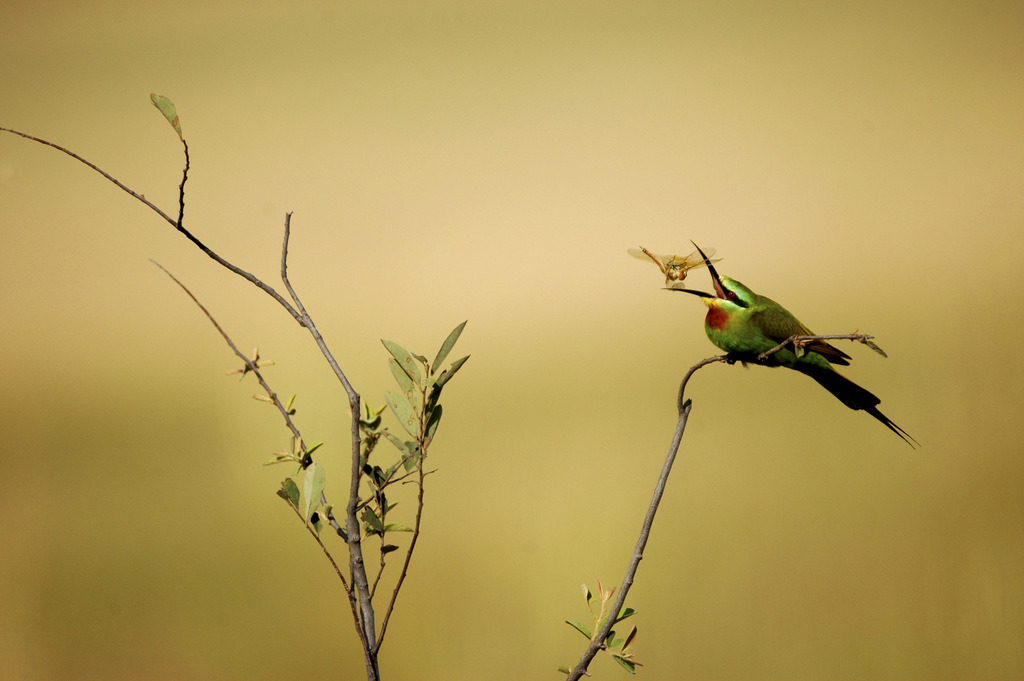
This story provides a little insight into some of the elements that are necessary in getting that “lucky” shot. This image was probably the second frame of a four-shot burst. While looking through the viewfinder I saw this behavior but I wasn’t sure if I managed to catch the action at just the right moment. Once finished shooting, I feverishly hit the review button on the back of my camera body and scrolled through the sequence of shots. As soon as the image appeared, even on the tiny 2-inch LCD screen, I knew that this might be the shot of the safari.
Once back home I was able to verify that that the shot was as good as I had hoped. Was this just a lucky shot? Well, some luck is almost always involved, but as they say, with hard work, you can create your own good luck.
How did this all happen?
Well, this is a photo of a Blue-cheeked Bee-eater (BCBE) in an area of the Kalahari Desert in Botswana. I had never seen a BCBE before this trip and I had tried for several days to get a decent shot with no success. While driving along a dirt path in an open field we spotted several BCBEs flying sorties and catching insects. Our guide told us that the birds were most likely trying to fatten up before continuing their migration. We accelerated so we could reach the point along the path that would bring us as close as possible to where the birds were flying—park rules do not allow us to go off the road so we had to hope that we could get close enough.
This is where knowledge of animal behavior comes in handy. I had seen many other types of bee-eaters in my day and I knew that when they are hunting they like to return to the same tree or shrub to eat their prey. BCBEs love to eat dragonflies and in the space of about five minutes, this bird had caught three! Early on I saw that he had perched on this shrub so while he was off hunting I set my camera up and waited for his return (hopefully). Knowing the behavior of the bird allowed me to set myself up properly and be prepared in advance for the next opportunity. From his previous “kill” I knew that he would whack the dragonfly a few times on the branch to make sure that it was dead before launching it into the air. Within a minute or two he was back with a dragonfly in his mouth.
Next, I had to make sure that I was using the right camera settings for this type of shot. For this scene I maximized the aperture—this does two key things. First, it allows for the fastest shutter speed possible to stop the action which I hoped we would see. Second, it creates a shallow range of focus — the bird would be in focus but anything in the background would be blurry — just what you want for a “portrait” like this. That great sea of yellow in the background is actually long yellow grass—the wide open aperture blurred that out and allowed the subject of the photo to pop out in contrast. I set the auto-focus to continuous mode — this setting is best for action scenes and it tells the camera to keep tracking the object and adjust the focus as necessary. Finally, the shutter was set to High-Speed Continuous — as long as I held the shutter release button down the camera would take photos. A high-speed burst of images was just what I needed to try and capture this split-second action.
Proper technique also played a big role in getting this shot. I was using a 300-800mm lens for this scene–this 22-inch, 12-pound beast magnifies the tiniest of minute vibrations–the slightest movement of the lens, of the camera, or the vehicle would create a blurred image. I used a bean bag on the roof of the vehicle to stabilize the lens, essentially using the truck as a large tripod.
Everyone in the vehicle was well versed (some would say threatened) on the importance of not moving, or even breathing heavily while I was shooting. I pre-composed the shot and pre-selected the focus point before the bird arrived. While shooting I braced my body against a seat, controlled my breathing, and gently squeezed the shutter release—all to ensure no movement of the camera.
And last, yes, a good dose of luck is always important. We were lucky to find the birds in hunting mode. We were lucky that the road came juuust close enough to allow us to get within range for a shot. The lighting was good and the backdrop for the shot was perfect.
This is one of my favorite photos and I have a 16”x24” version of it hanging on my wall. The image has an oriental feel with its minimalist design and from the hues and color palate of the scene.
Capturing the bee-eater just at this crucial moment, with the dragonfly in JUST the perfect position, in such a beautiful setting is truly a small miracle.
Lucky? Sure, but as you can see, serendipity can sometimes use a helping hand….:-)
Jun
15
Shot of the Month – June 2008
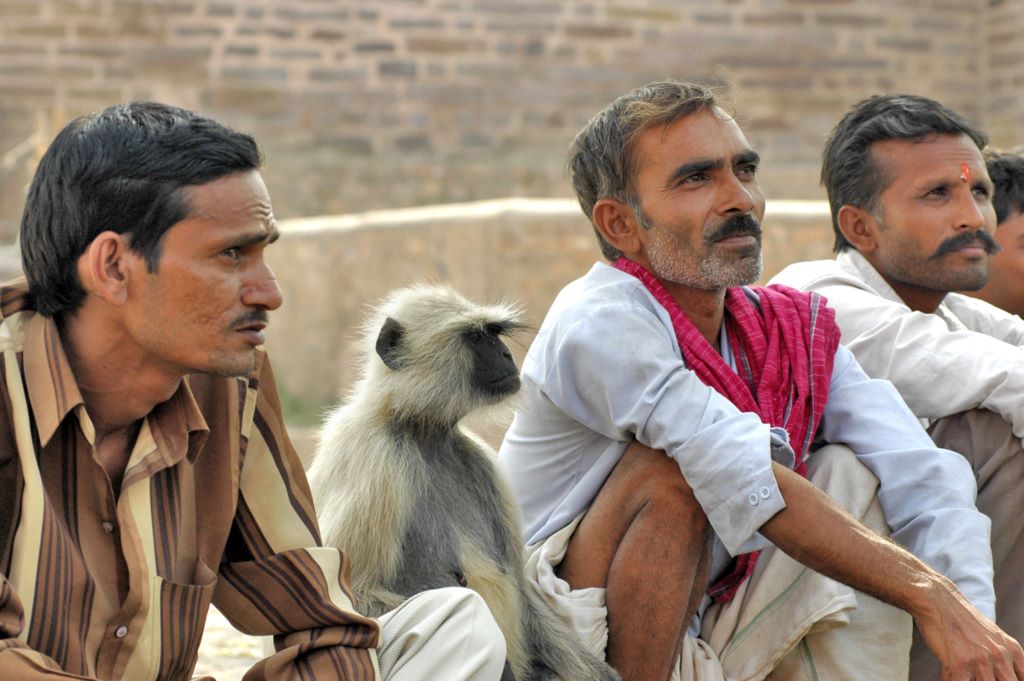
Once you know the story behind this photo, you can’t help but smile each time you see it.
This shot was taken at the entrance to the Ranthambore National Park in the Rajasthan Province of India. Ranthambore is one of the best places in the world to go if you want to see tigers in the wild. This was my third visit to this park and we had some unbelievable sightings on this trip.
At this park, you can only visit in the morning for a few hours and then all vehicles must leave to allow the animals some peace and quiet. In late afternoon you can enter the park again for a few hours to try your luck in finding the elusive tiger. There are several different entrances to the park but this one is found at the base of a fort. In the upper reaches of the fort is a Ganesh temple which attracts pilgrims from around the country. As the fort is located far from the nearest town, many worshippers cram into taxis to reach this holy spot.
In this photo, we see some of the taxi drivers waiting patiently for the worshipers to return so they can take them back to town. At this same spot, twice each day, a handful of safari vehicles sit with expectant tourists while guides complete the paperwork necessary to enter the national park.
The parking area is typically a hubbub of activity. Peacocks preen and call exotically from the nearby trees or from atop the fort ramparts. Langar monkeys are ever present–some playing in the trees while others run over, under, and into the vehicles. Pilgrims often dressed in bright, techno-color flowing outfits take water from the nearby fountain. Drivers joke with one another, safari guides share stories of tigers almost seen, and the park guards and wardens chastise, usually mockingly, the guides for some infraction or another.
But I digress. On the wall, we see a line of taxi drivers, hanging out, watching the scene. If you look closely you will see that one of the characters is not like the others. It is a langar monkey. A moment before the monkey had come up from behind the wall and tapped the guy with the red scarf on the hip, and nodded to the small space to his right. The man looked at his colleague, who shrugged nonchalantly, and slid over. The other men, domino-like, all slid down and made space for the monkey. The langar monkey jumped up and sat down with his buddies.
And that was it. No fuss, No amazement. The guy in the brown shirt made no comments, no questioning. The guys went on with their stories and conversations. The monkey sat there and took it all in.
For all parties involved, everyone acted like it was perfectly normal to have a monkey tap you and ask if he may cut in and join your group.
See, you’re smiling, aren’t you?
May
15
Shot of the Month – May 2008
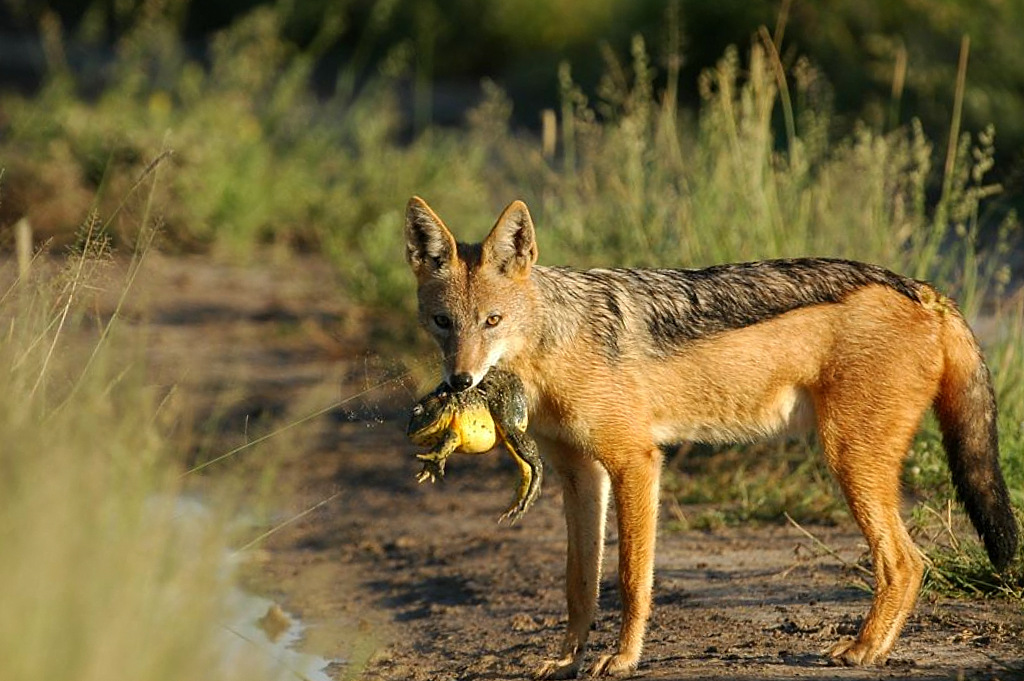
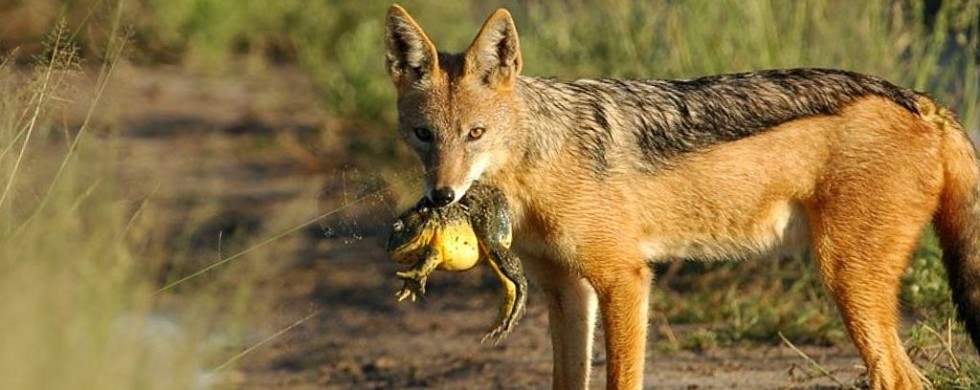
Let me share one of my fondest safari memories.
It was a special day in the Kalahari Desert in Botswana. You would never believe that it was the desert—It was the rainy season and the desert had transformed itself into this wonderfully lush, WET, bountiful oasis.
On this day we counted 64 Black-backed Jackals! They were all in high spirits since the rains had unleashed an eruption of frogs from underneath the ground. The jackals were having a feast.
And that leads us to this photo.
We found 6 jackals running along, with one jackal carrying this massive African bullfrog. It was clear that none of the jackals really wanted this bullfrog. One jackal would put him down. Another would come over and reluctantly pick him up. Their instincts told them that they simply couldn’t leave such a meal behind. But they had soooo much food around them; they didn’t really need the bullfrog.
So we laughed and laughed as one jackal after another repeated the sequence. Pick the frog up, run a bit, and put the frog down with a look of great angst and shame.
Next!
Pick the frog up, run a bit, and put it back down.
Finally, at wit’s end, the last jackal put the bullfrog down and the pack bounded off intent to escape any further predator dishonor.
Amazingly, the bullfrog had survived the ordeal and hopped off no worse for wear.
Until next month….:-)

