In Search of the King – December 2009

Shot of the Month – December 2009

This month some celebrate the birth of the King of Kings.  One Christmas story tells how three wise men were aided by a bright star that led them to the new King.

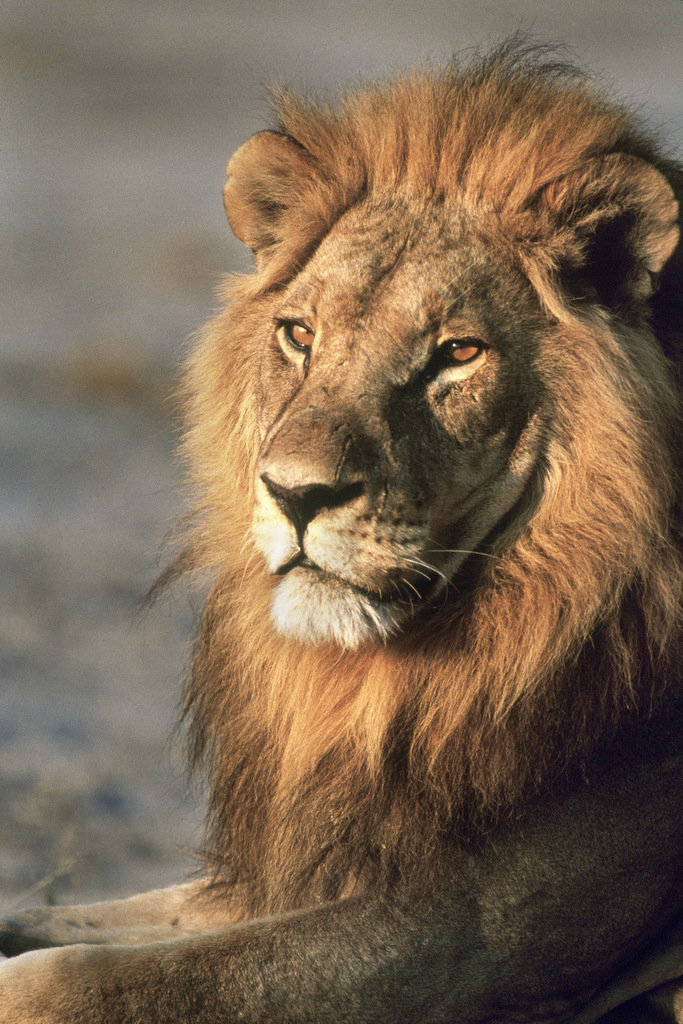
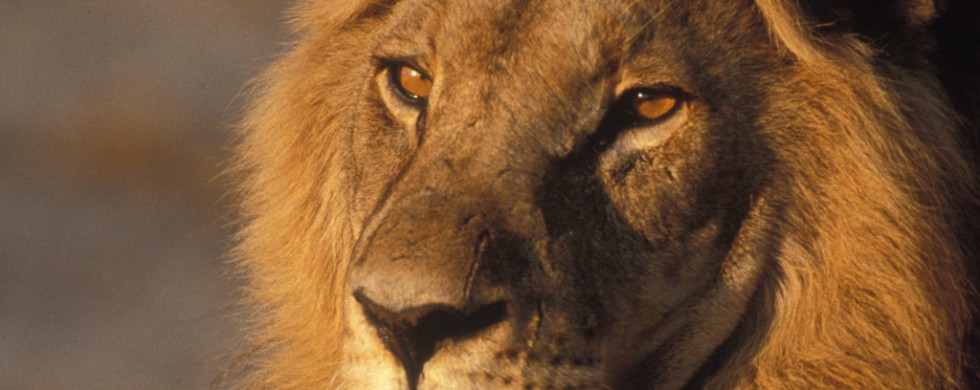
While less transcendent, three men (also less wise) were aided in finding the king of the animal world allowing me to capture this regal portrait of the male lion.

Our journey began on a crisp morning in Botswana as I, a visiting friend, and our guide/driver (the three wise-ish men) left camp in our Toyota Landcruiser (all out of camels) in search of royalty.  After a few minutes on the trail, we heard the roar of a lion.  We drove in that direction and found a young male lion walking with purpose.  The young lion was agitated; he was clearly trying to find his missing pride.

Finally, after 20 minutes of plaintive calls and walking hither and thither, we heard a bellow off in the distance.  Our young prince looked hopeful and called again and walked briskly in the direction of the deep roar.  After another 10 minutes of the lion equivalent of “Marco Polo” the young lion led us to the magnificent black-manned lion in this photo.  He was with a female and it was clear they were a mating couple.  Their reunion was full of head bumps and body rubs.  The animal lover in me reveled in the moment and the photographer in me went giddy as the sun finally rose above the horizon and an orange beam of light basked the lion in this heavenly glow.  Click….sigh.

During this holiday season, I hope that you will likewise manage to reconnect with those dear to you and revel in the simple pleasure of being together.  A warm head bump to you all.

(Speaking of great reunions.  In 1969 two Australians living in the center of London bought a lion cub at Harrods department store.  After a few months, it became clear that Christian, the lion, was becoming too big to live in the city.  Rather than put him in a zoo they persuaded conservationist George Adamson (remember “Born Free”?) in Kenya to take Christian and teach him how to live in the wild.  A year later the men returned to Africa to see how their now wild lion cub was doing.  See the amazing reunion here )
Colorful Conundrum – November 2009

Shot of the Month – November 2009

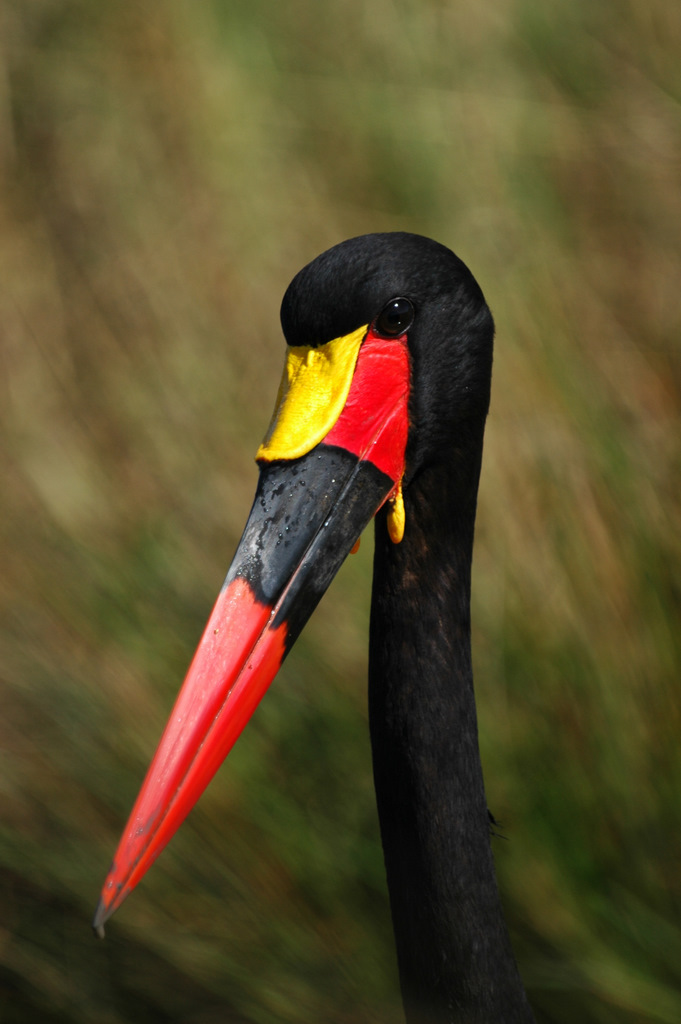
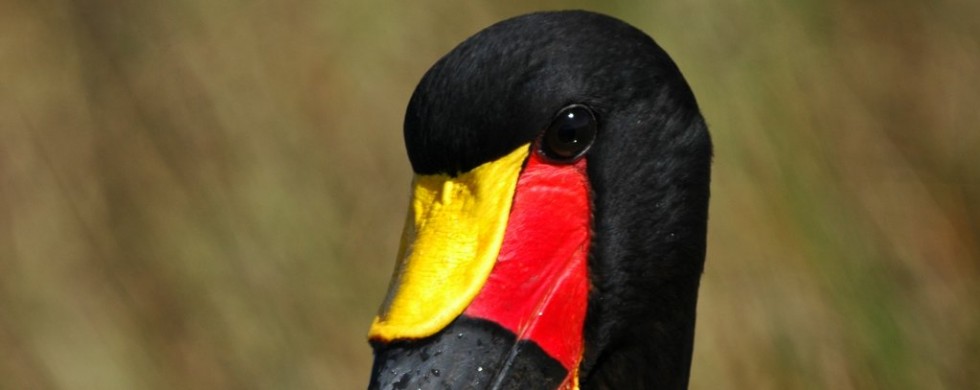
This month I offer this glam headshot of a Yellow Saddle-Billed Stork (SBS).  Such a close-up of this bird is a rarity – they are solitary birds that don’t hang out in flocks and generally don’t like company.  Most of my views of these storks have been at great distances and even then they often immediately turn and start walking in the opposite direction.  As a photographer, this can be extremely frustrating given how stunningly they are adorned.

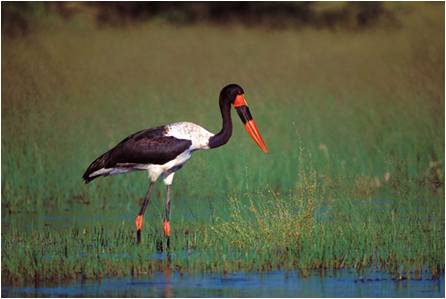
This stork is the sub-Saharan counterpart to Sesame’s Big Bird – they are the tallest stork in Africa and males can reach 5 feet in height and have a 9-foot wingspan.  And the colorations! Where to begin?  First, we have that massive brilliant red and black bill that is a great weapon for spearing fish, frogs, crabs, water beetles, etc.  On top of the bill is a bright yellow plate that resembles the saddle you might find on a horse.  Next, his face, neck, wings, and tail feathers are black while his back and chest are white.  Finally, his legs are black but they are offset by reddish colored joints.

In this photo you can get a better view of his wild outfit:


This guy does not “blend.” (Any “My Cousin Vinny” fans out there?)

The male, as shown in the portrait, can be significantly larger than the female and has dark eyes and a bright yellow waddle on each side of the bill.  Females have yellow eyes and no waddle.  These storks are believed to mate for life and apparently have no arguments – SBSs have no muscles in their voice box so they are silent.  Mating couples can communicate, however, by rattling their bills together.

It seems counterintuitive that such a solitary, shy, silent bird would be decked out in such a brilliant, ostensibly boastful display that demands notice and attention.

Another mystery of Mother Nature…


Members Only – October 2009

Shot of the Month – October 2009

The harbinger of success for some is acceptance into an exclusive club.  Perhaps it is membership at an expensive golf course or getting the nod from the man with no neck to jump the line at that by-invitation-only nightclub.

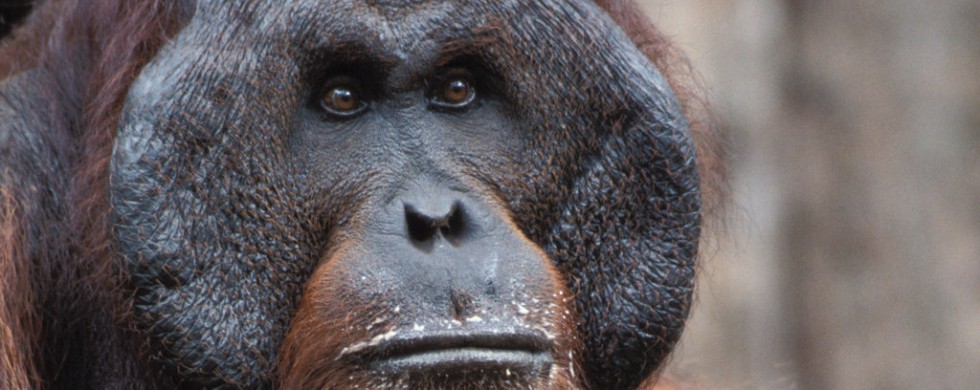
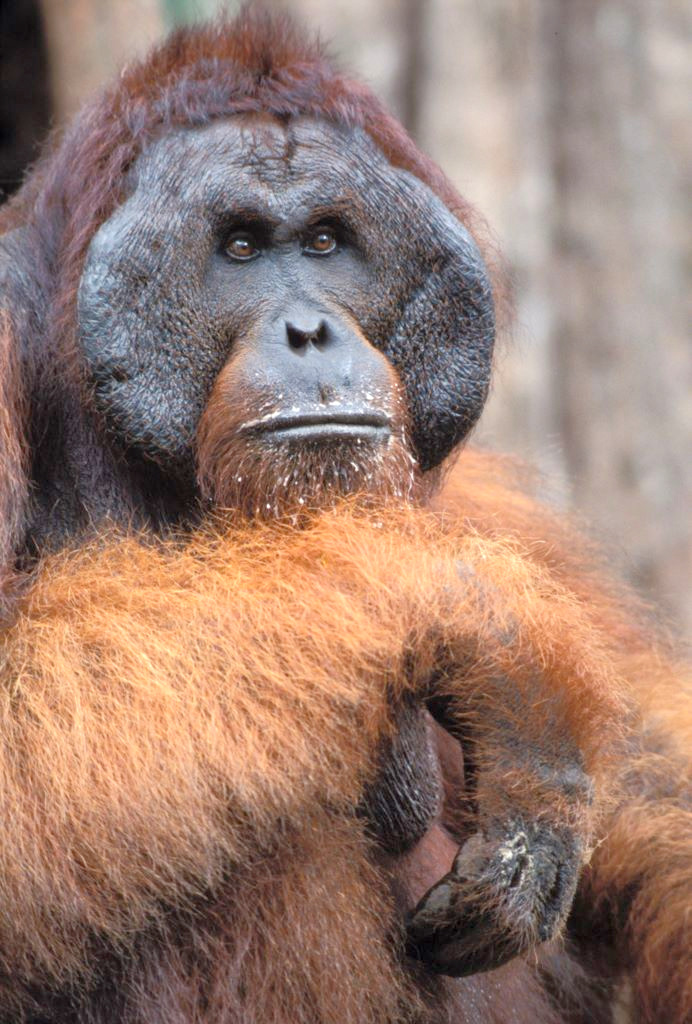
Based on a news story I read in 2002 about devastating wildfires in Borneo I decided to fly to Borneo to try and see orangutans in the wild.  Successful in my venture I became a member of a very exclusive club indeed.  There is no salary quota, or star power fame required to join the club, simply the effort needed to journey up the Sekonyer River in the Tanjung Puting National Park in southern Borneo.

So what makes this club so special?  Well, I may be among the last small group of humans to ever see an orangutan outside of a zoo.  Orangutan means “man of the jungle” in the Malay language.  In the last 20 years, we have destroyed 80% of all the forests they live in.  On the island of Sumatra, the orangutan population has dropped 86% from what it was just 100 years ago and they are listed as “critically endangered.”  The next status after critically endangered is “extinct.”

No jungle, no orangutan.

In Borneo, the orangutan is doing better and is only “endangered.”  These two Malaysian islands are the last refuge of the only great ape not found in Africa.

The forests are being razed and cleared at an astonishing rate to provide the hardwoods we like for our furniture and to make way for palm oil plantations.  We use palm oil in our cosmetics, in more and more processed foods, and increasingly, to make fuel for cars.  People also like to have baby orangutans as pets so many are captured and killed in that pursuit.

Orangutans are the most intelligent creatures on the planet after humans (though given our behavior, I demand a recount).  Of all the apes orangutans are the most arboreal – they spend most of their lives in the trees and rarely put a foot on the ground.  Unlike most apes, orangutans do not live in social groups and spend the majority of their lives in solitude.  Their arms are twice as long as their legs and they have opposable thumbs and opposable big toes so they can grasp with their feet as well.

Despite their lanky proportions, superhuman strength (at least 8 times stronger than man), and nifty opposable toes, I don’t think orangutans will be able to hang on much longer given our determined onslaught.

Our consumption here directly drives the loss of habitat there.  If you want to learn more about how you can help, follow the link: http://www.mongabay.com/take-action/orangutans.html

Planet Earth Club
Members Only
(Non-Humans Need Not Apply)

Flights of Fancy – September 2009

Shot of the Month – September 2009

I have to admit that I am a bit shallow when it comes to my interest in birds – photographically, I am most interested in the pretty ones.  True birders seek out all avian sizes and shapes and can be enraptured by a rare, but very dull, brown species of sparrow.  I, on the other hand, only seek out colorful cranes, resplendent rollers, brilliant bee-eaters, or other alliterative combinations of bright-colored fowl.

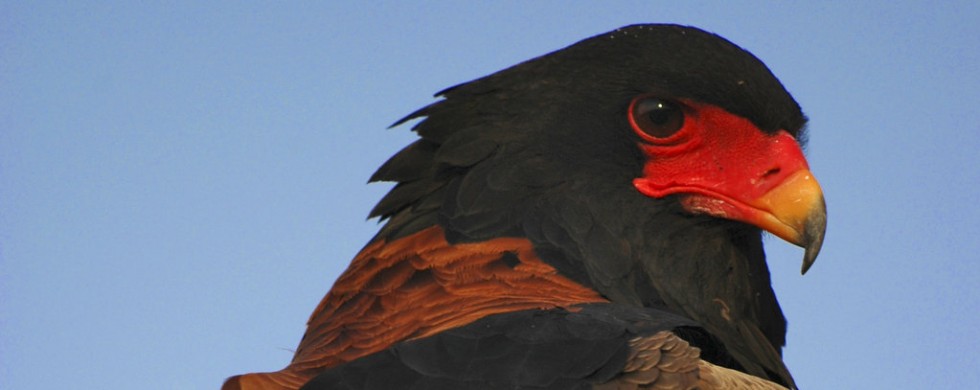
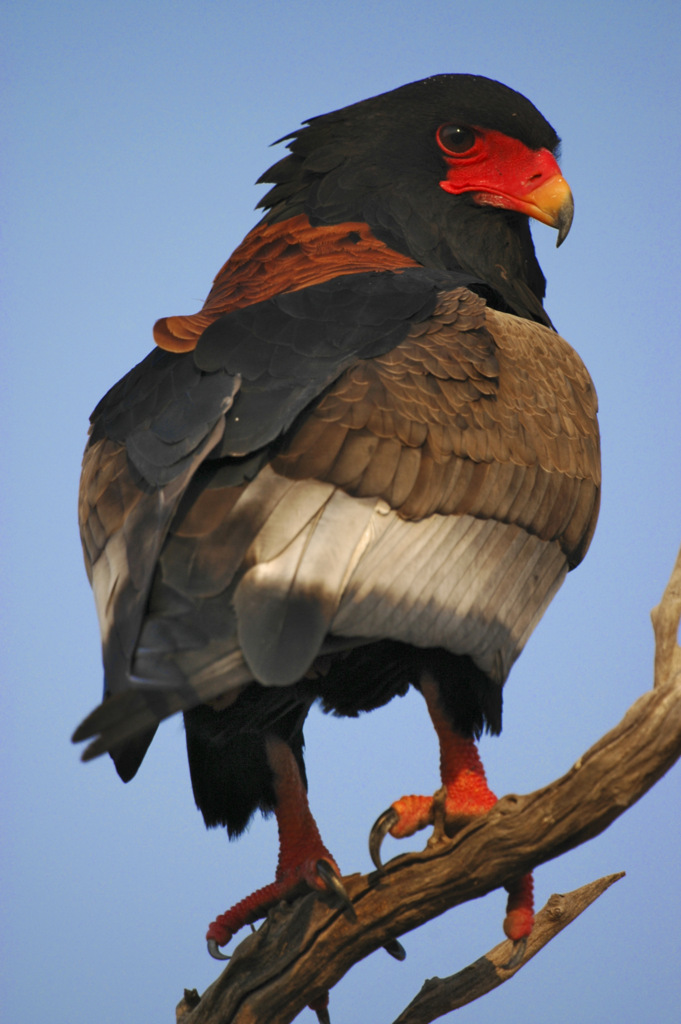
While I admire the majestic nature of eagles and hawks most are hues of tan and browns and would look equally well in a black and white photo as well as one in color.  There is one eagle however that makes a brilliant exception to this rule –the Bateleur Eagle.  The Bateleur’s black head is strikingly offset by a red face and bill and the banded tan, white, and black body is accentuated by brilliant red legs and feet.  For years I would often spot the bright red feet signaling from high up in a tree but invariably I could not get a shot as the rest of the body was hidden behind leaves and branches.  I couldn’t believe my luck when I found this fellow with his mate, they pair for life, in a dead tree in Botswana.  They were gracious enough to sit there for over an hour as I shot hundreds of images with nary a leaf or branch obstructing my view!

“Bateleur” is a French word that means “tightrope-walker” — in flight the Bateleur tips its wings from side to side, looking like a high-wire acrobat catching his balance.  The eagle has a very short tail so this motion assists in making turns.  The short tail however allows the Bateleur to do sideways barrel rolls and other spectacular aerobatics.

The eagle can spend eight to nine hours a day in the air searching for food and can cover up to 250 square miles looking for snakes, mice, birds, and carrion.

The Bateleur eagle has it all – noble in stature and form with striking crimson highlights — now that’s my kind of bird.


Lost Relative? – August 2009

Shot of the Month – August 2009

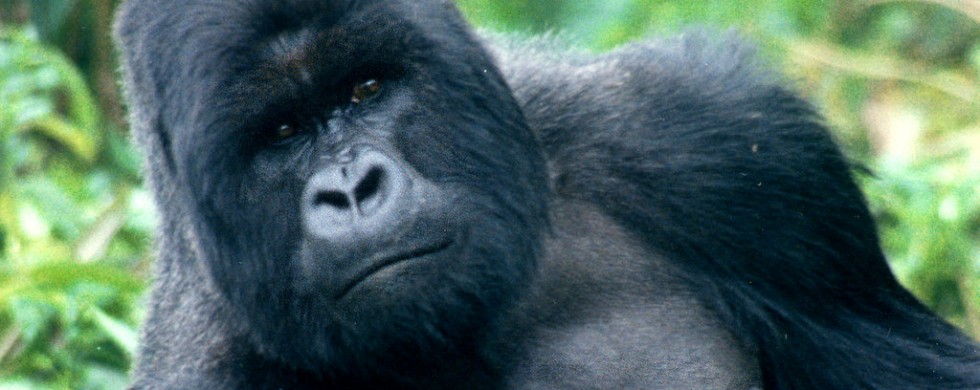
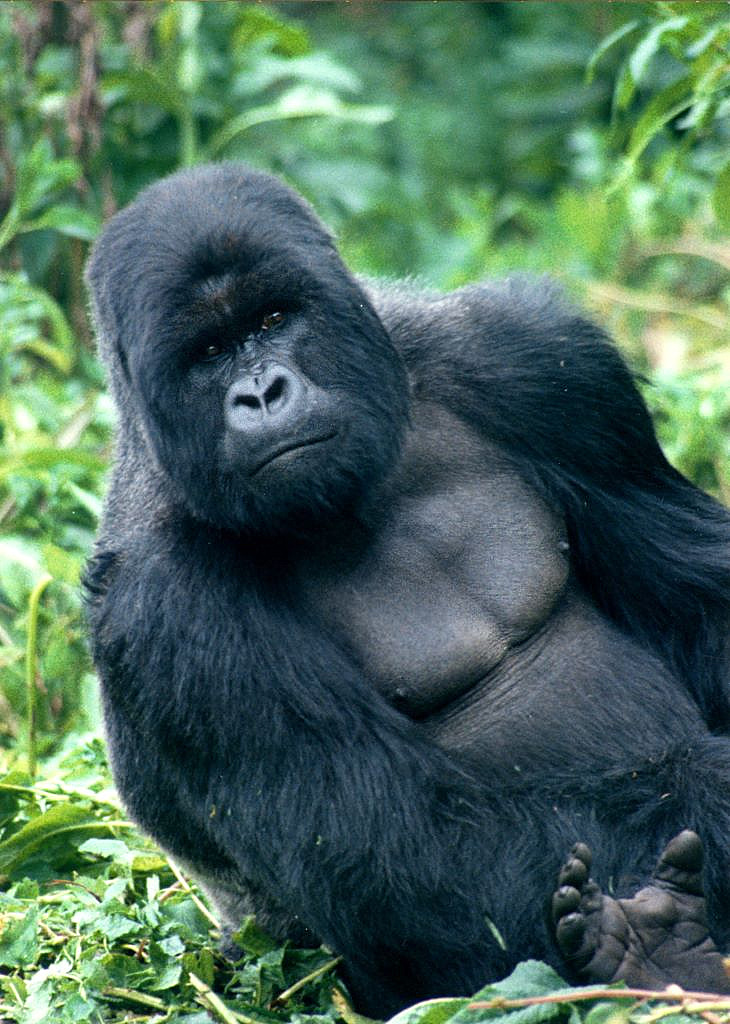
I can say unabashedly that you haven’t fully lived until you have hiked through a misty, vine-covered jungle and gazed into the eyes of a Mountain Gorilla.

First, the setting is surreal.  The jungle is an explosion of all things green.  Every shade, hue, and likeness of green that you imagine surrounds you.

Jade.  Olive.  Pea.  Pine.  Kelly.  Lime.  Malachite.  Sage.

Everything you encounter is a variation of green and whatever doesn’t move is padded in some form of emerald vine, plant, or moss.  Rain is ever present as a downpour, a light drizzle, or as a misty shroud as passing clouds snag onto the mountain canopy.

Second, you cannot make eye contact with the mountain gorilla without a sense of awe.  We share much of the same DNA and you cannot help but feel – see – experience, the intelligence of this creature.  The gaze from an equal that is looking back at you with as much intrigue and awareness as might be found in any member of your group.

We are, in fact, two members of an exclusive group.  The Hominidae, or “Great Apes” include chimpanzees, gorillas, humans, and orangutans.  Sadly, only about 700 Mountain Gorillas remain in the world – all live in a shrinking area of forest found in the Virunga Volcanic Mountains at the intersection of Uganda, Rwanda, and the Democratic Republic of Congo.  Their jungle is being cut down as humans encroach to take the trees for firewood or to make space for farming.

Soon there will be simply no space left on this planet for one of our closest family members.  Can humanity find a way to live in balance with other beings on this planet?

If not, our existence will be much poorer because of it.