
Menu
Aug
31
Shot of the Month – August 2013
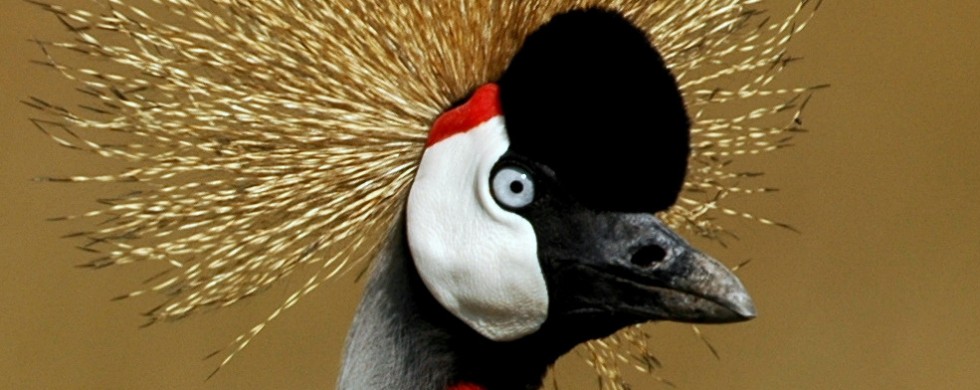
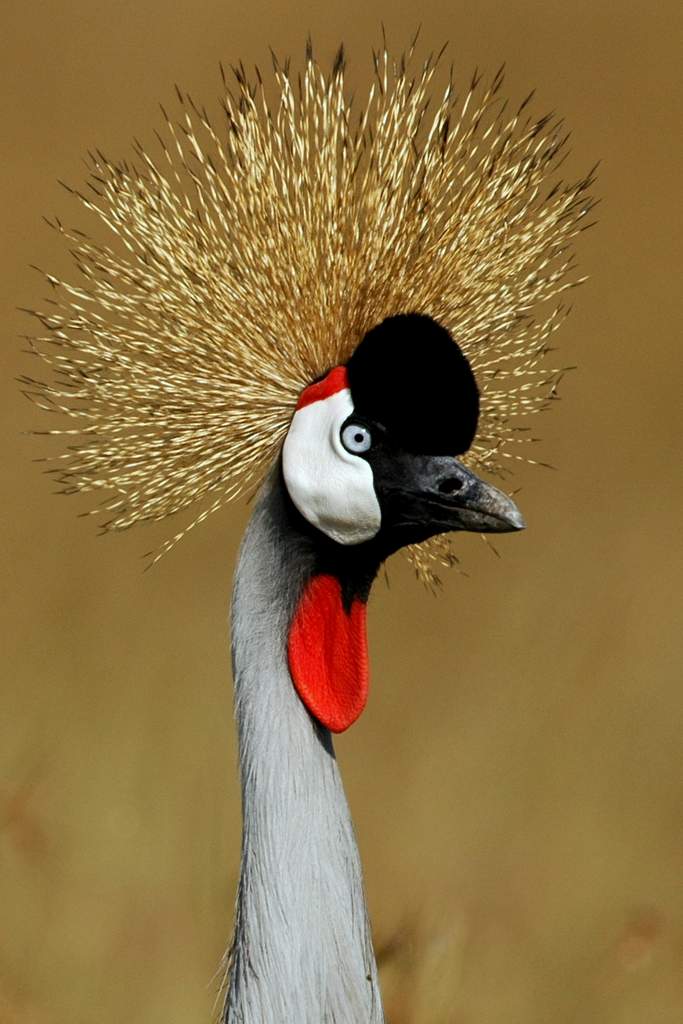 This month a look at the Grey Crowned Crane (aka, the Crested Crane), the seemingly dandelion-inspired, dancing dandy of the avian world.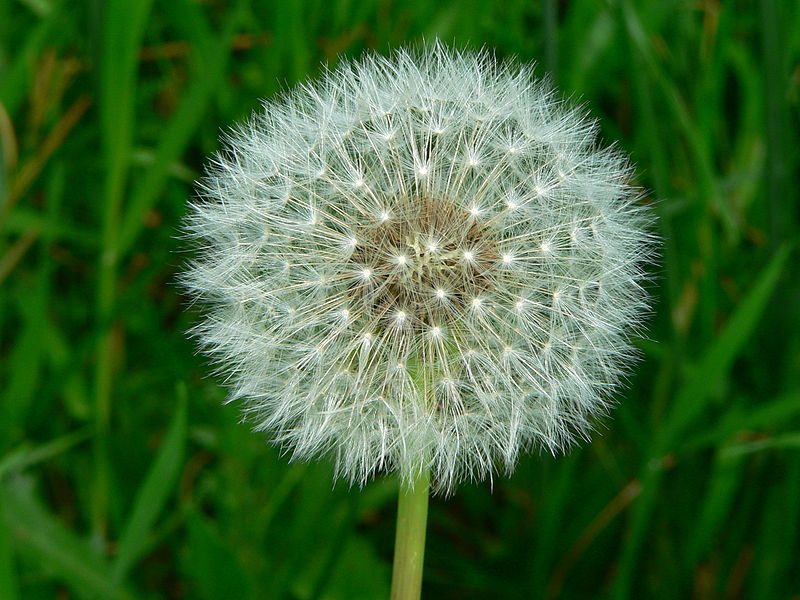
Dandelion: The golden crown on top is a sight to behold, especially when the sun hits it just right, and gives the bird a slightly crazed, mad hatter look. Gaze closely and you will see that each feather of the crown is dipped in black.
Dancing: When breeding the Crowned Cranes can put on quite a display called a “nuptial dance.” Their dance includes much bobbing, bowing, spreading of wings, and jumping to great effect. Here is a not-great-but-best-I-could-find video that gives you a sense of what the bird looks like when s/he busts a move.
Dandy: The Crowned Crane is a looker — she can stand three feet tall adorned in a lovely pearl grey body suit while the wings are mostly white but can include brown and golden feathers. The head is a stunning mix of white, red, and black.
Other Fun Grey Crowned Crane (GCC) Facts:
1. GCCs are the official bird of Uganda and can be found on the national flag. Its plumage contains the three colors of the Ugandan flag. Black identifies Uganda as a black nation in Africa. Yellow represents the abundant sunshine Uganda enjoys being situated on the equator. Red represents Uganda’s brotherhood with the rest of Africa and the world. (source)

2. As you may have gathered, GCCs are found in Africa. Two subspecies exist: the East African Crowned Crane and the South African Crowned Crane. The eastern lot can be found in Uganda, Kenya to Northern Zimbabwe. The southern crew can be found in Angola, Namibia, Botswana, Zimbabwe, and South Africa.
3. There are 15 species of cranes in the world — only 2 of those species can roost in trees. The GCC has long hind toes that give it the grip to be part of that elite group. (The Black Crowned Crane is the other)
4. GCCs do not migrate.
5. GCCs can live up to 22 years in the wild they seem to mate with the same partner for life.
6. While the population of GCCs is still fairly robust, the trend is dire. In the last 20 years, the population has dropped in half due to loss of habitat and the increased use of pesticides. In 2012 the GCC’s conservation status was downgraded from Vulnerable to Endangered (only 2 steps away from extinction)
Here’s hoping for a continued long reign for the crowned crane…
Jul
31
Shot of the Month – July 2013
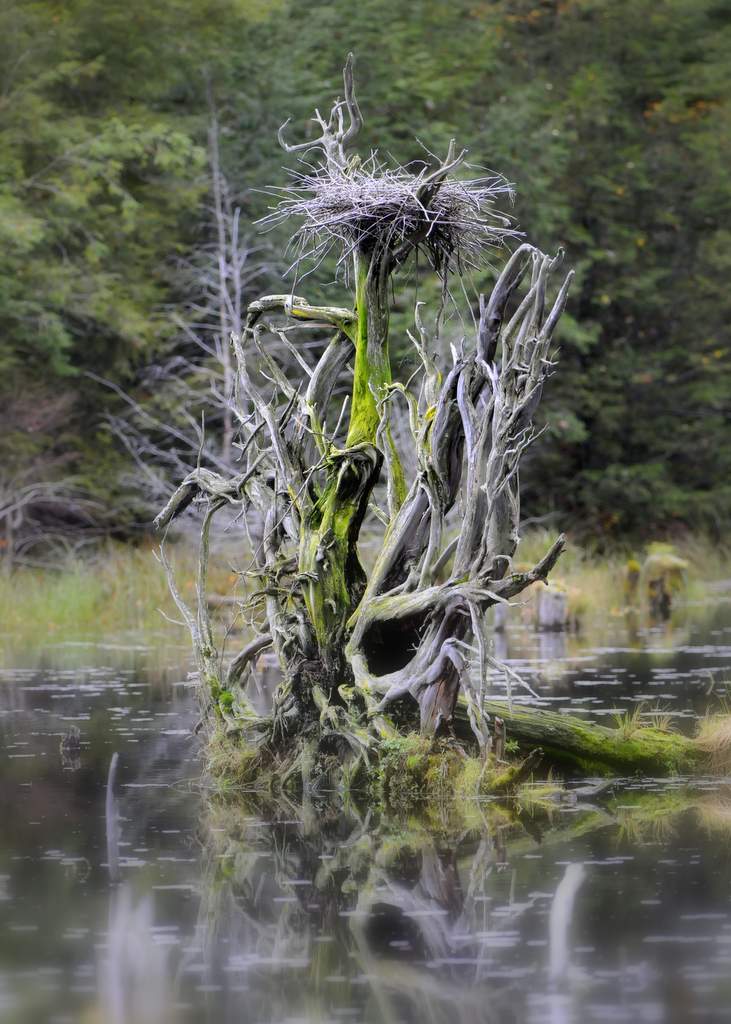
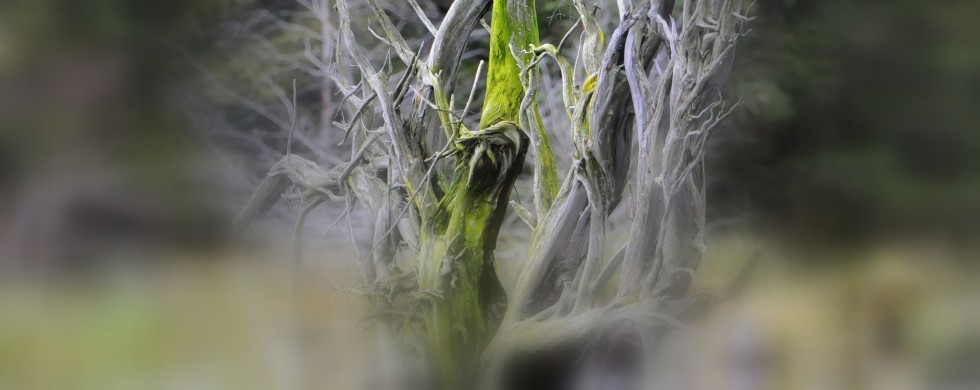
When I first gazed upon this scene I was baffled. I couldn’t make heads or tails of it. I could see only chaos. Well, the pile of sticks seemed familiar. Yeah, ok, that could be a bird’s nest. But the rest of it? No idea. I looked and I looked. I looked some more. Tilting of the head. Squinting of the eyes. Tilt to the other side.
Nothin’.
Finally, our guide gave me the orientation I needed to make sense of it all.
She explained that we were looking at a tree that had fallen over in this small bog. The main trunk of the tree can be seen in the water to the right.
The standing fan of “branches” was actually the root system of the fallen tree! Bam. It all snapped into place. The pile of sticks on top was an abandoned osprey nest. Well, at least I got that part right.
I couldn’t take my eyes off the visual disarray. It seemed like abstract art. I have tweaked this image in that vein to bring out the “art” even more. I have boosted the colors to make the green on the main vertical root really pop out. And I have blurred the edges of the photo to allow the eyes to be naturally drawn into the “canvas.”
Is it just me or do you also see a screaming face in the main vertical root? It’s mouth is agape as if caught in an eternal scream. A pointy nose and two furrowed brows filled with rage just above the black gob. Two root arms spread out in opposite directions as if appealing to the gods. Seems like the tree is unfurling its outrage over the injustice that has befallen it.
I love how something so real, a tree (you know, brown, stands straight, has some green stuff on it), has been transported into the realm of the abstract where lines and shapes no longer follow the rules and new meanings and realities blur from one into the next.
Perhaps this is Mother Nature’s version of the Rorschach test? If yes, I don’t think that I want to know how I did.
Something to ponder over your morning coffee: If there is no one in the forest to hear a tree scream, does it make a sound?
Until next month….
Jun
30
Shot of the Month – June 2013
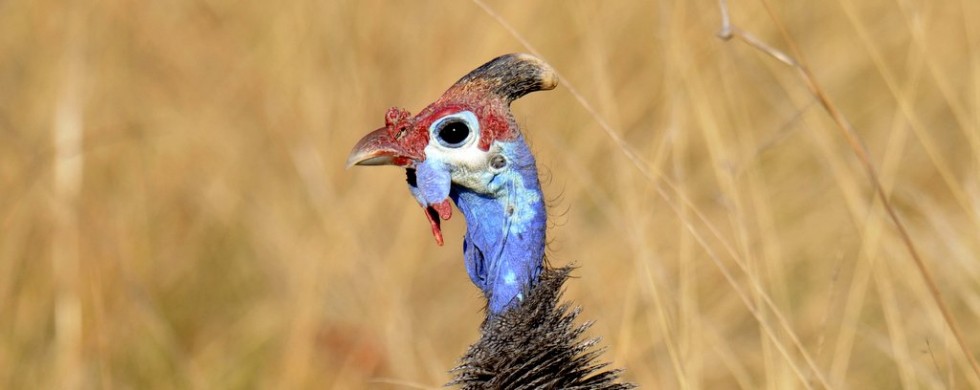
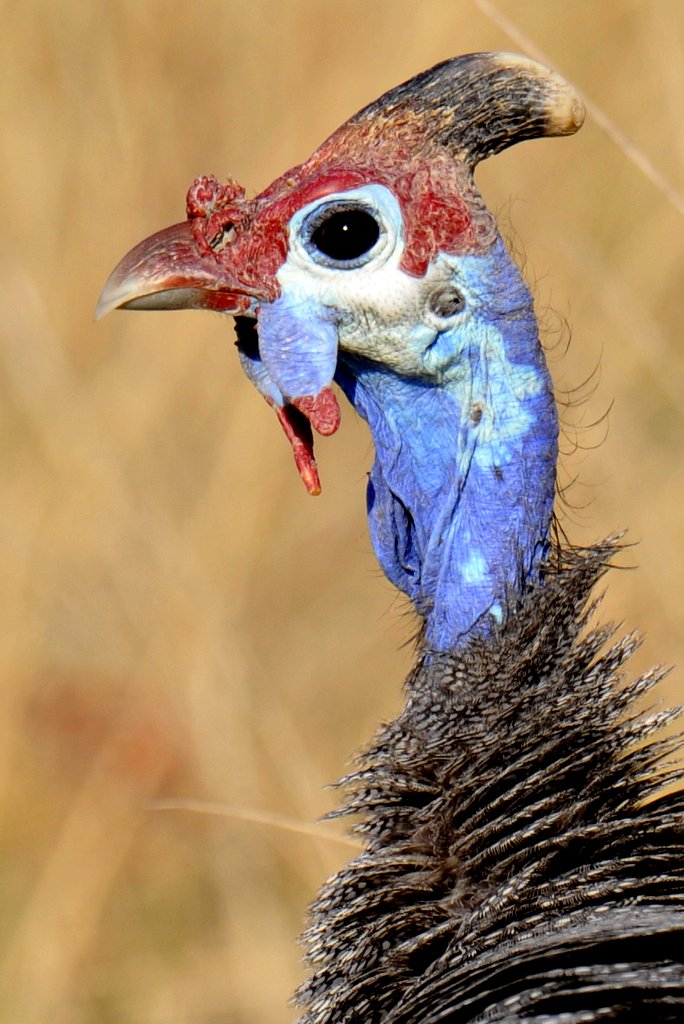 I love this shot. The image is r-a-z-o-r sharp, which is the holy grail for photographers (or at least a major component of said grail). I can see every freakin hair on this fella’s neck. The background is nicely blurred so the subject, a Helmeted Guineafowl (HG), really pops. I find the image to be a fascinating yet hard-to-categorize mix of textures, shapes, and colors. The spiky neck feathers add a nice ruff flair. The crazy colors (did he tie-dye that neck?); the red head, the jazzy dual-hued, yet color-coordinated, wattle things. The aforementioned neck hairs. The dramatic head crown doodad. The red stuff on the nose. Wow. Put it all together and the image stops you in your tracks. It certainly makes for compelling viewing, albeit, perhaps not for a long time. Warm and cuddly he ain’t.
Helmeted Guineafowl are naturally found in Sub-Saharan Africa though domesticated versions can be found in the US, England, and just about anywhere people can raise chickens. Wild varieties of the helmeted Guinea fowl have been introduced into the West Indies, Brazil, Australia, and southern France.
HG are members of the order Galliformes; the same order that includes turkeys, grouse, chicken, quail, ptarmigan, partridge, pheasant, and Cracidae.
Accordingly, HG spend much of their time scratching around on the ground in flocks of up to 25 birds looking for food rather, well, chicken-like. They can walk 6 miles or more a day. HG are similar in size to grouse or partridges, and like them, typically fly for only short distances and glide for most of the time in the air after the initial burst from cover. When in danger their preferred escape strategy is to run for it and only take flight if absolutely necessary. However, HG do roost in trees at night and during the heat of the day.
There are about 7 species of Guineafowl but only the Helmeted variety has the horn-like casque on top.
The Helmeted Guineafowl, I tip my hat to your bold if not totally beautiful style.
May
30
Shot of the Month – May 2013
Ever been at your favorite watering hole or dining establishment when a boisterous crowd rolls in and takes over the place? They talk too loudly. They, generally, make too much noise. You get jostled, perhaps spilling your drink, as they tumble into your space with their horseplay. They ravage through the snack bowls leaving you soggy and hungry.
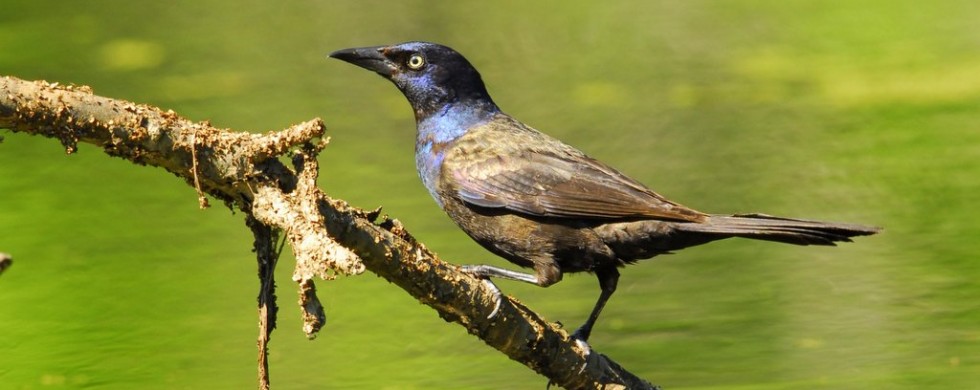
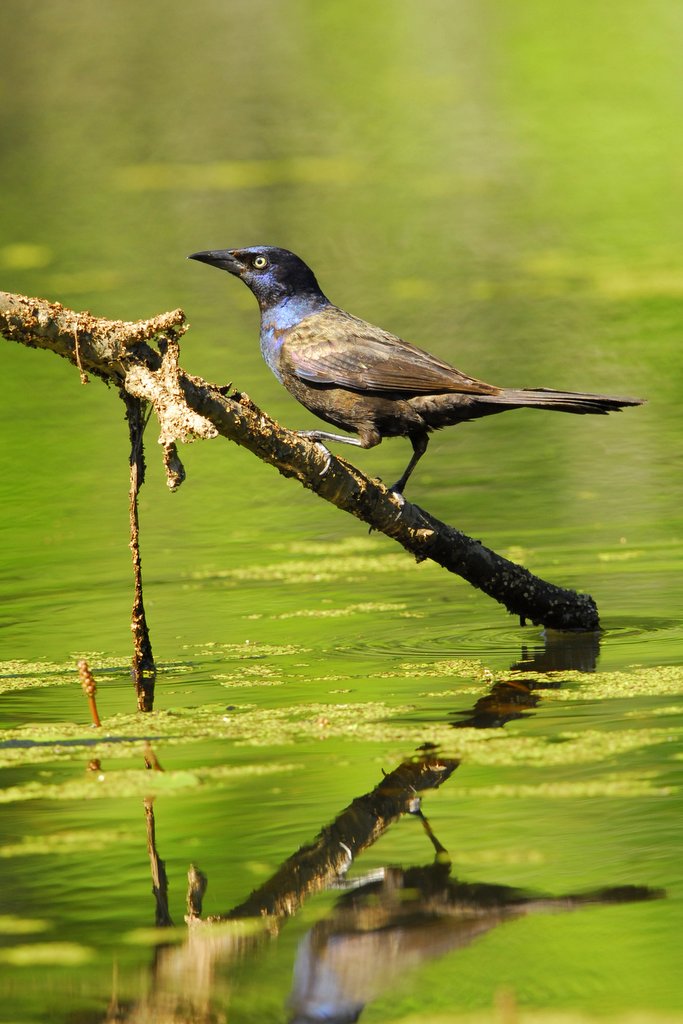
In Bird World (great rides but I always leave feeling a bit peckish…) a similar scene often plays out at the local bird feeder with a group of Common Grackles, like the one shown here, playing the role of roughneck. Grackles will often intimidate other birds at feeders and push them aside to eat first.
Common Grackles are large, noisy, and gregarious birds that often hang out together in large numbers. Their song is particularly harsh and when multiplied by thousands it can get to rock concert levels of cacophony.
Common Grackles are omnivores and very resourceful foragers and can eat insects, minnows, frogs, eggs, berries, small birds, and mice, and well, it would be easier to list what they don’t eat. Grackles sometimes follow plows to catch invertebrates and mice, wade into water to catch small fish, pick leeches off the legs of turtles, steal worms from the American Robin, or hang out at outdoor eating areas and feed on food dropped by humans. That partial list gives you a sense of the diverse range of strategies these crafty birds deploy to find food. During the summer up to one-quarter of a grackle’s diet may be animals. (source)
That being said, Grackles are especially fond of seeds and grains and are considered the number one threat to corn crops in the US!? (I guess we need more “Scaregrackles” and fewer Scarecrows.) They forage together in large flocks and typically descend on corn fields in large numbers causing millions of dollars of damage each year. Perhaps an irate farmer came up with the common name for a group of grackles: a plague.
Unlike many birds, Common Grackles are very successful in and near human landscapes due to their opportunistic and adaptable nature. Grackles prefer open and semi-open areas across North America east of the Rocky Mountains. The range of these birds was more “easterly’ but expanded west as settlers cleared the forests.
Despite their uncouth nature, the Common Grackle can be quite the sharp dresser. Catch the light right and their heads display a stunning green or blue iridescence, while their body plumage shimmers with a bronze hue.
The Common Grackle, the wily ruffian of the bird world.
Apr
30
Shot of the Month – April 2013
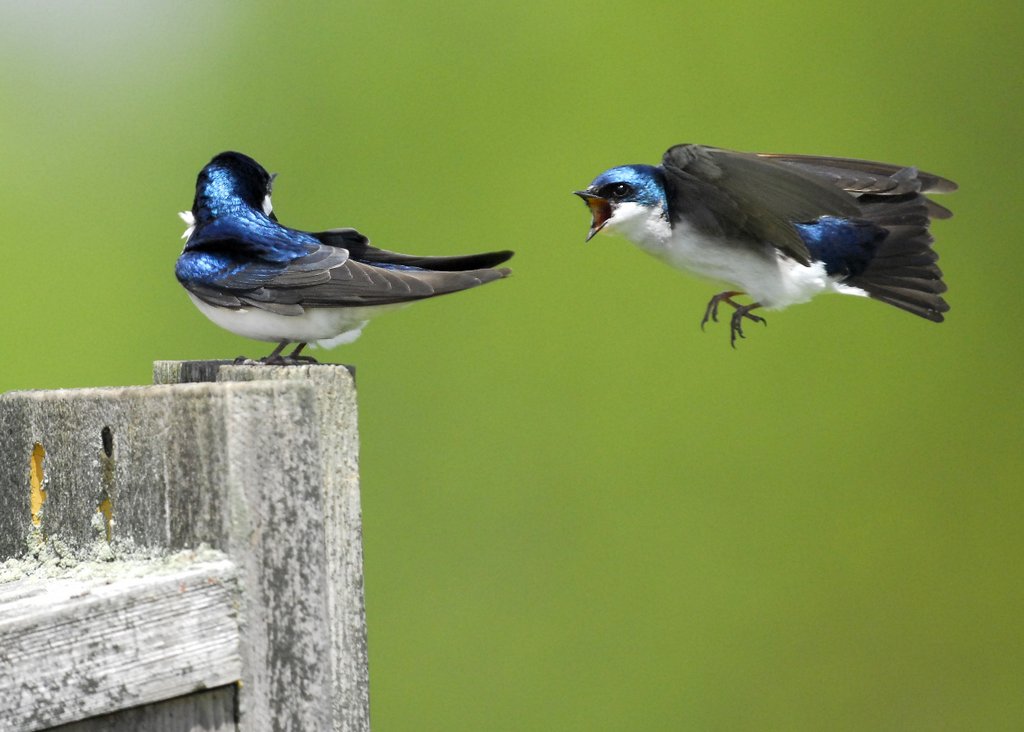
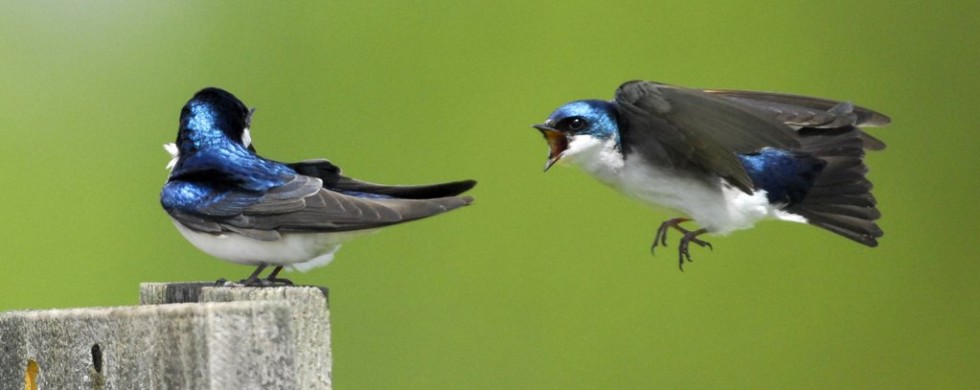
Most viewers cannot resist applying a narrative to this image of two Tree Swallows (TSs).
Many a spouse finds kinship with the bird on the left who appears to be getting an earful from the partner on the right. Perhaps the nest was left a mess? Forgot to bring home the mayflies for the kids? Well, no need to gossip.
Tree Swallows are found throughout most of the US and Canada but spend the winters in Mexico, Central America, and the Caribbean. (Who can argue with that?) I filmed these two at the Bombay Hook NWR in Delaware.
TS are very social and may be found in flocks that can include thousands and occasionally up to a million birds. During the breeding season the swallows are less inclined to mingle and a mating pair will defend its territory with great vigor from other birds and just about any creature that gets too close to the nest.
We actually don’t know if this is a breeding pair. Could be. It may be two adults fighting over a territory. Perhaps the bird on the right is last year’s chick demanding food — hoping that Dad won’t notice that Junior is all grown up now. Many possible scenarios. And that is half the fun…fill in the caption you find most appealing.
Nest predators include rat snakes, raccoons, black bears, chipmunks, mink, weasels, deer mice, feral cats, American Kestrels, Common Grackles, American Crows, and Northern Flickers. Outside of the nest adults are hunted by Sharp-shinned Hawks, Merlins, Peregrine Falcons, Great Horned Owls, and Black-billed Magpies. Sheesh. Should I stay or should I go?
Tree Swallows get their name from their preference to nest in tree cavities (cavities found in dead trees or perhaps a cavity made by a woodpecker, for example). They are also very happy to nest in wood boxes put out by humans. TSs breed in fields, marshes, shorelines, and wooded swamps and generally like to be near bodies of water that produce lots of flying insects. The dinner menu includes dragonflies, damselflies, flies, mayflies, caddisflies, true bugs, sawflies, bees, ants, wasps, beetles, stoneflies, and butterflies. Given their excellent flying skills, they typically chase prey in the air with acrobatic twists and turns and sometimes converge in large numbers in an insect swarm. During the breeding season, Tree Swallows eat high-calcium items like fish bones, crayfish exoskeletons, clamshells, and eggshells of gulls or loons. (source).
Tree Swallows pair up to breed but often mate secretly outside of the pair. The rapscallions! Occasionally a male attends two mates in separate nest sites. Though an individual swallow may have the same mate several years in a row, it is probably faithful to the site rather than the mate.
Given the aforementioned breeding behavior, those with active imaginations could divine yet another narrative for the above scene. As the screen fades to black, the voice-over opines “Tune in next week for more scandalous tales from the cattails….”
Until next month…..michael
Mar
31
Shot of the Month – March 2013
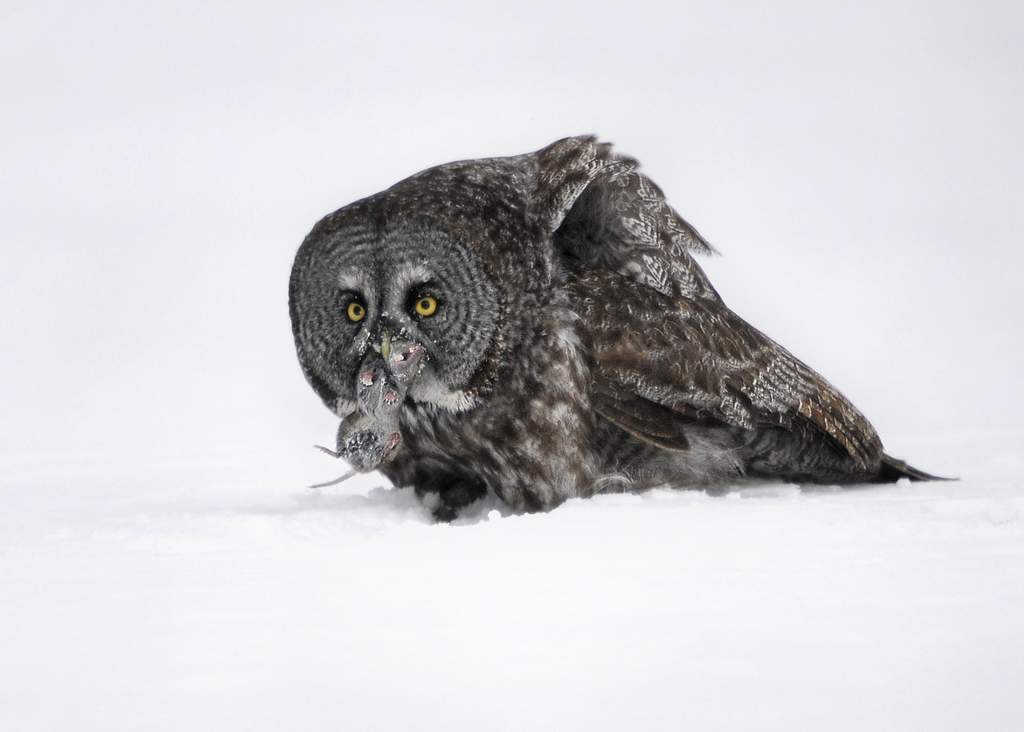 Like many people, I am a bit gaga over owls. I find them mesmerizing. They seem so majestic. Masterful. The embodiment of grace, power, and resolution.
Since moving to Vermont finding and photographing owls had been a top priority. The venture had not been going well — I managed a few sightings last year but I had not captured a single noteworthy image.
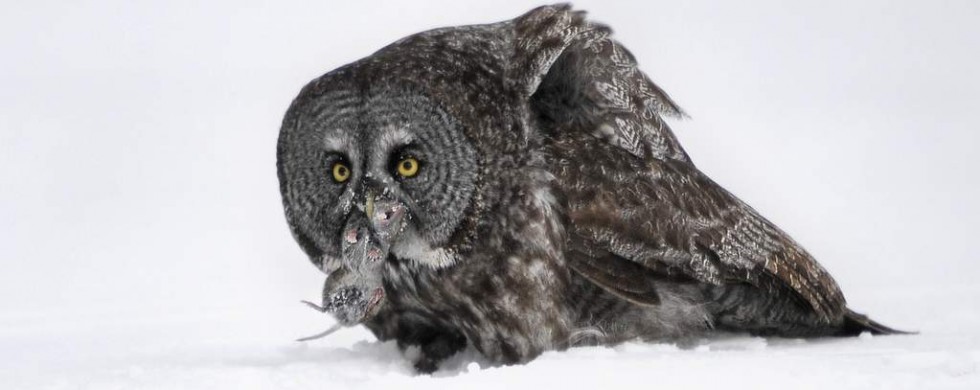
And then a few weeks ago a dramatic change of fortune. We found two Great Gray Owls wintering near Montreal, Canada.
It is hard to describe how fortunate I feel to have captured this image, and more importantly, to have had the opportunity to observe this animal over two consecutive weekends.
A quick inventory of the miracles. First, just seeing a Great Gray Owl is pretty amazing unless you hang out in the Boreal forests of Canada. Not many people do. Second, seeing a Great Gray hunt? Astounding. And finally, to actually get a decent shot of the hunt and record this spectacular behavior? I must have died and gone to Errol heaven.
Upon seeing this image a friend, also a photo enthusiast, lamented how she often missed the “decisive moment” and wondered how I had managed to pull it off. The decisive moment is typically that split second at the height of the action — just as the lion lands on the zebra, or just as the bald eagle catches a starling in mid air. (I initially responded that I didn’t get THE decisive moment, which in this case, was when the owl dove into the snow feet first to grab the mouse underneath the surface. But, this moment comes in as a pretty close second)
Capturing that key moment has less to do with big lenses or fancy cameras. Sure they help, a tiny bit, but there are lots of people who have expensive gear nowadays and they rarely get the shot.
The most successful wildlife photographers are large part naturalists, or biologists, either by training or by practice. For consistent success, one must really understand an animal and its behavior. This requires many, many hours in the field observing nature. Only then can you begin to predict where to find an animal and have a sense of how it will react in different situations. It is this body of knowledge that tells you when to go and where to go. It tells you which lens to use and what settings to apply to your camera BEFORE the shot happens. It helps you understand how to behave to avoid detection or scaring off the animal.
For me it’s a numbers game. It’s all a matter of putting the hours in. The more you are out there, the more chances you will have of seeing something special. And the more you observe the more you can predict what will happen next. It is difficult for weekend photographers like me and my friend to get those hours in so we are rarely properly prepared to seize those scarce opportunities when they arise.
In just the roughly 24 hours that I spent observing the owls over 5 days patterns and insights began to emerge. I noticed that one owl liked to roost on a preferred branch, in a preferred tree most mornings. Another Great Gray seemed to like to patrol a field and a group of woods a bit further away. I began to understand the difference in the light patterns in the morning vs. the afternoon. I began to understand the dramatic shift in exposure caused by the snowy fields compared to the wooded areas and how to adjust for it.
My small, but growing understanding of the landscape, the animal, and the interaction between the two helped me get this shot. Even after just 9 hours of observation, I had a better sense of where to set up my tripod if I wanted to have a chance of capturing a Great Gray Owl hunt on “film.” I didn’t get it perfectly right — the owl flew 20 yards past where I had set up my equipment. But I was right just enough to still be close enough to get the shot. Luck also helped. Originally the owl had his back to me. To my amazement, once he had the mouse in his mouth he spun around and faced me.
Click.
(And they lived happily ever after….ok, at least two of the three parties involved did)
Until next month…. 🙂
Mar
12
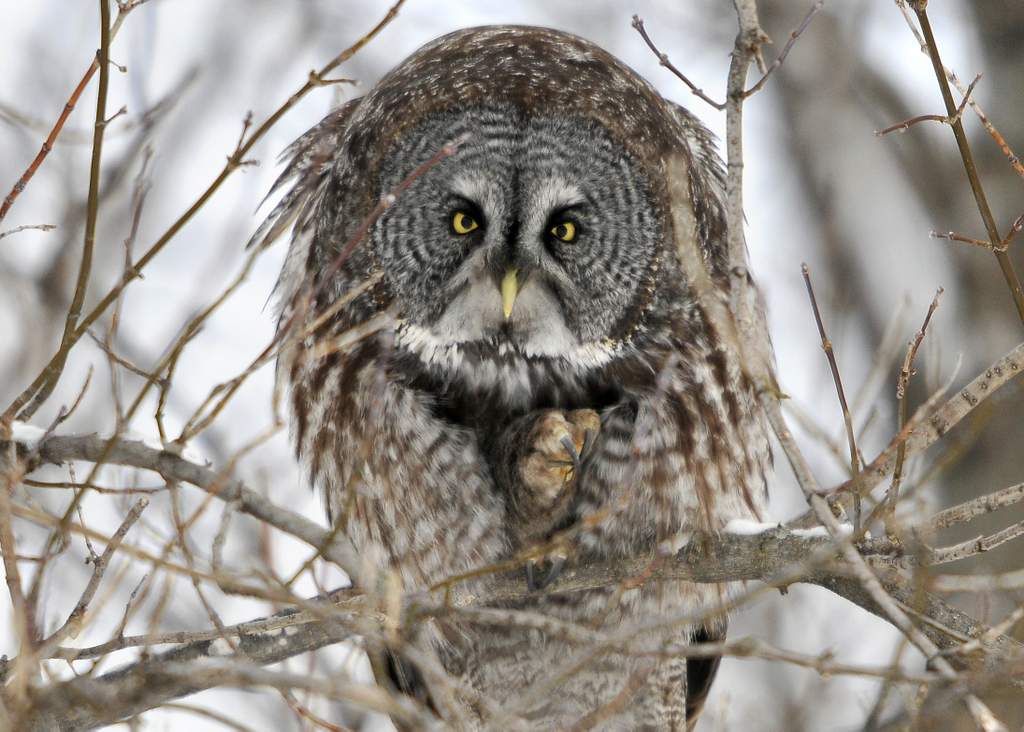
In the space of 10 minutes we saw this Great Gray Owl hunt twice – successfully. This was the first meal…
Mar
05
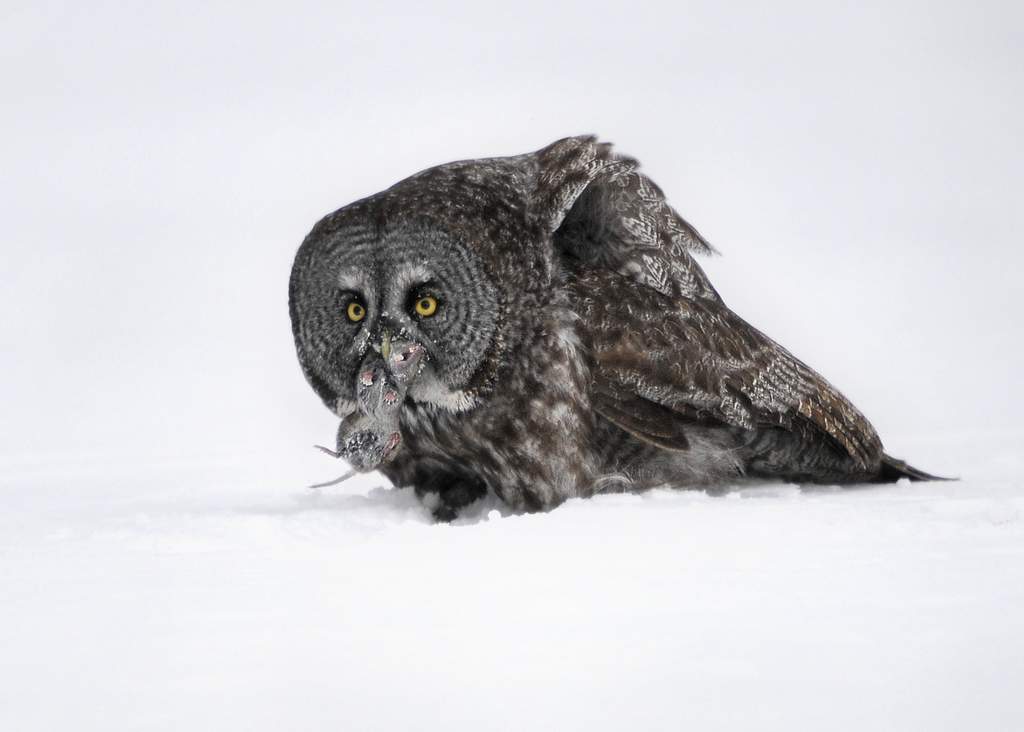
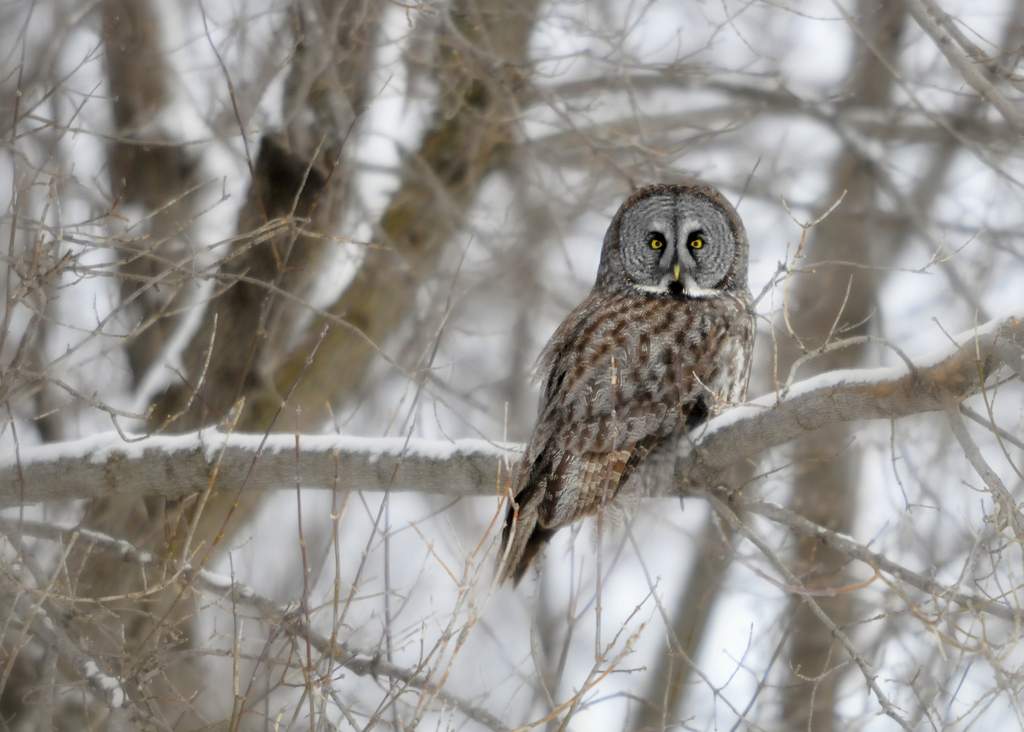
We spent the weekend in Canada looking for Great Gray Owls…more images to follow.
Feb
26
Shot of the Month – February 2013
 A common ailment this time of year in northern latitudes is “cabin fever,”
” a state characterized by anxiety, restlessness, and boredom arising from a prolonged stay in remote or confined space.” (source)
This image is from 2008 and is the result of a similar malady. I had been back in the US for over a year after living overseas most of my adult life. Since returning I had not made any ventures into nature nor taken any photos. It was near the end of a long winter. I was bored. I missed engaging with nature.
I needed to take a photo of something.
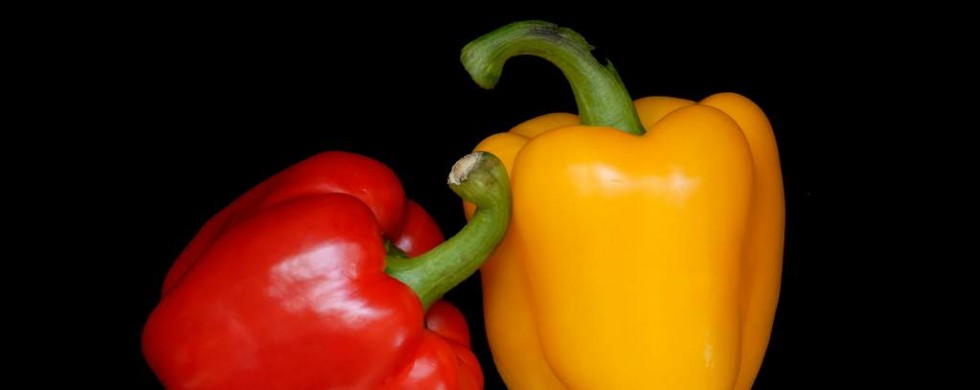
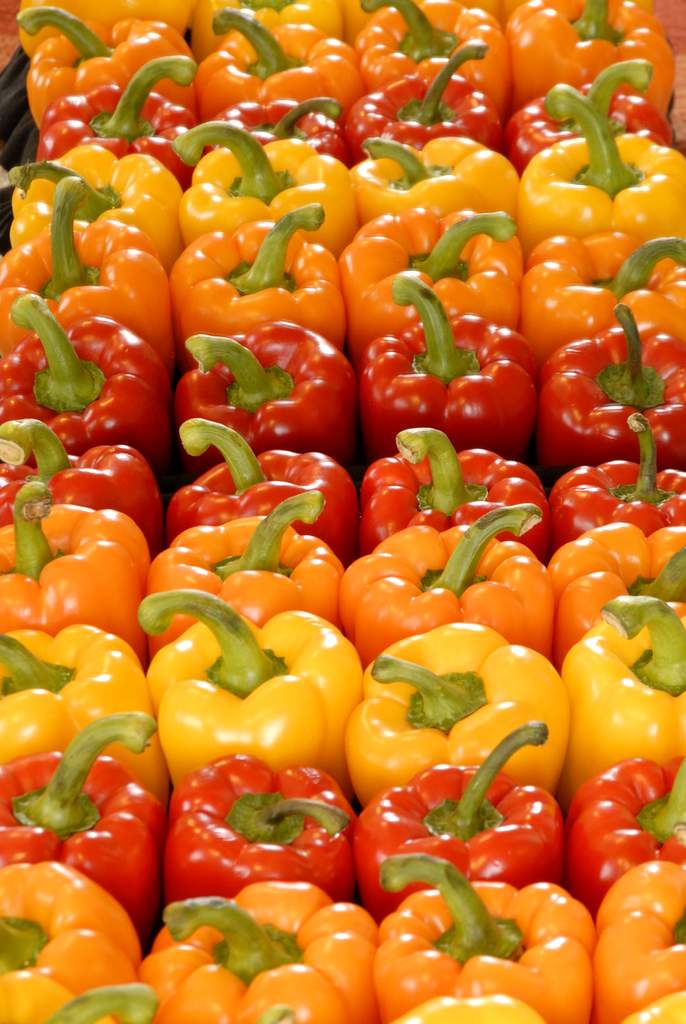
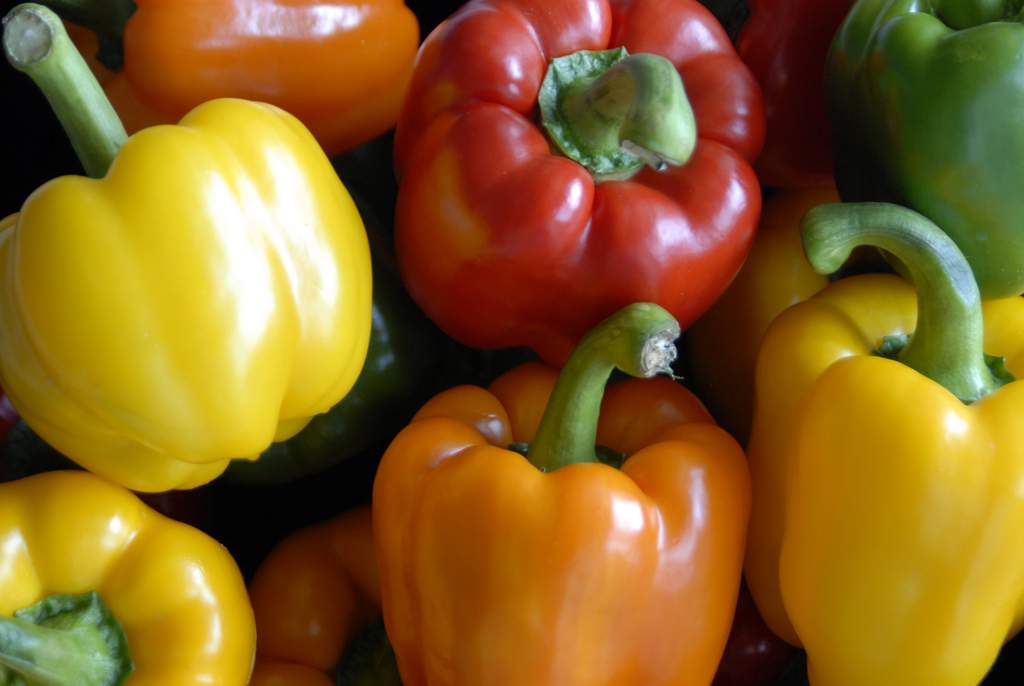
Alas, I was living in an urban setting and wildlife was scarce. In my visually mundane environment, one blast of color stood out. Each week we would go to the grocery store and I was captivated by the explosion of color in the vegetable department. There were rows and rows of bell peppers in vibrant hues of green, yellow, and red. Each week I found myself lingering in the produce section wondering how I could capture that visual feast.
The fever was obviously running high as I purchased a ridiculous number of peppers (disregard the odd look from the checkout person). Once home I realized that I did not have enough. Back to the store to buy more. Then I went to the art supply store and purchased some black poster board. And then I began photographing, uh, peppers. I didn’t really know what I was doing as I never do “studio shooting.” I didn’t have the proper light set up, nor the knowledge or technique. But the project kept me engaged for days.
This shot, “Pepper Love,” is popular this time of year since February is also home to Valentine’s Day. In my defense, I can merely plead “Innocent due to insanity.”
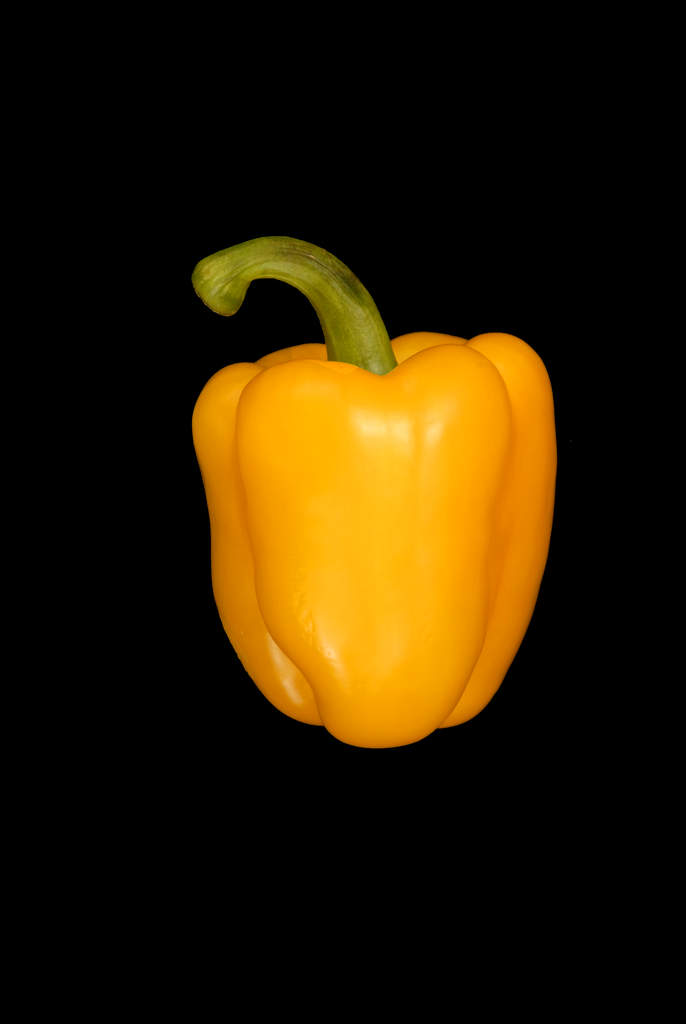
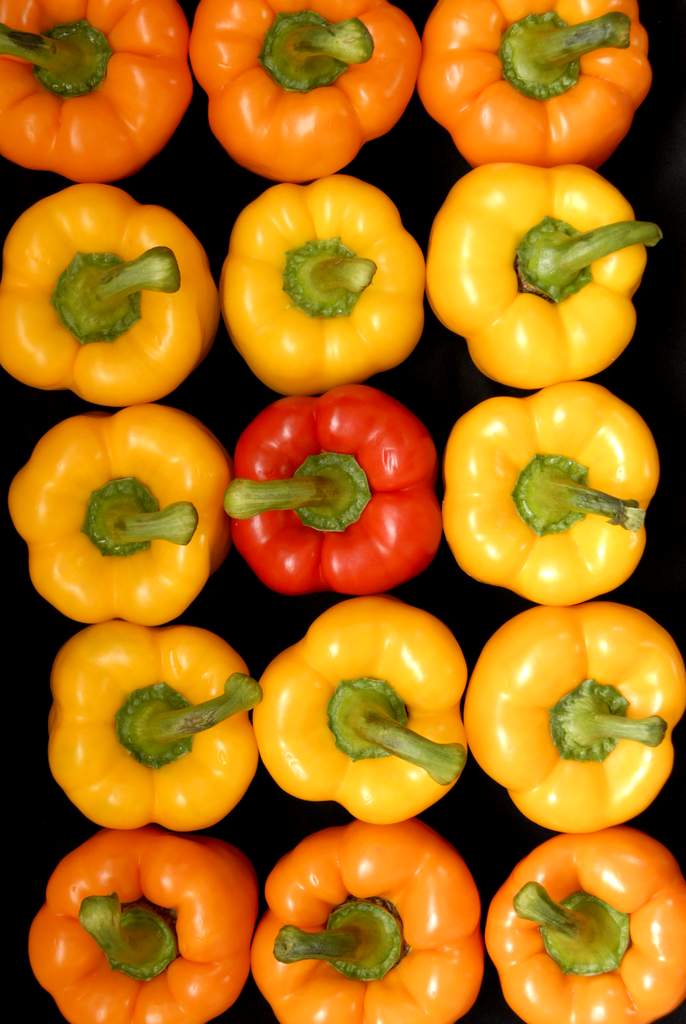
I tried all sorts of arrangements. Peppers lined up in rows. Peppers piled high in a bucket. Peppers grouped by color. Then alternating by color. Used a mirror to create the illusion of infinite peppers. Peppers sprayed with water. Intimate portraits. Then mob scenes. Stems lined up. Stems alternating. The delirium raged.
Once the fever passed, a cold hard reality set in. What in the hell were we going to do with all these rapidly ripening peppers? Let’s just say that our freezer was overflowing and we explored a vast range of recipes requiring peppers long into the spring and summer. (I believe it took about a year till the last one was gone…)
In the end, I did not get many images that worked. My lack of experience won out. But I did learn a lot and I am sure that I would get better images on the next attempt. And we do have all those pepper recipes collecting dust…. hmmmn….
A few more “slides” that confirm the diagnosis of “cabin fever.” (Click on a cropped thumbnail to see the full image)












Until next month…. 🙂

